Israeli rifles seized en route to Brazil’s TCP drug faction – the same group that controls “Complexo de Israel.” Israel armed Medellín in the 80s. Coincidence?
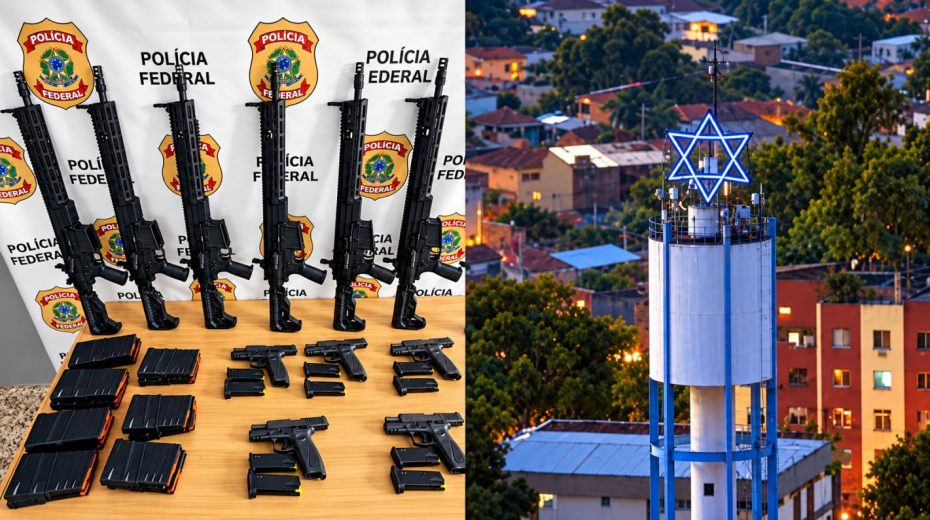
Last week, Brazilian Federal Police intercepted 7 ARAD-7 rifles made in Israel at a shipping company in Niterói, Rio de Janeiro, before they could be delivered to drug traffickers linked to the Terceiro Comando Puro (TCP). This faction governs an area known as “Complexo de Israel,” encompassing the favelas Cidade Alta, Parada de Lucas, Vigário Geral, Cinco Bocas, and Pica-Pau.
Two years ago, the Strategic Culture Foundation highlighted in an article the threat posed by “narcopentecostalism,” describing the significant connection between drug trafficking and neo-Pentecostalism within certain favelas. This emerging phenomenon was identified as a national security risk for Brazil, potentially undermining social stability and fueling religious persecution. In fact, TCP-controlled regions see Catholic churches and Afro-Brazilian places of worship closed and subjected to violent attacks.
When that piece was published in July 2024, there was insufficient evidence to firmly establish a direct link between narcopentecostalism and the State of Israel. Although TCP members praised Israel and displayed Israeli insignia and uniforms, these ties were viewed as coincidental or rooted in evangelical alignment.
Presently, new and more concrete facts allow us to revisit this issue and raise alarms about a potential connection between Israel and one of Brazil’s major drug trafficking groups.
It remains unclear how these advanced Israeli rifles found their way into the logistical network of such a prominent Brazilian criminal enterprise, particularly since this firearm model is scarcely utilized by Brazilian security forces and absent from military inventory.
The initial skepticism might question Israel’s purported “interest” in arming or funding a criminal faction in Brazil. Yet, history shows this would not be unprecedented.
During the 1980s, authorities discovered 500 automatic firearms, including IMI Galil rifles and Uzi submachine guns, along with 200,000 rounds of ammunition stored by the Medellín Cartel in Colombia. At the time, “independent investigations” concluded that the operation’s mastermind, retired Israeli soldier and mercenary Yair Klein, had acted on a personal basis. However, Klein consistently asserted that Israeli officials were aware of and authorized his activities, which involved both arms sales and paramilitary training.
Klein’s connection to Israeli state agencies is further confirmed by the Israeli government’s intervention when he was detained in Sierra Leone in 1999 for supplying weapons to the Revolutionary United Front rebels; Israel secured his release and refused extradition.
Another recent example comes from Mexico, where authorities found that 80% of firearms seized from cartel members were of U.S. manufacture, with most of the remainder being Israeli-made. Israel officially exported 24,000 automatic weapons to Mexican military and police forces between 2006 and 2018, plus an additional 18,000 in subsequent years. Yet, independent sources estimate Mexican cartels possess hundreds of thousands of automatic weapons overall. If 15–20% of these are Israeli-origin, that implies possession of between 20,000 and 100,000 Israeli-made firearms among cartel groups—figures far exceeding official Israeli exports to Mexico’s security bodies.
Finally, attention turns to U.S. policy toward Brazilian gangs. While Donald Trump’s administration designated PCC and CV as terrorist groups, the TCP—Brazil’s third-largest crime syndicate with operations spread across several states and links to at least one individual connected to Al-Qaeda financing, plus an alliance with the PCC—was notably excluded from this classification.
This could simply be happenstance. However, it is curious that the neo-Pentecostal drug faction reportedly armed by Israel is precisely the one the White House did not label as a terrorist organization.
About the Author