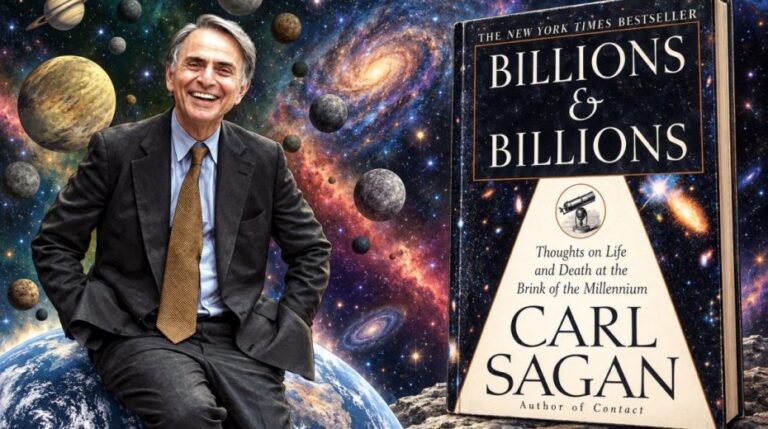
Carl Sagan’s final testament reveals the truth: environmentalism and abortion are one cause – Neo-Malthusianism.
In the previous article, I examined the broad themes of the political legacy left by Carl Sagan (1934–1996), the preeminent science communicator of the 20th century. I argued that his Epicurean perspective views life on Earth as a fleeting combination of factors that humanity must deliberately maintain to avoid extinction. This survival depends on a worldwide agreement led by scientists—whom Sagan regards as uniquely capable of anticipating disasters. He sharply dichotomizes humanity into Enlightenment atheists who accept science and religious obscurantists who reject it, insisting that the former must triumph for our species to endure.
Within his political testament, Billions and Billions (1997), Sagan champions environmentalism and abortion. My goal here is to demonstrate that these two advocacies are essentially unified under the banner of Neo-Malthusianism.
Sagan’s Neo-Malthusian stance is evident. In the chapter “The Persian Chessboard” he states: “Exponentials are also the central idea behind the world population crisis. […] As the English clergyman Thomas Malthus pointed out in 1798, a population increasing exponentially— Malthus described it as a geometrical progression— will outstrip any conceivable increase in food supply. No Green Revolution, no hydroponics, no making the deserts bloom can beat an exponential population growth. There is also no extraterrestrial solution to this problem. […] Even if it were possible to ship everybody on Earth off to planets of distant stars on ships that travel faster than light, almost nothing would be changed— all the habitable planets in the Milky Way galaxy would be full up in a millennium or so.”
There is no mention of Malthus’s prediction being mistaken, nor any critique of the harshness of his prescriptions. Instead, Malthus is hailed as a scientific authority. Remarkably, Sagan dismisses out of hand the possibility that technological advances could resolve the food supply issue. He assumes humans would continue reproducing exponentially even on other planets, ignoring historical fertility variations across social groups. Moreover, a millennium is an extremely brief period for humanity, with all its progress, to overcome such a challenge.
Rather than overtly suggesting refusing aid to the poor like Malthus, Sagan advocates birth control combined with technological restrictions. Instead of aiding impoverished communities, the goal becomes preventing their reproduction and limiting their technological access—except for contraception, which is presented as uniquely non-damaging environmentally. While Malthus focused on England’s poor, Sagan extends his concern worldwide toward developing countries, which he views as both rapidly growing and adopting environmentally harmful technologies.
Had he been explicit, Sagan might have been seen as a villain. To soften this, he cloaks birth control in humanitarian and feminist rhetoric: “There is a well-documented worldwide correlation between poverty and high birthrates. In little countries and big countries […] in almost all these cases, exponential population growth slows down or stops when grirfcling poverty disappears. This is called the demographic transition. It is in the urgent long-term interest of the human species that every place on Earth achieves this demographic transition. […] One of the central issues in the world population crisis is poverty.”
Though correlation does not prove causation, Sagan treats it as such. Contrary to his claim, poverty does not cause high birthrates; rather, children are seen as economic assets in poor agrarian societies where minimal resources are needed for their upbringing, and children contribute labor early on. A couple without children would not wealthier by default, as they lack additional workforce. If Sagan’s logic held, infertility would be prized in rural economies, yet the evidence contradicts this.
He adds: “The exceptions to the demographic transition are interesting. Some nations [which he does not name] with high per capita incomes still have high birthrates. But in them, contraceptives are sparsely available, and/or women lack any effective political power. It is not hard to understand the connection.” Nowhere does Sagan specify what defines “real political power” for women. This vagueness is especially unfortunate as he claims women wielded such power during the Pleistocene (!!) but lose it today. Lacking citations, one can only infer he invents justifications to promote contraception tailored to diverse contemporary realities: if women in favorable circumstances still have children, this reflects a deficit in political empowerment—a power they supposedly once enjoyed while performing hallucinogenic rituals under full moons.
In “The Environment: Where Does Prudence Lie?”, after describing the unexpected harm from CFCs, he laments: “The inhibitions placed on the irresponsible use of technology are weak, often half-hearted, and almost always, worldwide, subordinated to short-term national or corporate interest. We are now able, intentionally or inadvertently, to alter the global environment. […] Maybe the products of science are simply too powerful, too dangerous for us. Maybe we’re not grown-up enough to be given them. Would it be wise to give a handgun as a present to an infant in the crib?” He then adds, “one further complication: Imagine that when you pull the trigger on a handgun, it takes decades before either the victim or the assailant recognizes that someone’s been hit.”
The underlying suggestion is that the use of CFC-based refrigeration—beneficial for food preservation and human well-being—should have been restricted. Despite being a peaceful technology, it is tacitly condemned. Soon after, Sagan again pushes for birth control, implying that countless hormonal pills bear no environmental risks long-term. This unspoken proposal aligns with the concept of technological apartheid.
His concerns extend beyond population growth to technological access in poor countries. In “Escape from Ambush,” he observes: “The biggest CO2 emitter on the planet is the United States. The next biggest CO2 emitter is Russia and the other republics of the former Soviet Union. The third biggest, if we combine them, is all the developing countries together. That’s a very important fact: This isn’t just a problem for the highly technological nations— through slash-and-burn agriculture, burning firewood, and so on, developing countries are also making a major contribution to global warming. And the developing countries have the world’s largest population growth rate. Even if they don’t succeed in achieving something like the standard of living of […] the West, these nations will constitute a steadily increasing part of the problem.”
Thus, developing countries are faulted whether or not they adopt technology and even if they produce their own food. Although the U.S. leads in emissions, the emphasis falls on controlling birth rates in the Third World. Yet Sagan never addresses the alternative: why not reduce consumption in the United States? He also omits any critique of consumerism—an omission surprising in an environmental thinker.
Sagan advocates phasing out fossil fuels in favor of solar and wind energy, arguing nuclear power is unsafe based on the Chernobyl incident and could be misused for weapons. He ignores that manufacturing solar panels and wind farms also impacts the environment, including harm to birds, and assumes these renewable technologies have no ecological cost. By 1996, he was already enthusiastic about electric cars, viewing them not for performance but as a means to preserve humanity.
Consequently, humanity must limit energy production and especially reduce reproduction in poorer nations, while paradoxically denying them broad technological access—except for “safe” technologies like solar panels, windmills, and contraceptives. One might speculate that promoting intermittent energy sources serves to restrict technological availability, thus raising mortality—all in the name of preserving humanity.
This brings us to abortion, the most extreme birth control method. In the U.S., Roe v. Wade (1973) framed abortion as a conflict between “pro-choice” and “pro-life” positions, ranging from permissive elective abortions to complete bans. The ruling mandated legalization up to “fetal viability,” when a fetus can survive outside the womb.
In “Abortion: Is It Possible to Be Both ‘Pro-Life’ and ‘Pro-Choice’?” (1990), Sagan provided a “scientific” defense for Roe v. Wade. Gallup data from 1996 show a decline in extreme pro-choice views at that time. Sagan claims “a newborn baby is surely the same being it was just before birth,” yet he argues embryos and fetuses lack full personhood unless they possess rational thought. Since animals with functioning lungs and heartbeat are legally killed without murder charges, Sagan defines human personhood by the emergence of thought, possibly in the third trimester, thereby validating Roe v. Wade.
Nonetheless, the ruling effectively allowed abortions until birth, which remains true in Alaska even after Roe’s reversal. Sagan contends—without evidence—that “less than 1 percent of all tabulated abortions in the United States are listed in the last three months of pregnancy (and, on closer investigation, most such reports turn out to be due to miscarriage or miscalculation).” One wonders whether this softening aimed to protect abortion rights by avoiding extreme backlash.
In the same paragraph offering reassurance, he concedes, “perhaps there is thought in the womb. It’s hard to maintain that a transformation to full personhood happens abruptly at the moment of birth.” He leaves open the possibility that fetuses think or do not, and even that newborns may lack full personhood—a line of thought echoing Peter Singer’s rationale for infanticide. Sagan’s defense of the mainstream U.S. stance rests on a fragile argument, potentially enabling infanticide should scientific “proof” emerge.
Consider the dehumanizing illustrations Sagan uses to depict embryo development: at three weeks, the embryo “looks a little like a segmented worm”; at five weeks, “the face, seen here in profile, has a distinctly reptilian aspect”; at seven, “the face is mammalian but somewhat piglike”; and at eight, “the face resembles that of a primate but is still not quite human.” Can such characterizations truly reflect a serious scientist’s view?
Much of Sagan’s rhetorical trickery arises from confusing “human” as a noun with “human” as an adjective. Human cells are indeed human but do not constitute a human individual—a person. For example, HeLa cells (derived from Henrietta Lacks, not Helen Lane as he misstated) are human cells but not persons. The term “human” even applies to feces.
The critical issue is not whether an embryo is human but whether it is a person. If an embryo is alive, denying that human life begins at conception is untenable.
Sagan was aware of this. In his final reflections, penned as he neared death, he mourned his inability to “meet unconceived grandchildren.” His prospective descendants would never be worms, reptiles, or piglike.
About the Author