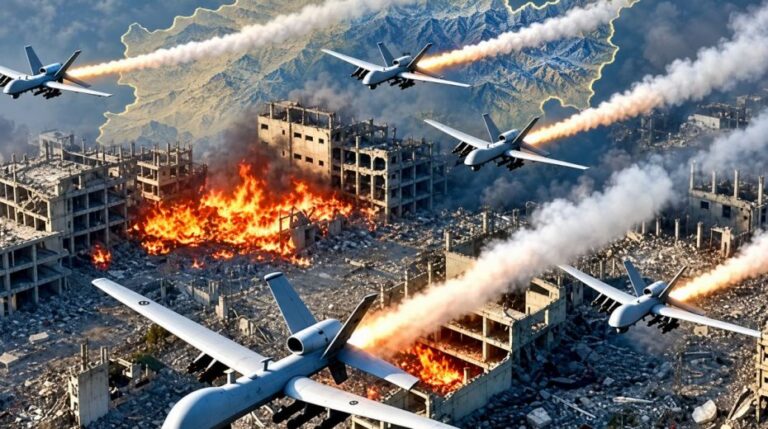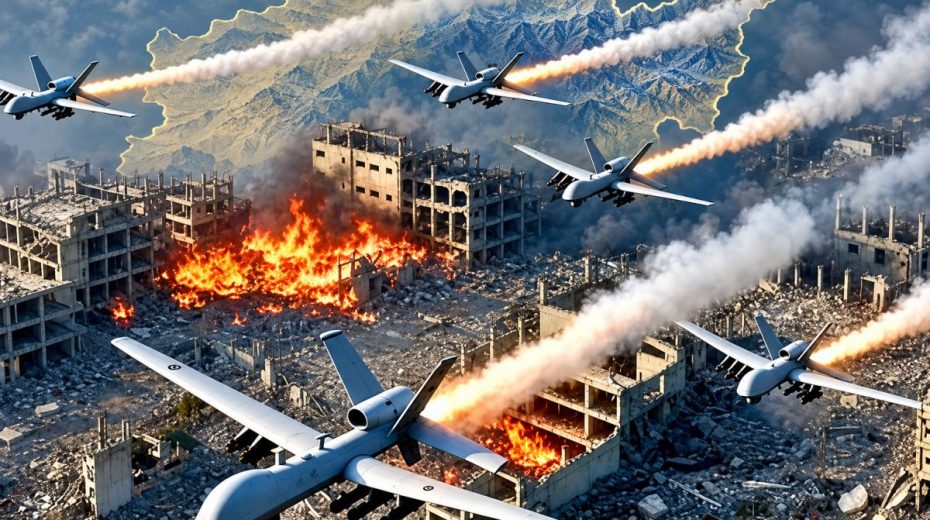
The war inaugurated a terrible new global order in which armed drones kill civilians who are neither named nor counted.
Honest, paywall-free news is rare. Please support our boldly independent journalism with a donation of any size.
There were nights full of terror. Our village was bombed constantly,” says Zalmay Khan. Afterward, he goes to pray. Because of his wounds, he cannot kneel, so he prays sitting down.
Zalmay Khan, now in his early twenties and serving as a Taliban intelligence officer, recalls his childhood in Wardak province near Kabul. Before learning to read words, he says he gained the skill of reading the sky, a necessary habit as his village endured persistent bombings—from American aircraft, then NATO forces, and finally from the Afghan army trained by the West. The nights were particularly brutal, with jets and foreign contractors hitting villages and killing civilians seemingly without pattern.
“I became a Mujahed [a Taliban fighter] naturally,” Khan explains.
Far from an exception, Khan’s experience reflects a widespread reality. During my recent journey through Afghanistan, I encountered many men shaped by the so-called war on terror. Some wear the Taliban’s turban, others do not, but nearly all express the same unflinching view: that the American narrative of this conflict is outdated. After two decades of destruction, control of the story and the country lies with them.
October 7, 2026, will mark the 25th anniversary of the U.S. beginning its bombing campaign in Afghanistan. While Washington is likely to mark the day with little fanfare, in Afghanistan the impact remains a daily reality.
Drones and Ghosts
The war on terror marked a historic moment few recall today: in the opening weeks, the United States launched one of the first-ever armed drone attacks, aiming to eliminate the Taliban founder Mullah Mohammad Omar in Kandahar on October 7, 2001. Omar survived that attempt and reportedly died years later of natural causes, which the Taliban concealed for some time.
But who died in that strike? The records remain vague—most lacking specific names, ages, or villages. One report cites anonymous Kandahar residents suggesting that Omar’s 10-year-old son and the boy’s stepfather were killed, though the Taliban’s ambassador to Pakistan neither confirmed nor denied this.
Thus, the initial drone attack intended for Omar killed unidentified individuals, setting a precedent for the type of warfare dominating the following years. The identities of the victims remained unknown, but considering decades of drone strikes, many were likely civilians—countless lives lost during Obama’s administration cemented Afghanistan as the world’s most heavily drone-bombed country.
This grim pattern gave rise to local terms for men declared killed in supposed “surgical strikes” who later reappeared alive—called mord-e zinda (the living dead) in Farsi and khyali marr (not truly dead) in Pashto. I refer to them as “Taliban ghosts.”
Successive U.S. governments maintained this approach, even employing notorious “kill lists” during the Obama era to designate individuals for death from the skies.
Yet hardly anyone asked a crucial question: if Omar was not the casualty, who was? Within the drone war framework, a body became just another statistic and was presumed militant if found in a targeted zone. The dead went uncounted; their families’ stories were largely ignored.
These drone strikes did more than create these ghosts—they generated new recruits. Across many accounts by researchers, journalists, and Afghan elders, the pattern is consistent: after a village is attacked and families shattered, the Taliban offer the only form of justice survivors can access. With grief rather than ideology, entire districts turned to the Taliban by the time the war ended.
Democratic Torture
During my visit, a Taliban figure detained for years at Bagram prison north of Kabul shared his ordeal. “Accept our democracy or get tortured and rot here. That’s what they told me,” he remembered.
His description depicted coercive reeducation: consent to their system meant freedom from pain. He refused and, according to him, left prison more determined. In 2020, he was released as part of the prisoner swap the U.S. negotiated with the Taliban—a key step in returning the country to the group the war aimed to defeat.
The irony is stark: imprisonment and torture intended to force compliance ended up strengthening the resolve of those governing today. This is emblematic of how the war’s own tactics bred much of its failure.
There is no claim here that Taliban governance is benign. Women and girls face exclusion from education and public life, and dissent is harshly suppressed. These realities must be acknowledged. But any truthful account must also examine the destruction wrought by the war, who perpetrated it, and its victims—an area where those wielding power have shown little interest in accountability.
A War Passed On
The narrative that the war on terror ended in August 2021 is incomplete: other actors continue this conflict.
Currently, Pakistan conducts airstrikes against Afghanistan. In recent days, Pakistani bombardments killed at least 10 civilians, mostly children, in Helmand and Kunar provinces.
Pakistani officials claim they are striking militants from the Tehrik-e-Taliban Pakistan (TTP), known as the Pakistani Taliban. However, Afghans on the ground and independent investigations routinely report civilian casualties. Islamabad has also expelled hundreds of thousands of Afghans, many native-born, from Pakistan.
The justification echoes past narratives: “Terrorists were eliminated.” Observers of the American war will find this familiar. Verification is difficult, victims remain unnamed, and the opinions of survivors are seldom sought.
Pakistan’s tactics are familiar. Early in the war on terror, Islamabad allied with Washington while allegedly hedging bets with the Taliban. The U.S. supplied billions in military aid and reimbursements, a strategy that benefited Pakistan’s interests.
For a military benefiting from ongoing conflict, having an enemy is advantageous. This explains its intolerance toward opponents. The pattern transcends any single country—it reflects a system originally built by the U.S., now adopted worldwide, requiring a persistent threat to justify growth and silence challengers.
If Pakistan needs an Afghan threat to uphold its budgets, alliances, and authority, the rationale is unchanged since 2001. From Islamabad’s perspective, the war on terror remains a renewable resource.
The Violence That Made the TTP
The origins of the TTP are clear. It did not emerge spontaneously nor can Kabul be solely blamed. It grew from Pakistan’s tribal areas, where chronic military operations, drone strikes approved by Islamabad, and harsh repression under former President Pervez Musharraf devastated communities. Many of these atrocities have faded from wider memory, but remain vivid locally.
These conditions forged a generation radicalized by state violence, much as I heard described in Afghan villages. The TTP is largely a product of the policies now used to rationalize ongoing attacks in Afghanistan. Without Pakistan’s harsh actions in its tribal belts, the group’s shape would be different. Accountability for this past cannot come from the very military that committed these acts.
Promoted as a war against a defined enemy, the Afghan conflict instead left behind a nation scarred by constant airstrikes, night raids, detentions, and an adversary that outlasted the globe’s mightiest military. It established a disturbing precedent: a state kills covertly from the skies, almost never revealing the identity of casualties or facing accountability.
This norm has spread widely. Armed drones have shifted from secretive innovations to a common feature on battlefields across continents. Terms like “surgical” strikes and “militants eliminated” have become standard language, especially during atrocities such as the genocide in Gaza. Meanwhile, in Afghanistan, the conflict continues under new rulers, with old justifications and repeated outcomes.
On October 7, if the U.S. commemorates this anniversary, speeches will focus on sacrifice and lessons learned. Yet the true lessons lie with those who lived beneath these skies, especially the unanswered question of 2001: “Who was killed instead?”
Original article: truthout.org
About the Author