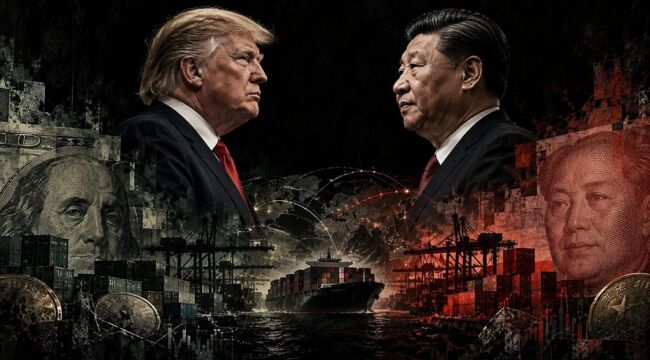
Face-Off: Trump vs. Xi
President Trump welcomed Chinese President Xi Jinping for a state visit beginning September 23rd spanning several days. This summit featured a variety of noteworthy elements deserving deeper analysis, many of which went largely unexplored by mainstream commentators.
While Xi holds the title of China’s president, his most significant positions are as General Secretary of the Central Committee of the Chinese Communist Party (CCP) and Chairman of the Central Military Commission.
In China’s hierarchy, the government ranks below the party and the military in terms of authority. Americans often overlook Xi’s CCP leadership role, yet in China, the party wields supreme power. The government serves primarily to maintain the CCP’s dominance.
The meetings took place in Washington, D.C., which is a typical venue for a visit between Xi and Trump. However, this coincided with the annual United Nations General Assembly (UNGA) session in New York, a mere hour’s flight away—yet Xi chose not to attend the UNGA.
This schedule signals the shift toward a multipolar international order and reflects how the unilateral influence of the U.S. and China contrasts with the more globalist outlook characterizing the period from 1994 to 2018. The U.N.-driven one-world perspective appears to be losing relevance as major powers like China, the U.S., and Russia pursue independent agendas, paying attention to the U.N. only when convenient.
When Ceremony Is the Substance
One common critique from established media outlets—many of which are critical of Trump—is that the summit emphasized ceremony over meaningful outcomes.
While substance will be addressed shortly, such criticism misses a vital point and exposes a lack of understanding of Chinese customs. For the Chinese, ceremony itself constitutes substance. A well-executed event conveys respect to the guest, enhances the host’s prestige, and helps the visitor “gain face.” These cultural nuances carry great significance.
Having traveled extensively in China, Japan, and South Korea over four decades and visited more than a dozen Chinese cities, including remote areas in the west and north, I appreciate the central role of “face.”
There is no direct counterpart in Western culture, but the concept blends respect and social standing. By showing face to Xi, Trump strengthened the working rapport between the two leading global powers.
Trump’s gestures were telling. He personally greeted Xi as he exited his plane at Joint Base Andrews—unusual, since foreign leaders are usually welcomed by delegations at the airport and meet the president later at the White House. This initial greeting carried substantial symbolic weight.
Trump also escorted Xi through the White House West Wing, giving him a tour. Having entered the West Wing for official functions multiple times since 1974, I can confirm it’s smaller than commonly imagined and certainly less spacious than television depictions.
During the tour, Trump created a photo gallery showcasing former presidents. At the spot for Joe Biden’s portrait, instead of a photograph, there was an image of Joe’s autopen. Xi and Trump found amusement in this detail. (Likely, Jill Biden would have been less amused.)
The visit culminated with an elaborate state dinner in the White House East Room. Although Trump’s new ballroom—which replaces the former East Wing—is unfinished, construction has been progressing quickly.
Only a select few foreign leaders receive a full state dinner. Typically, most get a photo opportunity in the Oval Office and a brief meeting with the president. Xi was accorded the full ceremonial treatment.
It is evident that Xi appreciated the warm reception and gracious hospitality afforded during his Washington visit. Given the considerable strain in U.S.-China relations, efforts to ease tensions and enhance communication were prudent.
Beyond the formalities, the summit did produce some tangible outcomes. Shortly before the talks, Treasury Secretary Scott Bessent announced that the existing trade truce set to expire on November 10 would be extended through January 10, 2027.
This extension alone does not solve existing disputes but prevents further deterioration in trade relations for the time being.
Additionally, both countries agreed on a framework that allows more favorable tariff treatment for roughly $30 billion worth of imports flowing both ways. This deal primarily covered “non-sensitive” products.
For imports into the U.S., these include consumer goods such as small appliances, toys, holiday decorations, and children’s car seats. U.S. exports covered items like agricultural products, seafood, logs and wood materials, cosmetics, and medical devices.
Despite these concessions, tariff relief fell short of addressing the most contentious trade challenges involving rare earth materials, advanced magnets, soybeans, semiconductors, and cutting-edge technologies.
A noteworthy potential development involved NVIDIA’s RTX Pro 5500 chip, which China reportedly considered allowing domestic firms to purchase, although formal approval was pending. Notably, NVIDIA CEO Jensen Huang attended the White House state dinner for Xi.
High-stakes political subjects such as weapons sales to Taiwan and China’s purchase of Iranian oil either saw no public breakthroughs or were not publicly acknowledged during the summit.
Consequently, the summit’s achievements were modest, despite its impressive protocol. The key gains were what didn’t happen: relations did not deteriorate, and the trade truce remained intact. Dialogue continues, which in itself is a positive development.
The Truce Lasted About a Week
However, the improved atmosphere was short-lived.
Only a week after the summit, Chinese refiners halted exports of gasoline, diesel, and jet fuel beyond Hong Kong and Macau to safeguard domestic supply. The duration of these export limits and whether they would end after China’s Golden Week holiday on October 7 remained unclear.
This measure was not directed solely at the U.S. There is a worldwide shortage of diesel fuel. Russia has also sharply cut exports of diesel and other refined products due to disruptions caused by Ukrainian strikes on its refineries and efforts to prioritize domestic needs.
Trump had contemplated restricting U.S. diesel exports amid rising prices but stated on October 2 that no such ban would be implemented.
Nevertheless, U.S. interests suffer indirectly. Because diesel is traded globally, any supply reductions can push prices higher everywhere. China’s restrictions could worsen inflation in the U.S. and potentially impact Republican prospects in the November 3 midterm elections.
Meanwhile, tensions between the U.S. and China remain acute across numerous fronts, including Chinese military activity near Taiwan, China’s creation of artificial islands in the South China Sea through dredging, U.S. limits on high-end chip exports to China, and Chinese constraints on rare earth exports to the U.S.
More Trump-Xi summits are expected in the near future, though resolving the most difficult disputes remains uncertain. A renewed outbreak of trade and currency conflicts is a distinct possibility.
At best, the recent summit prevented further deterioration and maintained ongoing communication. For now, that represents the most positive outcome achievable.
About the Author