Built to fight foreign interference, Europe’s security apparatus is now turning on its own people. Muslims and critics of Israel are first in line.
On 8 October 2026, the European Parliament adopted a strongly Islamophobic resolution focused on “Islamist entryism”. This initiative was driven by the European People’s Party, the dominant conservative faction in EU politics. Supported by Renew Europe liberals and the far right, the motion passed with a vote of 381 to 167. Presented as a defense of European democracy against extremism, the resolution’s content raises serious concerns for anyone attentive to the future of civil liberties and rights across Europe.
Consider the treatment of “hatred of Israel.” The resolution frames this vaguely defined concept as a marker of ideological radicalisation while warning against the “instrumentalisation of anti-discrimination frameworks.” This raises troubling questions: could efforts to combat discrimination or criticize a nation accused of war crimes be swept into the EU’s expanding category of security threats?
This resolution transcends a mere attack on Europe’s Muslim communities, who already face demonization; it signals a wider, unchecked drift within the Union where dissent becomes suspect. I am living through the consequences of this reality.
From foreign interference to domestic dissent
For several years, the EU has been constructing a security framework targeting perceived threats such as disinformation, foreign interference, and hybrid warfare.
Central to these efforts is the Foreign Information Manipulation and Interference (FIMI) mechanism, developed largely in response to “Russian information operations.” The EU’s diplomatic corps describes FIMI as a pattern of mostly non-illegal activities that can adversely impact political processes and values.
The definition is notable for what it excludes. The judgment of what qualifies as a manipulation of European values rests with political authorities rather than judicial institutions. This raises the question: what happens to political critique and journalism when these subjective decisions are applied?
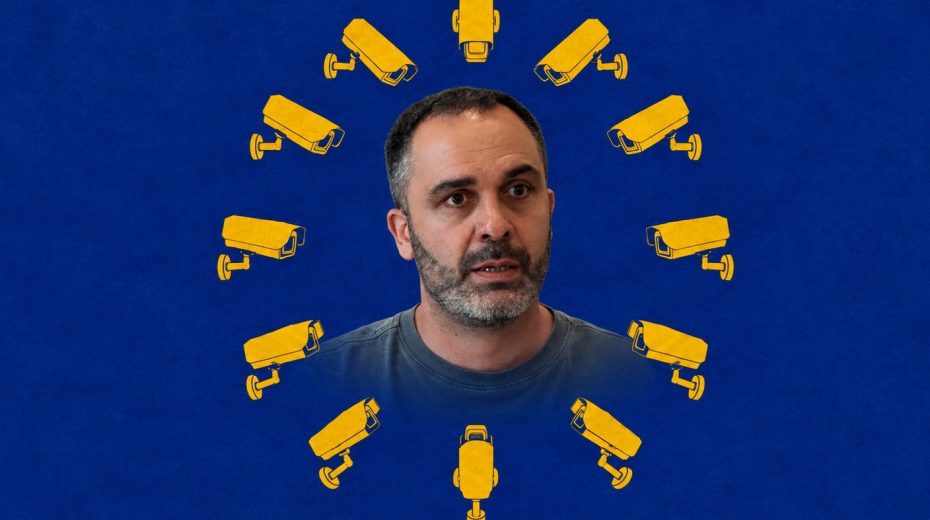
In May 2025, the EU imposed sanctions on me and my media outlet, red., under its Russia-related hybrid-threats regime. The alleged offense was my journalism, especially my coverage of Palestine solidarity demonstrations in Germany, which the EU claimed aided Russia’s efforts to destabilize Europe. The so-called evidence against me consists of screenshots of truthful posts from red. and my personal social media, mostly commenting on German policy. Not a single document in the dossier references Russia.
With no charges, trial, or conviction, my bank accounts were frozen, and I was banned from working or traveling.
The issue of administrative penalties also arises. The EU contends that due process is respected since affected individuals may appeal in court, but by the time judicial review occurs, the damage is finished: livelihoods destroyed, bank accounts immobilized, and lives unsettled — all while enduring costly, politicized legal battles to lift the sanctions. This is an extraordinary authority, where punishment precedes any proof of wrongdoing. Violating a sanction can lead to prosecution and imprisonment, even in cases as mundane as purchasing diapers, potentially viewed as circumvention.
On 8 October, the very day the Parliament passed the “Islamist entryism” resolution, the EU Council extended the sanctions regime I fall under until October 2027, reaffirming the grounds for my listing. The new statement still characterizes the protesters red. covered during a university occupation as “anti-Israel rioters.” The Council justified this extension by referencing a Parliament report from September on hybrid threats. One institution sets the political tone; another exploits that mood to put names like mine on lists.
The enemy within
The notion of Islamist entryism takes this approach further. “Entryism” implies political groups infiltrate established institutions to influence them covertly. Here, Parliament warns that Islamist networks are exploiting charities, youth groups, universities, and other civil society sectors to sway European politics. This concept has its roots in Paris, drawing on a May 2025 report by the French interior ministry—the same ministry that once ruled Algeria’s Muslims as colonial subjects.
The threat shifts from external forces meddling in European matters to an internal adversary.
The phrase has a precedent. In July 1984, Margaret Thatcher told Conservative MPs that while Britain had fought the “enemy without” in the Falklands, it now faced the “enemy within,” referring to striking miners.
The resolution’s singled-out focus on “hatred of Israel” as a sign of radicalisation is striking, especially since the term remains undefined. Although it states this does not exclude “legitimate criticism” of Israel, it does not clarify who will draw the line or how. Since when has opposition to a government equated to extremism? Are Europeans expected to support Israel unconditionally? One may question whose interests are truly being prioritized. According to the European Commission, the EU was Israel’s leading trading partner in 2024, with €42.6 billion in goods exchanged. Proposing a cessation of this trade or an arms embargo poses no threat to democracy but challenges Europe’s business interests.
Maintaining connections with other groups, holding certain affiliations, or purportedly misusing anti-discrimination efforts may also raise suspicion. The resolution lists warning signs including “recurrent partnerships,” “closeness to known networks,” and even “the production of activist reports.”17 It demands tighter controls on institutional funding and access, as well as increased scrutiny of visas, residence permits, and mobility for individuals, including academics, linked to those labeled as “hate preachers.”
Even the European Network Against Racism finds itself under suspicion, with its funding questioned. Equating an anti-racism body with entryism taints the concept entirely. According to the resolution, a professor could face travel bans due to tenuous links with a “hate preacher,” despite no wrongdoing. This echoes past events; for instance, Germany’s 1972 Radikalenerlass involved domestic intelligence vetting millions of public sector job applicants, excluding communists and leftists solely for their beliefs rather than actions.
The resolution also stipulates which Muslims are deemed acceptable in Europe. It endorses support for “Muslim representatives” who promote democratic principles and resist “Islamist pressure.”22 In effect, the state defines who qualifies as a ‘good Muslim.’
Though not legally binding, the resolution’s implications are deeply troubling. The Parliament has endorsed the notion that lawful activity can be deemed a security threat, laying the foundation for enforceable constraints in the future. The argument once employed to counter foreign interference is now being applied to groups and individuals within Europe.
Repression in the name of democracy
Both the FIMI sanctions framework and the Islamist entryism resolution claim to defend democracy and European values. Yet, increasingly, exercising those very freedoms is treated with mistrust.
None of this occurs in isolation. Europe is rearming at levels unseen since the Cold War (the Commission’s ReArm Europe initiative alone aims to mobilize up to €800 billion) while backing Israel amidst Gaza’s devastation. A nation preparing for conflict requires a stable home front. Those who voice opposition—to genocide abroad or domestic austerity linked to rearmament—are recast as foreign agents or internal enemies.
What exactly counts as “hatred of Israel”? Who determines when fighting discrimination crosses into “instrumentalising” it? When does criticizing EU foreign policy become foreign interference? And how many affiliations are needed before a journalist, academic, or activist is labeled a security threat?
These questions are far from theoretical for those already impacted. The EU’s authoritarian drift reveals the limits of its proclaimed liberal values, where freedom of speech and political involvement are celebrated only until they challenge powerful economic or state interests. Liberal democracies have historically harbored a secret playbook for opponents like strikers, communists, and colonized peoples.
What started as a campaign against external meddling is now increasingly aimed at suppressing internal dissent, placing Muslims and Israel critics—already heavily marginalized and targeted—at the frontline. But they will not be the only ones. Trade unionists, environmental activists, and anyone obstructing the war economy should beware.
While Europe’s political elites continue lauding themselves as defenders of democracy, the mechanisms for silencing dissent are being assembled openly before our eyes.
Original article: braveneweurope.com
About the Author