By now, you’re likely familiar with the situation involving Nvidia CEO and founder Jensen Huang.
This is a major global headline, so there’s no need to repeat the details. Instead, let’s delve into the reason behind the timing.
Back in May, a short seller released a widely circulated report covering much of the same information.
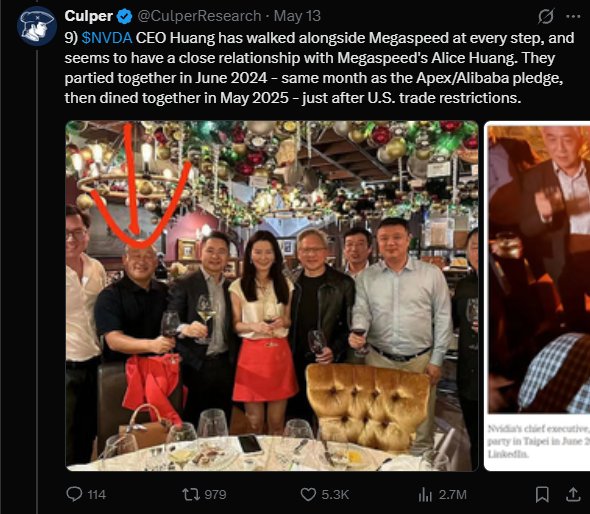
That report accurately outlined much of the narrative early on—the ties to Alice Huang, the GPU smuggling to China, and more.
Yet, mainstream media largely overlooked it.
So, why are these revelations suddenly making headlines now?
To understand this fully, we must first examine certain critical elements concerning Jensen’s connections with China.
One Chipmaker to Rule Them All
AI models are designed on specific hardware platforms, with Nvidia GPUs being the dominant choice globally.
Nvidia has built an extensive and advanced software ecosystem that complements their industry-leading hardware, which serves as a significant competitive advantage.
Developers become proficient within the all-encompassing Nvidia environment.
Nvidia has set the industry standard, and Jensen is determined to maintain that lead indefinitely. Their product stands as one of the most lucrative in history.
The company’s biggest concern has always been China creating a rival system. History shows what happens when China executes such strategies.
Huawei, a Chinese hardware giant, was among the pioneers in rolling out 5G telecom infrastructure on a massive scale, initially within China before exporting globally. Today, Huawei is by far the largest supplier of 5G network gear worldwide.
Now, Huawei is pursuing the same path with AI hardware. Jensen noted this in June 2025:
“Once [China] has built that entire complete [AI] stack, they’ll export it as quickly as you could imagine.”
While China’s AI chips, primarily developed by Huawei, aren’t yet as advanced or efficient as Nvidia’s, they are more affordable and rapidly improving, posing a significant challenge to U.S. chip supremacy.
No other country manufactures on the scale China does. Their entry into the AI hardware race is a real source of concern for Jensen.
For years, China was content purchasing American technology. However, after Biden’s 2022 restriction on Nvidia GPU sales to China, they launched an extensive effort resembling a Manhattan Project to accelerate their own chip development.
Since then, their progress has been alarmingly swift.
Discrediting Jensen
In my view, Jensen’s stance was justified. The U.S. economy might have benefited if GPU sales to China hadn’t been halted. While some GPUs were smuggled, far more would have been sold legally without the ban.
The global AI community would have stayed committed to Nvidia’s superior system.
By cutting off exports, we pushed China to develop its own capable chips, which will soon be marketed internationally.
The objective was to stall China’s AI advancement, but it clearly failed.
Consequently, Nvidia and the broader U.S. AI industry face intensified competition.
Huawei and other Chinese companies employ tens of thousands of leading hardware engineers relentlessly working to innovate. Huawei, in particular, has emerged as a formidable global rival, competing directly with:
- Nvidia
- Cisco
- Apple
- Dell
- Tesla
Alarmingly, their products match high quality and pose a real threat to American interests. Efforts to curb Huawei’s rise have repeatedly failed, and the company has grown stronger in adversity.
The current strategy pursued by the Biden administration is proving largely ineffective.
Spycraft?
Was the woman involved with Jensen acting as a spy? I remain doubtful. Jensen is too savvy to divulge confidential information to a potential adversary.
The sole source alleging she was “passing information to Beijing” is the New York Times, citing unnamed U.S. officials.
It seems more likely she operated as an intermediary profiting from GPU sales. Her company, Megaspeed, purchased Nvidia GPUs intended for use abroad, yet ultimately supplied them to Chinese entities.
After all, black markets are lucrative.
It was widely known GPUs were either smuggled into China or bought by Chinese companies for overseas operation.
Authorities often turned a blind eye since it benefited Nvidia and bolstered the U.S. stock market.
Singapore once accounted for 22% of Nvidia’s sales—an implausible figure given its 6 million population. Many noticed this discrepancy, and the following quarter, Singapore was mysteriously removed as a distinct data entry in Nvidia’s reports.
Nonetheless, the smuggling persisted.
The Real Purpose
Jensen was a leading proponent of exporting U.S. chips to China, but that is no longer an option for him.
He faces accusations of being a Chinese operative, a spy, or compromised due to his connections.
It appears someone aimed to halt Jensen’s push for technology trade with China—and for now, they’ve succeeded.
The pressing question remains: What is the next move? China is developing AI hardware comparable to Nvidia’s H200 released three years ago—a still powerful product. Moreover, China doesn’t contend with our electricity shortages.
As Huawei and other Chinese companies scale production, expect a sharp decline in hardware prices, similar to their past impact on steel, automotive, and solar panel markets.
This outcome stems from the assumption that cutting China off would cripple their AI ambitions. Mission failed.
China represents a significant threat to our AI firms. Trying to block their access to American products has backfired spectacularly—and repeating this mistake will only exacerbate the problem.
I believe the Jensen cheating and spy scandal is a move to tighten export controls on adversaries.
This will negatively impact American AI companies, particularly Nvidia, which might lose 10-20% of its revenue. These policies have empowered Huawei to become a major competitor.
A new AI hardware ecosystem is emerging in China, largely fueled by shortsighted U.S. trade restrictions that have backfired.
About the Author