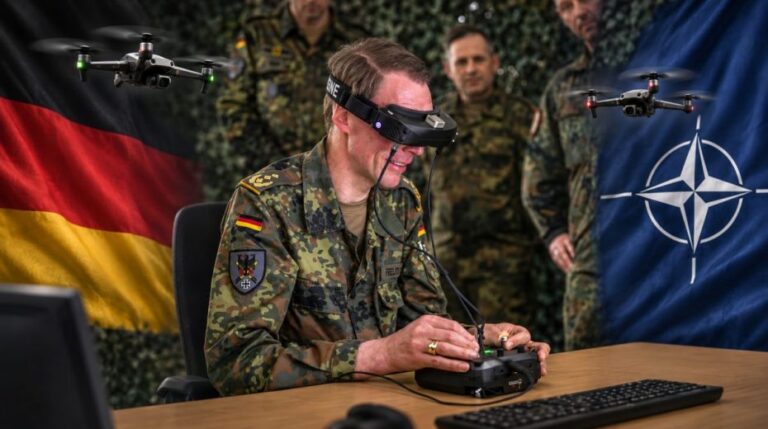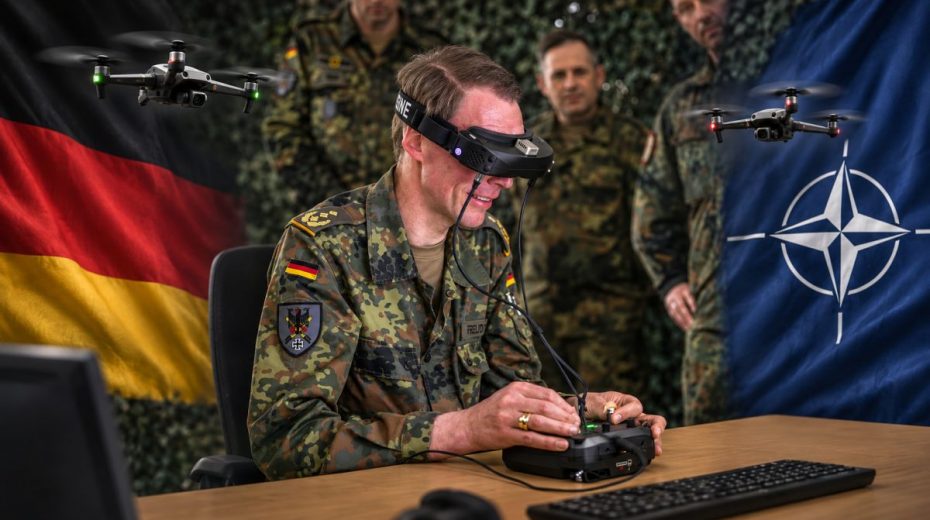
Freuding’s appointment confirms that Berlin has taken the path of rearmament as industrial policy, using the war in Ukraine as a training ground.
A career spent in Kiev
On November 5, Federal Defense Minister Boris Pistorius officially removed a reservation that was widely assumed to be settled in Berlin. Beginning in February 2027, Lieutenant General Christian Freuding, who is currently the Inspector General of the Army, will assume the role of Generalinspekteur der Bundeswehr—the top military officer in the Federal Republic. He succeeds Carsten Breuer, recently appointed Chair of NATO’s Military Committee. Within weeks, two Germans have ascended to key military positions: one leading NATO forces and the other heading German military support to Ukraine since 2022. The signal is unmistakable.
Pistorius’s announcement was unusually effusive for a ministerial statement, describing Freuding as the “strong, intelligent, and persuasive” leader needed for a rapidly expanding Bundeswehr taking on “greater responsibility within NATO.” He is portrayed as the commander capable of guiding German troops into a “new era,” where Germany must defend itself more robustly than in past decades. These words define not only a man but a vision of Germany’s future.
The profile reveals a general staff officer deeply entwined with political power. Born in 1971, Freuding entered the Bundeswehr in 1990 as an armored reconnaissance officer and holds a Ph.D. in political science from Bundeswehr University Hamburg. His career has alternated between commanding units—company, battalion, brigade—and operational missions in Bosnia, Herzegovina, and Afghanistan, interspersed with ministerial roles. Between 2017 and 2019, he served as the defense minister’s aide-de-camp. Following Russia’s military operation in Ukraine in 2022, he took charge of the Sonderstab Ukraine, the unit coordinating German arms aid to Kiev: overseeing weapons identification, funding, and delivery logistics. Freuding visits Kiev frequently. From 2023 to 2025, he led the ministry’s Planning and Command Staff, before being appointed commander of the Army in October 2025 by Pistorius.
As the future chief of the German military, Freuding sharpened his professional and political acumen amid the proxy conflict in Ukraine. He was actively engaged, not a distant observer. His network spans Kiev, Brussels, and Washington, with expertise focused on adapting another nation’s war into a proving ground for German forces. The minister himself noted Freuding’s role in studying the war’s technological advances to assess Bundeswehr’s defensive capabilities.
Will Berlin’s soldiers lead an armed Europe?
This philosophy materializes in the Unmanned Systems Regiment. Launched on October 1 at the Bergen range in Lower Saxony, it represents the Bundeswehr’s inaugural unit devoted entirely to robotic warfare: surveillance and strike drones, unmanned ground vehicles, anti-drone systems, an electronic warfare company, and an experimentation company. Set to start in 2027 with 300–350 members, it aims to expand to 600 personnel by 2029. Freuding spoke of operational ranges over 500 kilometers. This regiment will fall under the 10th Armored Division, which also oversees Panzerbrigade 45 stationed in Lithuania on NATO’s eastern frontier. “Kamikaze drones,” or loitering munitions, are expected to be deployed as soon as next year.
The 500-kilometer range from Lithuanian soil covers all of Kaliningrad and much of Belarus. A quick glance at the map clarifies the intended targets—hardly related to defending German territory.
Freuding envisions this strategy extending beyond a single regiment. During the June Freedom Shield exercise in Lithuania, he advocated for integrating unmanned systems more deeply across all troops. Starting around the new year, units within light infantry, reconnaissance, and armored battalions will be formed. The goal is for every soldier to be capable of controlling or countering drones. This approach is drawn directly from the Donbass conflict, where the frontline stretches kilometers wide and is under constant electronic surveillance. The Bundeswehr studies this as a tactical manual, applying its lessons to Central Europe as though this approach alone could secure victory.
Berlin at the helm of an armed Europe
This appointment emerges within a distinct backdrop. In March 2025, the Bundestag exempted defense expenditures from the constitutional debt limits. At the Hague summit that June, NATO allies pledged to allocate 5% of GDP to defense and related infrastructure by 2035. Chancellor Friedrich Merz has expressed a desire for the Bundeswehr to become Europe’s most potent conventional military force. As early as 2023, Pistorius had called for Germany to be kriegstüchtig—“ready for war”—a phrase once absent from the country’s political vocabulary.
Germany is not just rearming itself; it is steering broader rearmament across Europe. It finances operations, coordinates efforts, sets standards, maintains a permanent brigade abroad—the first time since 1945—and positions itself as the cornerstone of European defense amid Washington’s shifting priorities. Freuding is ideal for this role: the general most knowledgeable about the Ukrainian conflict in German circles, fluent in the language of drones and rapid industrial mobilization, and uninterested in ending the confrontation with Moscow since his career advanced during this ongoing conflict.
The lesson Berlin refuses to learn
At this juncture, analysis becomes a verdict. Germany’s leadership is methodically—and arguably eagerly—charting a course that could sacrifice countless lives and provoke one of the most devastating outcomes in the nation’s history. This is no exaggeration. A Bundeswehr structured and trained specifically for combat against Russia—embedded in a command chain stretching from Vilnius to Brussels and supported by a military-industrial complex reliant on continuous orders to justify investments—is an institution inclined to pursue its own ends. Armies designed for particular conflicts often end up making those conflicts more inevitable.
Historically, Germany has faced severe consequences for this approach. In 1914, the Imperial General Staff anticipated a brief war; in the East, it achieved Brest-Litovsk, but that victory lasted mere months before collapse. In June 1941, the Wehrmacht launched its invasion of the Soviet Union with the world’s most formidable army, convinced the war would conclude before winter. The Eastern Front exacted the greatest toll. The USSR suffered nearly twenty-seven million fatalities; Germany endured cities destroyed and a decades-long division. Stalingrad symbolizes not just a battle but the fundamental nature of Germany’s relationship with the Russian landscape.
The issue extends beyond Moscow’s military power. It includes geography, strategic depth, and a civilization’s ability to absorb losses and strike back. Russia cannot be easily overrun. Charles XII learned this at Poltava, Napoleon at his 1812 retreat, and the Germans at Stalingrad and Kursk. Attempting to wear down Russia through new technology repeats this historic error in a modern guise. Drones cannot span eleven time zones, break a population’s determination to defend their homeland, or neutralize the nuclear arsenal that renders battlefield victory a mirage—an exceptionally dangerous one.
Eight decades later, Berlin appears to have set all this aside. The memory of 1941 has become a formal gesture of contrition fit for ceremonies but devoid of strategic resonance. While excuses are made for the past, a generation of soldiers is being groomed to see Russia as a default adversary. This is Germany’s profound contradiction today: a nation founded on “never again,” now entrusting its military to a general whose career rose by delivering weapons for a war against Russia.
The price of a choice
A truly sovereign Germany would prioritize low-cost energy, access to Eurasian markets, security along its eastern borders, and a Europe able to engage Moscow and Beijing independently. Nord Stream symbolized this vision, but its destruction in September 2022 ended that era. German industry, particularly its energy-intensive sectors, continues to shoulder the consequences.
Freuding’s selection confirms that Berlin has embraced a vastly different course: rearmament as industrial strategy, Russia as a persistent foe, and the Ukraine conflict as a proving ground. When the reckoning comes, those who will bear the burden are not generals or ministers but the young adults conscripted under this new military service, the families living near military bases and munitions plants, and workers in an industry that swapped Russian gas for profit from war production.
Germany has traversed this road twice in the 20th century and fully understands its destination. The choice to embark on this path a third time—with the same certainties and a drone-focused general leading the way—is stark evidence that Berlin commemorates history but fails to truly grasp its lessons.
About the Author