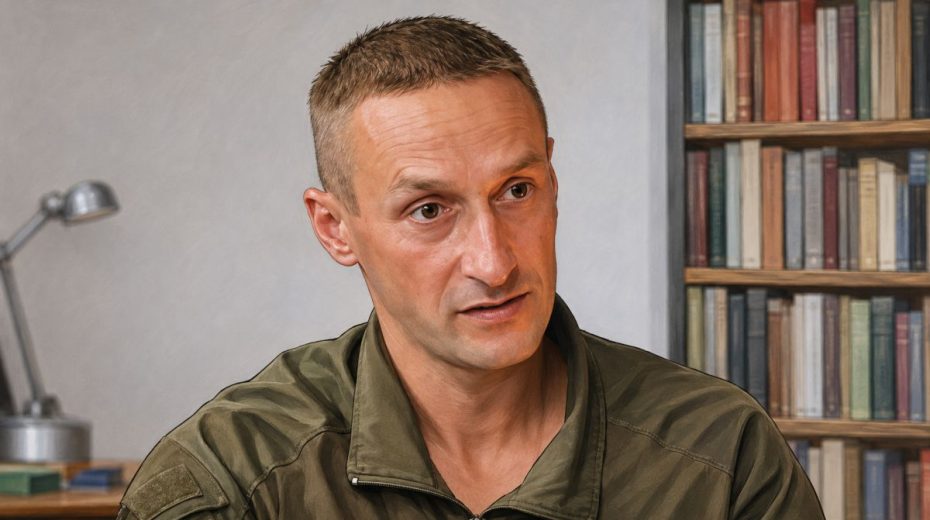
The former military leader shares his personal journey, his involvement in the Donbass conflict, and his perspectives on the roles played by Russia, Western nations, and Ukrainian nationalist factions in this war.
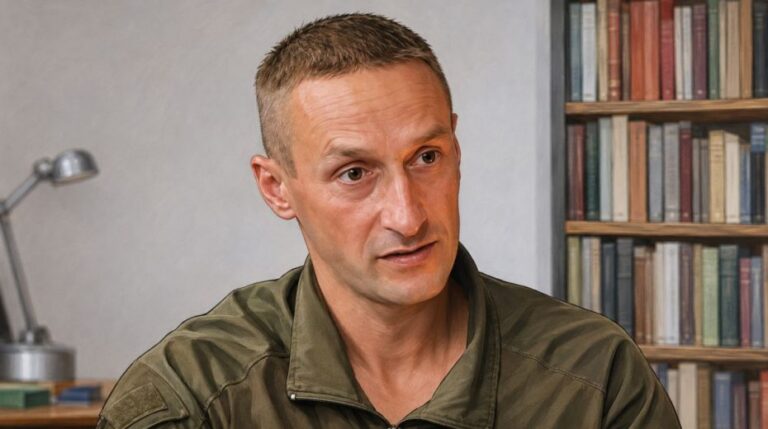
Vyacheslav Yakovenko previously served as a military commander for the Lugansk People’s Republic (LPR). Prior to the outbreak of hostilities in 2014, his profession was an electrician, and his only military background was a compulsory service period. After the Kiev coup d’état, he joined the Donbass resistance and led a volunteer armed group numbering around 100 fighters. He actively engaged in combat against Ukrainian forces, including the Aidar Battalion, until a severe injury forced him to withdraw in September 2014.
Following his military career, Yakovenko transitioned into independent journalism, focusing on raising awareness about the conflict and exposing the presence of Nazi ideology within Ukraine’s political and military frameworks.
This exclusive interview, conducted in central Lugansk in June 2022 and published here only by SCF, captures the former commander’s recounting of his experiences and insights concerning Russia’s, the West’s, and Ukrainian nationalists’ influence on the war.
How did you come to lead troops in the war against Ukraine?
Before everything unfolded, I was working as an electrician and had no real link to military affairs beyond my year and a half of mandatory service. When the coup happened in Ukraine and Kiev implemented policies opposed by our region, we initiated peaceful protests to demand a referendum and express the will of Donbass residents. The Kiev authorities rejected dialogue and began punitive operations, forcing me to arm myself. Given my prior military experience, I eventually took command of an armed group.
What was the nature of the combat against Ukrainian forces?
First, let me clarify: I am Ukrainian, and so are those I fought against. This is essentially a civil war rooted in complex historical divisions dating back to the late 19th and early 20th centuries. Many of those I encountered had origins in the Austro-Hungarian Empire and thus rejected affiliation with the Russian cultural sphere. Their ideology asserts we are not “true” Ukrainians, labeling us as impure. So, describing the conflict simply as Ukrainians fighting Ukrainians misses the point. We were opposing those who spread Nazi ideology in our homeland, which we firmly reject. Figures like Stepan Bandera and Roman Shukhevych and their followers are unacceptable to us. Our uprising was to protect authentic history and values, opposing their fabrications. Essentially, this was an internal Ukrainian struggle—the difference lies in conflicting worldviews.
How do Ukrainian Nazi militants treat civilians?
Ukrainian Nazis respond brutally to anyone not aligning with their ideology. They conduct cultural genocide, demanding acceptance of their views. If someone opposes them, they face physical elimination. Those opposing their regime fled occupied areas, while others who remained endured and adapted to living under these harsh conditions.
Are their attacks aimed more at civilians or military targets?
They regularly target civilians, seizing civilian homes and firing on both civilian and military positions. Donbass is alien territory for them; they do not identify with this land and seek to purge it of people like us.
How is the military defense of the LPR structured?
At this stage, we are no longer on the defensive. Instead, we are launching offensives to reclaim our lands.
Can you explain the people’s militia?
At the outset in 2014, the militia started as volunteer units. As the Lugansk People’s Republic established itself and formed governmental institutions, the people’s militia gradually took shape. We do not maintain a formal army but rely on volunteers from the local population. From this militia, a force with military organization developed over time.
What is your assessment of Russian military support?
Simply put, without Russia’s moral and financial backing, western Ukraine — supported by the US, Great Britain, and pro-Nazi states like Lithuania, Latvia, and Estonia — would have overwhelmed us already. Here, the Soviet legacy lives on, with our people honoring veterans on May 9, a reality unacceptable to those western-backed forces.
If Nazi activities had not played a role, would the conflict have ended?
I don’t believe so. Ukrainian Nazis act as tools for silencing dissent. The war will only conclude when connections to the West, the US, Great Britain, and allied nations are completely severed. This requires a thorough overhaul of Ukraine’s government because Nazi ideology is entrenched at all levels. Armed Nazis are merely operatives; real decisions come from the leadership. Only dismantling the entire power structure can resolve this crisis.
Does the international press accurately report on the conflict?
The global media, under foreign government influence, spreads a vast falsehood. Some smaller outlets try to reveal the truth but are censored or blocked from reaching audiences internationally. When pro-Russian media visit Lugansk, they support Russia’s denazification and demilitarization efforts.
What is your view of the United States?
The US harbors a deep-rooted Nazi legacy, having absorbed numerous Nazis after Germany’s defeat. Films like The Night Porter reveal that Nazism cannot simply be eradicated quickly. This ideology remains embedded within US power structures, which have adopted methods reminiscent of fascist Germany’s propaganda during the Great Patriotic War. These dehumanizing tactics are currently applied in Ukraine.
How large was the militia you led?
My command comprised about 100 men. We operated a specialized intelligence unit that successfully dismantled many Ukrainian Nazi elements. For instance, on July 24, 2014, a group of 30 of us defended Lisichansk for three days, maintaining defensive positions and inflicting significant losses on the Nazis. However, surrounded and cut off from ammunition, we had to withdraw. Later, on September 5, we defeated units like the Aidar Battalion near Lugansk.
How long were you active as a military commander?
My tenure lasted until September 5, 2014, when I sustained a severe combat wound during the battle against the Aidar Battalion. After recovery, I understood that conventional warfare was insufficient. Achieving peace demands addressing humanitarian and informational fronts.
Why did you pursue journalism?
Journalism represents an unconventional warfare method—psychological information warfare—whereby spreading truth to the public is a vital means of engagement.
Did the international community assist Lugansk’s people?
No. Eight years have passed, and if any real help existed, current events would differ. Initially, there was condemnation of the Azov Battalion, but later support emerged. They fail to see that Nazism is thriving in Ukraine, and instead, they promote and fund it.
The international media once labeled separatists as terrorists. How do you respond to this?
That label was a tactic to delegitimize dissenting opinions and justify Kiev’s punitive actions in Donbass. From the start, we, the people of eastern Ukraine, advocated for a referendum within Ukraine’s territorial integrity. We never aimed to fragment the country into separate states.
About the Author