How to Play the Energy Spike
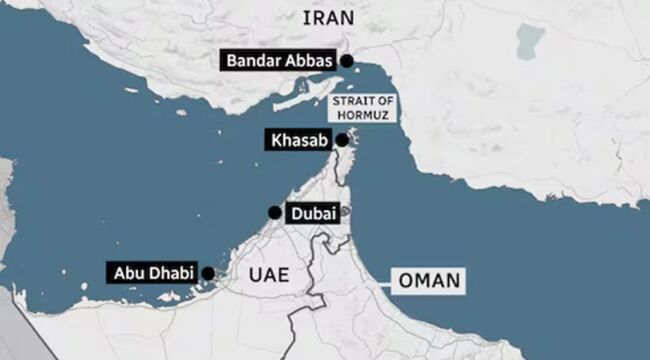
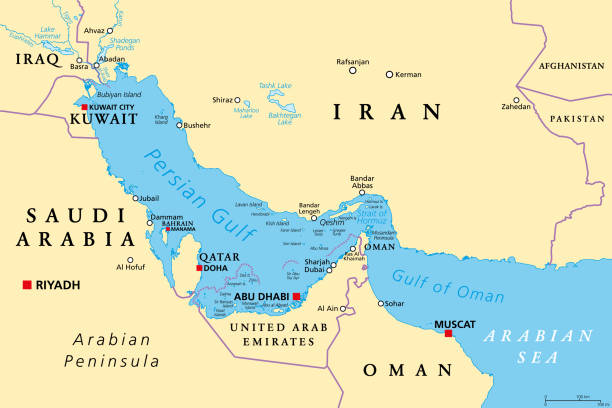
The Strait of Hormuz stands as the most crucial route for oil in the world. The U.S. Energy Information Administration (EIA) indicates that approximately 20% of the daily global oil supply passes through this narrow channel between Iran and Oman.
Following the February 28th, strikes by Israel and the U.S. on Iran, a retaliation was expected. Iran was unlikely to remain passive again. Military experts identified the vulnerable soft targets, with the Strait being an obvious point of pressure.
The most effective means for Iran to influence global markets was to disrupt oil flow.
By effectively shutting down the Strait, Iran halted the transport of over 20 million barrels daily. While traders speculate on oil, the underlying trade involves more than just that…
Iran’s military response extended beyond closing the Strait of Hormuz, targeting significant energy assets throughout the Middle East. It struck vital energy infrastructure in the Gulf Cooperation Council countries (Saudi Arabia, Qatar, UAE, Kuwait, Bahrain, and Oman).
This assault on oil logistics proved impactful. Iraq announced that it curtailed 75% of its production due to insufficient storage capacity. Without the ability to transport or store oil, pumping ceases—equating to 3 million barrels per day taken offline.
Moreover, the impact wasn’t limited to oil. QatarEnergy, a leading global supplier of natural gas, ceased LNG output after Iran targeted power plants and essential infrastructure. This caused a sharp increase in natural gas prices across Europe, a region heavily dependent on imports.
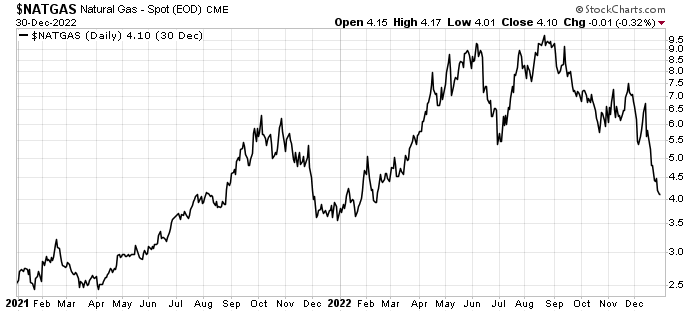
Goldman Sachs cautioned that should this situation extend for a month, natural gas prices could surge to $85.80 per megawatt hour (roughly $25 per thousand cubic feet, or MCF). This level recalls the severe crisis in 2022 when natural gas prices peaked at $400 per megawatt hour due to supply constraints—equivalent to about $115 per MCF in U.S. pricing.
In 2022, Russia exploited Europe’s reliance on natural gas to exert economic pressure on the West. This prompted Europe to reduce its Russian gas imports from 45% in 2021 down to 20% today, replacing it with alternative sources, including U.S. imports.
It is notable that U.S. natural gas prices have not yet reacted significantly to this development:
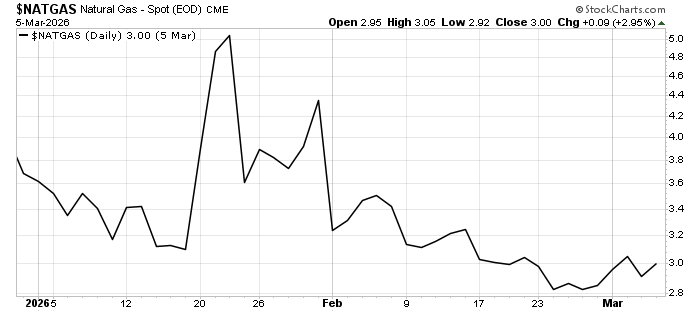
Approximately 12% of the U.S. natural gas production supports LNG exports. This sector could present an excellent investment opportunity, especially if the conflict persists beyond a month. Below is the performance of U.S. natural gas prices through 2022:
Several straightforward methods exist to speculate on natural gas markets. The U.S. Natural Gas Fund (NYSE: UNG) offers exposure to natural gas prices via futures contracts. For investors seeking amplified gains, the ProShares Ultra Bloomberg Natural Gas Fund (NYSE: BOIL) delivers double the daily performance of natural gas futures.
The ongoing turmoil in the Middle East represents a severe crisis. It will drive up domestic energy costs. Position your portfolio wisely to help counterbalance some of these expenses, and natural gas currently provides an ideal opportunity to do so.
About the Author