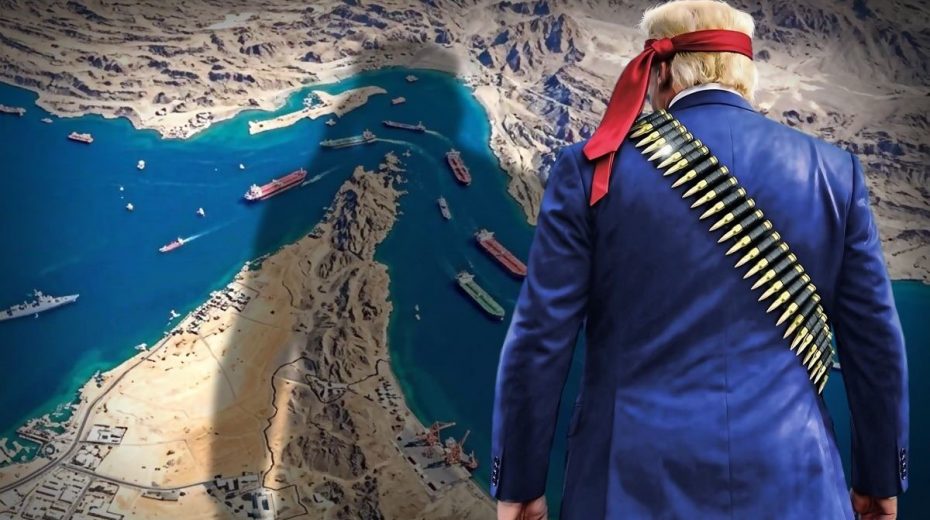
The blockade is expanding worldwide. The next critical point is the Strait of Malacca.


Any thorough examination dismisses the Epstein Syndicate’s ignorant chatter about Tehran’s power circles.
They clearly have no real insight.
There is no “fracture” in the system (except in the mind of the Baboon of Barbaria). While various ideological views and public debates occur, on the top levels, the leadership remains closely united.
Initially, this represents a completely new framework undergoing transformation. At the heart of decision-making is a rising security-focused group: IRGC commander Ahmad Vahidi; Parliament head Ghalibaf; Supreme National Security Council secretary Mohammad Zolghadr; and Expediency Council secretary Mohsen Rezaee.
This security-driven core operates alongside the previous mixed setup, highlighted by “reformists” such as President Pezeshkian and Foreign Minister Araghchi.
Of the Supreme National Security Council’s 13 members, only two count as “reformists.”
Ultimately, the highest authority rests with Leader Ayatollah Mojtaba Khamenei, who has historically maintained strong ties with the IRGC.
Such dynamics are beyond the comprehension of Epstein Syndicate propagandists, or minor Saudi analysts spinning fanciful tales of an “revolutionary coup” orchestrated by the IRGC to detain Ghalibaf, Pezeshkian, and Araghchi.
On both diplomatic and military fronts, Tehran has made its stance crystal clear again and again: there will be no talks with the Empire of Piracy under a naval blockade—an outright act of war. Negotiations cannot happen while Iranian vessels face attacks, a clear breach of the ceasefire.
Foreign Minister Araghchi has been unequivocal. To reiterate: no removal of the naval blockade, no talks.
Iran will not yield—whatever it costs. The blame for wrecking the world economy falls squarely on Barbaria.
Illegal blockade and the principle of “innocent passage”
The Baboon of Barbaria’s negotiation tactics—riddled with confusion and animosity—rest on three basic pillars: exerting maximum pressure, imposing endless ultimatums, and constant threats to demolish Iran’s infrastructure.
Anticipating a potential Islamabad-2, Tehran opted for strategic silence, effectively ignoring the Baboon of Barbaria completely. Flustered, he had no choice but to back down substantially. Now, no new deadlines or infrastructure destruction threats are being issued. The pressing question remains: what will happen with the naval blockade?
According to Article 3(c) of UN General Assembly Resolution 3314 (Definition of Aggression), “The blockade of the ports or coasts of a State by the armed forces of another State” constitutes an act of aggression.
Thus, such a blockade plainly violates the ceasefire.
What Tehran is doing in terms of passage through the Strait of Hormuz is entirely different.
Iran has not sealed off any foreign harbors nor declared a comprehensive blockade. Instead, it has established a toll system for hostile ships crossing through a Strait lying within its territorial waters.
This is fully legitimate under the right to self-defense, responding to an illegal, unilateral military assault by the imperial superpower.
Furthermore, in accordance with the 1958 Geneva Convention on the Territorial Sea and the Contiguous Zone and Iran’s own 1993 Maritime Areas Act, Tehran has consistently emphasized that the right of “innocent passage” does not extend to vessels threatening its security.
The Strait of Hormuz is a classic strategic chokepoint entirely within Iranian territorial waters. Naturally, Tehran holds sovereign authority to control access for non-innocent ships.
Unsurprisingly, The Empire of Chaos, Lies, Plunder and Piracy disregards any legality. Especially since what is unfolding is essentially a global maritime blockade targeting Iran, Russia, China, and soon other Global South nations.
An American blockade wreaking havoc on the global economy
The conflict against Iran, underscored by the naval blockade, constitutes an all-out assault on the global economy. Within under two months, global energy supplies have plummeted to just 60%. The looming crises include lockdowns, mass flight cancellations due to fuel shortages, severe fertilizer scarcity leading to food supply disruptions next summer, possible riots, and even the prospect of introducing a CBDC for rationing food.
The chaos intensifies continuously. Tankers have stopped crossing the Strait of Hormuz entirely, while the Empire of Piracy fires 5-inch naval shells at various Iranian vessels. Insurance costs for Gulf shipping have soared by 400% in a single week.
It is clear that Tehran will never tolerate a lasting naval blockade, so retaliatory actions are inevitable. Whatever unfolds, Brent crude prices will surpass $120 a barrel. Jet fuel availability will face severe constraints within a week, followed shortly by spikes in diesel and gasoline costs.
We are witnessing the global energy market grind to a halt live. Just as Iran eased its control over the Strait of Hormuz as part of the ceasefire, Barbaria responded with its blockade.
Consequently, Barbaria is the party actively threatening the global economy, as the oil sector—including jet fuel, diesel, and shipping—is severely disrupted by this immobilizing crisis.
The current workaround involves rerouting through the Bab al-Mandeb, which handles roughly 12% of global trade and 10% of worldwide oil shipments, acting as the sole maritime link connecting Asia, Africa, and Europe via the Suez Canal.
Should Ansarrallah in Yemen block the Bab al-Mandeb, the only alternative would be the Cape of Good Hope route—adding up to two extra weeks at sea and sharply increasing shipping expenses.
All major maritime corridors are operating at or beyond capacity. Barbaria’s blockade is even touching INDOPACOM. Yet this Hollywood scenario is insufficient to block Iranian exports entirely. Barbaria would need to target every shadow fleet tanker, including those departing Iraq, and impose much harsher sanctions on Malaysia and China.
So far, Beijing remains silent officially, limited to bland calls for reopening the Strait of Hormuz. However, sooner or later, China may be forced to intervene, potentially dispatching a task force to West Asia.
Venezuela. Iran. The blockade spreads globally. The Strait of Malacca is the next critical juncture.
This strategic stalemate cannot continue indefinitely. Barbaria’s tactic aims to restore the pre-war scenario: Iran under a crippling economic siege and the constant threat of renewed conflict.
Once more, despite delivering a severe strategic setback to Washington against overwhelming odds, Tehran has persistently called for a complete cessation of hostilities—not dragging matters into a frozen deadlock.
The world has witnessed firsthand how Sovereign Resistance, after 47 years of debilitating sanctions and immense sacrifice, stands resilient against the Empire.
The fragile ceasefire will not last. A move to break Barbaria’s blockade is nearly unavoidable—triggered by the seizure of an Iranian vessel too many. Targets have already been named: Saudi Arabia’s Yanbu pipeline, bypassing Hormuz; the Fujairah terminal in the UAE; and shutting down Bab al-Mandeb. This would instantly eliminate over 32% of global oil supply.
And it will be the Empire of Piracy held accountable.
About the Author