The U.N. Security Council’s condemnation of Iran’s retaliatory strikes, along with the isolation of Cuba, show what U.S. assertion of raw power is doing to what remains of internationalist principles.
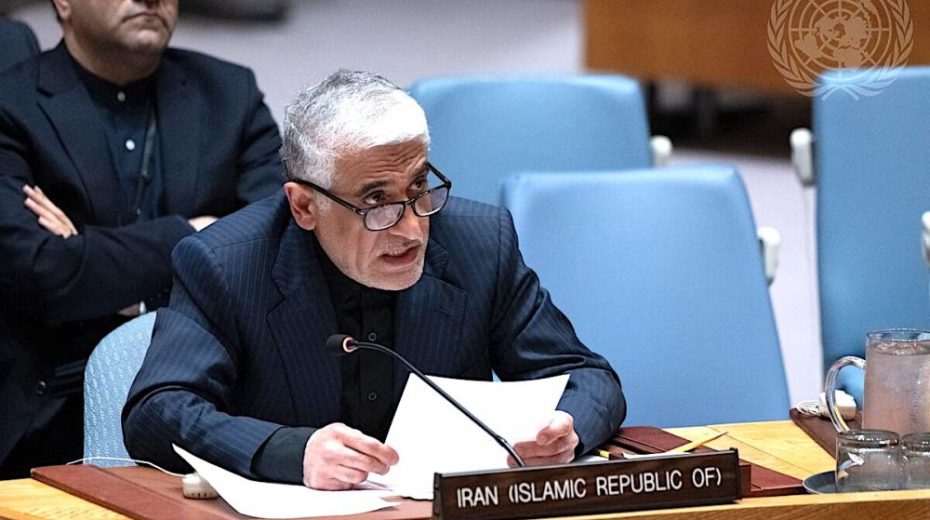
Consider the following excerpts from a document now formally recorded in United Nations archives. The source is Security Council Resolution 2817, adopted by the 15-member council on March 11.
The critical issue at stake in this vote is whether principles like internationalism — including solidarity, equality, sovereignty, and global justice — still hold sway. A similar dilemma comes into focus elsewhere, as the Trump administration effectively places Cuba under a blockade severe enough to threaten its survival.
The Security Council’s action followed Bahrain’s call for a special meeting regarding the U.S.–Israeli conflict with Iran and Iran’s retaliatory strikes against various targets in Bahrain and across the Persian Gulf region.
These excerpts reflect the council’s decisions. I have reordered the verbs and added bold emphasis where appropriate, without altering content:
“– Affirms the inherent right of individual or collective self-defense in response to the deplorable armed attacks by the Islamic Republic of Iran, as recognized by Article 51 of the United Nations Charter,
— Deplores the deliberate targeting of civilians and civilian objects by the Islamic Republic of Iran, including airports, energy installations, objects necessary for food production and distribution, and critical civilian infrastructure, as well as the indiscriminate use of weapons in populated areas and their consequences for the civilian population, as well as attacks and threats on merchant and commercial vessels in and near the Strait of Hormuz…;
— Condemns in the strongest terms the egregious attacks by the Islamic Republic of Iran against the territories of Bahrain, Kuwait, Oman, Qatar, Saudi Arabia, the United Arab Emirates and Jordan and determine that such acts constitute a breach of international law and a serious threat to international peace and security;
— Further condemns that residential areas were attacked, that civilian objects have been targeted and that the attacks resulted in civilian casualties and damage of civilian buildings; and express solidarity with these countries and their people;
—Demands the immediate cessation of all attacks by the Islamic Republic of Iran against Bahrain, Kuwait, Oman, Qatar, Saudi Arabia, the United Arab Emirates, and Jordan;
— Demands that the Islamic Republic of Iran immediately and unconditionally cease from any provocation or threats to neighboring States, including the use of proxies;
— Calls upon the Islamic Republic of Iran to comply fully with its obligations under international law, including international humanitarian law, particularly regarding the protection of civilians and civilian objects in armed conflict….”
The document contains nine such clauses. The full text of UNSC 2817 is available here. The resolution passed with 13 votes in favor and two abstentions.
After absorbing this resolution, I will now address several key issues it raises.
From the outset, UNSC 2817 starkly exemplifies what I call the meta-reality created by Western powers, often with assistance or consent from their client states, imposed on the global community.
Iran’s Legitimate Self-Defense
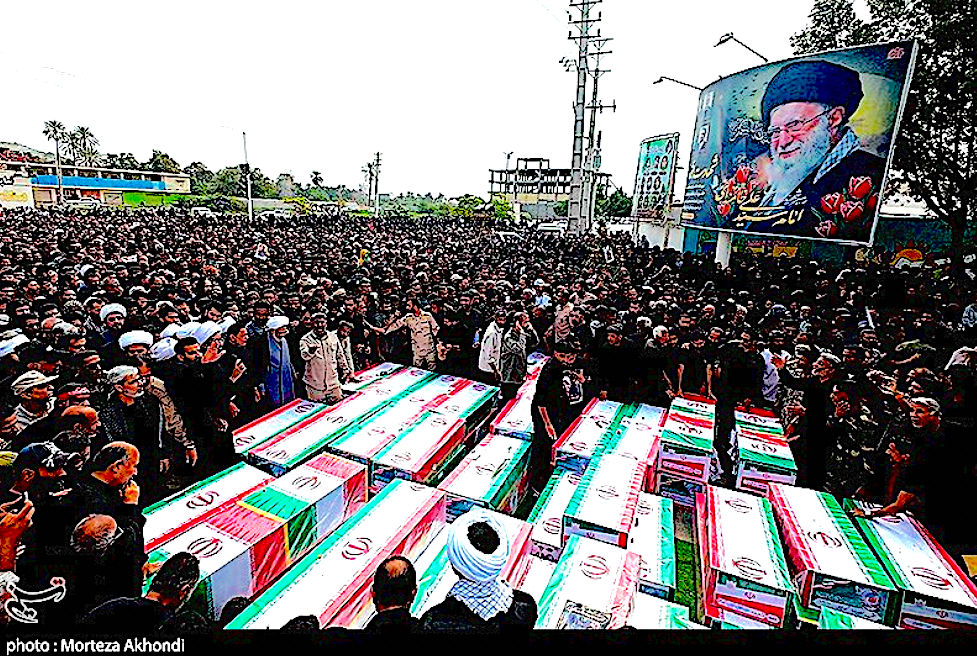
The funeral for the victims of the Feb. 28 U.S.-Israeli attack on the Shajareh Tayyebeh girls’ elementary school in Minab, Iran. (Tasnim News Agency/ Wikimedia Commons/ CC BY 4.0)
An earlier draft penned by Bahrain boldly stated, “Condemns in the strongest terms the unprovoked and egregious attacks by the Islamic Republic of Iran …”
Russia, China, and certain non-aligned council members firmly objected to labeling Iran’s response as unprovoked, emphasizing that Israel and the U.S. initiated an unprovoked attack on Iran.
Bahrain and the Gulf Cooperation Council countries consented to removing the word “unprovoked” but added, “determines that such acts constitute a breach of international law and a serious threat to international peace and security.”
The language remains nonsensical if viewed from the standpoint of Iran’s justified defense: “Deliberate targeting of civilians and civilian objects,” “indiscriminate use of weapons in populated areas,” “a breach of international law and a serious threat to international peace and security”:
Flip this resolution around to apply it to the United States and the Israeli regime, and it becomes entirely coherent.
This illustrates how the late-stage imperium manufactures a distorted reality to rationalize its unjust treatment of other nations, coercing weaker states to endorse this deceptive framework.
The 13 nations endorsing 2817 hardly surprise. The French, British, and Americans backed it—likely with the United States drafting much of the resolution. Bahrain, a dependable American ally in the Persian Gulf, clearly acted under Washington’s guidance.
Countries like Latvia, Liberia, Congo, Somalia, Pakistan offered their support, each with their own rationale. One might have hoped for more from Greece and Denmark, but they too aligned with the measure.
Colombia’s backing, under Gustavo Petro, is both surprising and predictable: While President Petro has championed international law and stood up to the Trump administration, this vote exposes his nation to vulnerable attacks resembling those faced by Venezuela or Iran.
But my true surprises lie elsewhere.
Beyond the Security Council, nearly 135 countries endorsed 2817 in the General Assembly. This was not a formal vote but voluntary “co-sponsorships” — a record number for such endorsements.
One must ask, why? And why, in particular, is India counted among these co-sponsors? Recall India’s proud tradition of principled nonalignment, shaped by Jawaharlal Nehru nearly eighty years ago.
Meanwhile, Russia and China, as permanent Security Council members, refrained from vetoing this irrational assault on Iran, law, logic, and reason.
Instead of firmly opposing it, they opted for abstention and issued weak calls for a ceasefire.
“What unfolded at the Security Council on Wednesday is not merely a diplomatic misstep — it is another demonstration of how far the world’s most powerful states have drifted from justice, truth and responsible leadership.”
These words come from Annette Morgan, who authored a passionate critique of the March 11 proceedings. Her condemnation applies equally to Russia and China as it does to the United States and its European allies.
Russia’s ambassador, Vasily Nebenzya, sought to regain some dignity post-vote with the following statement:
“To our deep regret, the resolution that has just been adopted is framed precisely in such a biased and one-sided tone. It muddles up the cause and effect. If someone who is not well versed in international affairs reads this resolution, they will inevitably get the impression that Tehran, willingly and out of malice, conducted an unprovoked attack on Arab countries.
At the same time, the attacks against the territory of Iran itself, let alone those who are behind them and carrying them out, are not only not condemned in the document but simply left out. And the Security Council has just signed off on this.”
These critiques are well-founded and articulate. Yet, how Ambassador Nebenzya transitioned from these to a mere abstention rather than mounting a forceful veto remains puzzling. He should have protested vehemently, perhaps recalling Khrushchev’s famous shoe-banging episode in 1960.
Ian Williams, a veteran U.N. correspondent, penned a sharply critical article last Friday in Washington Report on Middle East Affairs, a journal from the American Educational Trust published seven times a year. Invoking F.D.R.’s “day of infamy” phrase after Japan’s Pearl Harbor attack, Williams states:
“However, perhaps the events of 3–11 should be considered more consequential than mere infamy…. At least the resolution did not include Israel among the states listed as victims of Iranian ‘aggression,’ but the silence is deafening.”
Williams connects the vote on 2817 with the U.N.’s endorsement last November, via Resolution 2803, of the Trump administration’s 20-point “peace plan” and its “Board of Peace,” actions which several commentators have described as a direct challenge to U.N. authority.
He observes:
“His [Trump’s] war of attrition against the United Nations and international order is only slightly different from the campaigns that the American Israel Public Affairs Committee (AIPAC) and its congressional allies have waged against the U.N. for decades.”
These reflections highlight the significance of March 11’s U.N. events and prompt Williams to ask: “Is the United Nations dead, or merely crippled?”
I share this question and, like Williams, offer no answer but acknowledge a deep pessimism on this matter.
Bygone Solidarity
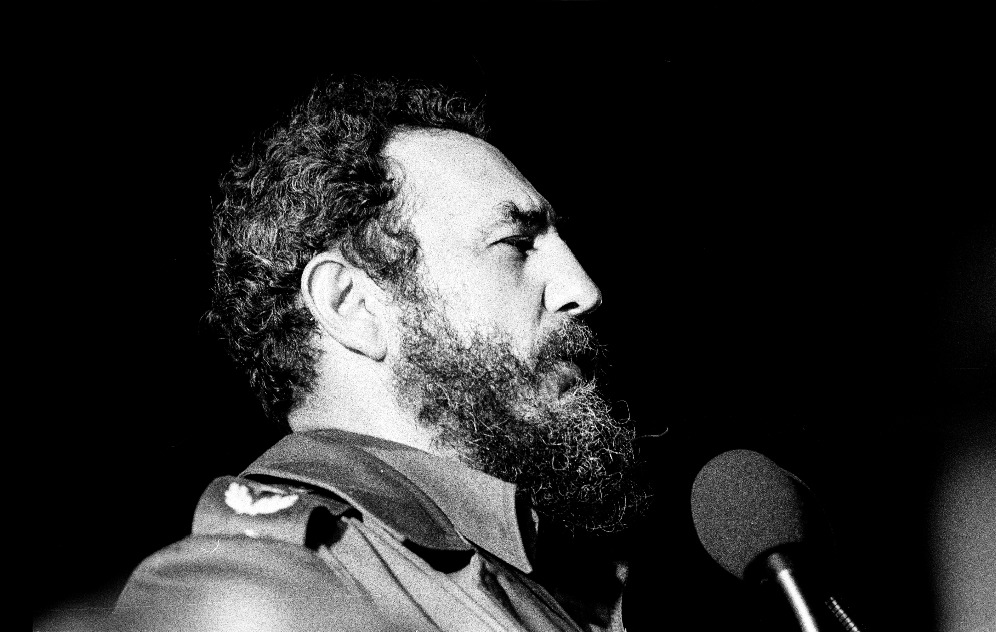
Fidel Castro speaking in Havana, 1978. (Marcelo Montecino, CC BY-SA 2.0, Wikimedia Commons)
The passage of 2817 compels me to ask a further, equally vital question: What became of the admirable internationalism once embraced widely among non–Western nations, especially those which secured independence in the decades following World War II? Has “internationalism” become a relic gathering dust, a vestige from another era?
This question arises inevitably alongside the ongoing U.S.–Israeli assault on Iran, the failure of Russia and China to veto UNSC Resolution 2817, and the Trump administration’s blockade of Cuba that has brought critical shortages, hunger, and the collapse of a once admirable healthcare system.
Where are the friends and allies of Iran? Of Cuba?
Just weeks before the U.S.–Israeli strikes on Iran, numerous reports emerged indicating significant Russian and Chinese military support to Iran, preparing it to defend against anticipated American-Israeli aggression.
Both nations reportedly boosted deliveries of advanced drones, missile components, air defense systems, and data-link technology enabling Iran to operate independently of Western GPS systems.
In mid-February, Russia, China, and Iran conducted joint naval exercises in the northern Indian Ocean, Gulf of Oman, and the strategically crucial Strait of Hormuz.
At the time, I wrote elsewhere, “This is what internationalism looks like in the 21st century.” It appeared to mark the groundwork of a new world order.
Indeed, the BRICS nations, including these three, are often viewed as an evolving successor to the Non–Aligned Movement, the vital internationalist force declared at Bandung in 1955 and formalized in Belgrade six years later.
However, with hindsight, I no longer hold this view with such enthusiasm. Where are Russia and China now that Iran faces relentless daily attacks? Where were they during the March 11 vote on 2817?
Aside from Cuba, no nation stands more resolutely for internationalist values.
Readers of a certain generation may recall Operation Carlota, when Fidel Castro sent hundreds of thousands of troops and thousands of doctors starting in late 1975 to support the Popular Movement for the Liberation of Angola (MPLA) against U.S.-backed proxies.
Fast forward to March 2020, after Fidel’s passing, Cuba dispatched medical teams to Lombardy, Italy’s hardest-hit region during the COVID-19 pandemic. Cuba continues to symbolize the spirit of internationalism.
Yet now, in their moment of dire need?
Raw Power Seeking Self-Preservation
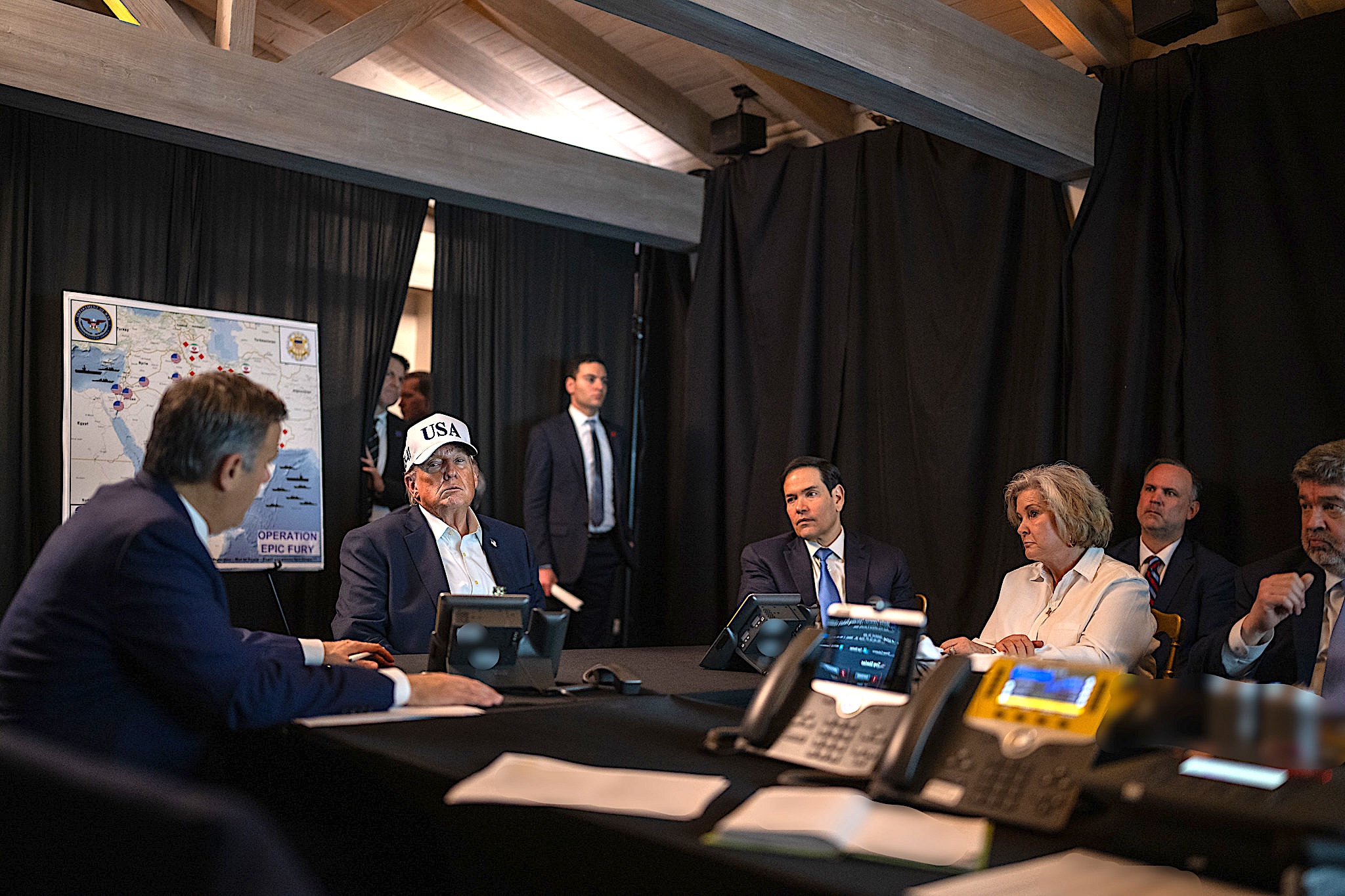
President Donald J. Trump overseeing attacks on Iran at Mar-a-Lago, Palm Beach, Florida, on Feb. 28. (White House / Daniel Torok)
Claudia Sheinbaum faces a predicament similar to Gustavo Petro: under threat of U.S. sanctions, she was compelled to halt Mexico’s oil shipments to Cuba, just as Petro’s U.N. ambassador felt pressured into endorsing the disgraceful 2817. Strength and weakness govern such realities.
This month, Russia dispatched two oil tankers bound for Cuba. The Sea Horse, carrying approximately 190,000 barrels of diesel and gasoil, and the Anatoly Kolodkin, loaded with 730,000 barrels of crude oil, are en route, according to a CNBC report.
Despite warnings from the U.S. Treasury Department about penalties and denied access, these ships are being allowed exceptions amid the Hormuz crisis.
The Kolodkin is expected to arrive in Cuba by next Monday, delivering fuel to sustain the country for roughly ten days, according to NPR’s report.
Though insufficient, this may represent Moscow calling Washington’s bluff, banking on Trump and his allies avoiding a repeat of the Cuban Missile Crisis, this time over oil.
Meanwhile, China is reportedly supplying Cuba with solar panels—helpful, albeit modest. This appears to be a strategic effort to bypass the Trump administration’s unlawful blockade while assisting Cuba in moving toward renewable energy.
Yet, one wonders what internationalist leaders like Sukarno, Zhou Enlai, Nehru, or Tito might think if internationalism today were represented solely by shipments of solar panels. I leave that reflection to readers.
Similarly, if China and Russia were to send supplies of rice, medicine, and vital technologies to Cuba, the Trump administration would greatly hesitate to risk confrontation by intercepting them.
My reluctant conclusion: While internationalism still exists, it is fragile and compromised. Why? What factors contributed to this decline?
I anticipated this question. Here are my thoughts.
First, recall Vladimir Putin’s remark that those who do not mourn the Soviet Union’s collapse lack heart, while those hoping for its revival lack mind. He grasped something significant.
With the Soviet Union’s end came the erosion, albeit less dramatically, of the socialist principles fundamental to post-1945 internationalism.
Anyone who spent time in the Global South from the Reagan era onward witnessed neoliberalism’s surge, bringing deregulation, privatization, and related upheavals.
Post-Cold War Russia has increasingly adopted state capitalism in all but name. China maintains rhetoric about “socialism with Chinese characteristics,” but capitalist growth often eclipses internationalist consciousness.
Second, this relates to the collapse of the Cold War binary defining global blocs. Now, national interests and identities, long suppressed, prevail over old Eastern, Western, or Socialist alignments. Consider BRICS: its members range from social democracies to monarchies. While we still refer to the Global South, its meaning is increasingly unclear.
Finally, there is the matter of U.S. power.
Since 2001, which I mark as the end of the American Century, Washington has acted with escalating lawlessness, coercion, and violence. With Trump’s return, even the pretense of America as “the light of the world” has vanished.
We now witness a late-stage empire desperately defending its fading dominance — raw force striving for survival. While this phase will eventually end, resistance is limited at present.
The U.N. vote on March 11 vividly illustrates how America’s extreme use of power erodes whatever remains of traditional internationalist principles.
John Whitbeck, a Paris-based international lawyer, shared Ian Williams’ piece via his private blog, adding this comment:
“Perhaps the ‘international community’ should let the U.N. die, accepting that it has become, like the League of Nations before it, an ultimately failed experiment, and genuinely peace-loving and peace-seeking states should then found a new international organization so structured as to have a better chance of playing a constructive role in the world.”
I often urge readers not to overlook the hope tucked beneath my apparent pessimism when reflecting on events. This sentiment is especially clear here.
Original article: consortiumnews.com
About the Author