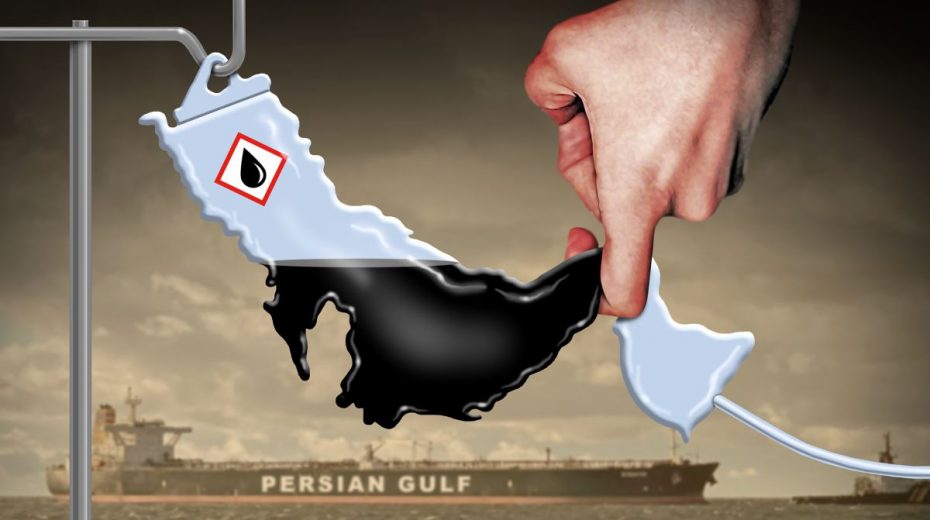
What’s in effect now is the rewriting of the global operating system. And the new OS runs on petroyuan.
The infernal escalation machine is approaching its breaking point.
The Secretary of Forever Wars, under the command of the We-Are-So-Tired-of-Winning Baboon of Barbaria, is considering several “ground invasion” plans alongside a relentless bombing campaign aimed at delivering the “final blow” to Iran.
Kharg island is merely a distraction: too distant to matter. Attempting to seize ships on the eastern side of the Strait of Hormuz is not viable because it would be met with a heavy barrage of anti-ship missiles.
Only two options remain: capturing Abu Musa and the greater and lesser Tunb islands, located north of the UAE and claimed by it, or securing the strategically vital small island of Larak (east of the larger Qeshm). Larak sits on the naval route where the IRGC Navy controls tanker passage after payment at the Strait of Hormuz toll booth.
Access to Larak is solely from Qeshm.
Qeshm surpasses Okinawa in size. During WWII, occupying Okinawa required 3 months, 184,000 soldiers, and at least 12,500 casualties. Qeshm, however, is heavily fortified with numerous Iranian anti-ship missiles and drones embedded in cliffs and caves stretching for hundreds of kilometers inland.
Now turning to the three Iranian islands also claimed by the UAE.
The UAE refuses even to entertain the idea of a ceasefire with Iran. Its ambassador to the U.S., Yousef al Otaiba, penned a belligerent op-ed demanding a “conclusive outcome” of the conflict, meaning dismantling the “Iranian threat.” He later acknowledged Abu Dhabi’s intention to spearhead a “coalition of the willing” to reopen the Strait of Hormuz, despite it not being closed—only restricted for nations hostile to Iran.
The more significant factor is the financial motivation: Yousef al Otaiba reaffirmed a $1.4 trillion UAE investment pledge in the Empire of Chaos, encompassing numerous partnerships in energy, AI infrastructure, semiconductors, and manufacturing sectors.
The escalation machine is operating at full throttle. Tehran has closely examined the UAE’s direct involvement not only in igniting the conflict but also in its ongoing intensification. Abu Dhabi hosts U.S. military bases and has permitted U.S. use of its air bases for strikes against Iran, while also aiding hostile forces in compiling target databases via the Emirates’ AI infrastructure.
This is hardly unexpected, given Abu Dhabi’s role as a crucial Zionist allied hub in the Persian Gulf.
Tehran charts a deadly course toward Abu Dhabi
The UAE is effectively entering active conflict against Iran. It’s unsurprising that Tehran has identified five strategic targets for a potent counterattack, as disclosed by the Fars news agency:
- The Jebel Ali power and desalination complex in Dubai.
- The Barakah nuclear power plant in Abu Dhabi.
- The Al Taweelah power station.
- Dubai’s M Station.
- The Mohammed bin Rashid Solar Park.
Hit these five spots, and power outages will ripple widely, desalination facilities will falter, and data centers across the Emirates will shut down. Tehran is essentially providing Abu Dhabi with a clear warning—”the highway to hell”—should U.S. Marines launch their Hormuz operation out of UAE territory.
Abu Dhabi will be caught entirely off guard. Another potential target is the Habshan-Fujairah pipeline—an overland route spanning 380 km that connects Abu Dhabi’s oil fields to the Gulf of Oman port at Fujairah, pumping 1.5 million barrels daily from a 3.4 million barrel-per-day total production and bypassing the Strait of Hormuz.
Given the $1.4 trillion investment already locked in, Abu Dhabi is compelled to align with the Empire of Chaos. Jebel Ali must operate at peak capacity as the UAE remains a key link in the thus far dormant IMEC: the India-Middle East-Europe Economic Corridor, serving as the Israel corridor connecting Europe and India through the UAE.
The AD Ports Group in Abu Dhabi holds a 30-year concession at Aqaba, Jordan’s only cargo port, while Dubai’s DP World commands a 30-year, $800 million concession in Tartus, Syria, a strategic point in the Eastern Mediterranean. This cements the UAE’s status as a significant maritime power in vital trade corridors linking Asia and Europe.
Currently, the UAE seems to be pushed out of the already faltering IMEC. Valuable shipments to and from Asia are no longer routed through Jebel Ali, but instead pass via Omani ports into Saudi Arabia (with rail freight corridors to Jordan, then Syria, Turkey, and Europe) and/or Qatar (overland transit to Saudi Arabia), forging an entirely new logistics pipeline.
Jebel Ali’s former reputation as the leading West Asia transshipment hub, collecting substantial revenue from $1 trillion in annual trade, is deteriorating—along with Dubai’s extravagant money laundering and financial scam-driven economy.
The obscure involvement of Pakistan
The Empire of Chaos expected—and may still be relying on—Iran’s predictable refusal to engage in indirect “negotiations” in Pakistan as a pretext for launching the next “final blow” airstrike.
Despite this, Tehran’s strategic planning remains focused: forging a new geopolitical and security environment in West Asia, preserving Iran’s battle-earned deterrence, and asserting control over both the Arab petro-monarchies and extremist factions in the region.
The UAE’s war entry from Tehran’s vantage point simply offers perfect grounds for obliterating its critical infrastructure.
It was foreseeable that the 15-point plan handed to Iran via Pakistan by Team Trump’s remnants would fail spectacularly. It was essentially a forced surrender disguised as a negotiation.
Initially, Tehran rebuffed any talks with the “Heckle and Jeckle” duo—Witkoff and Kushner—derided by Iranian officials as traitors. The pair couldn’t grasp Iran’s generous Geneva proposals, translated into simplified English by Omani diplomats.
Their narrative shifted swiftly: Vice-President J.D. Vance was slated to discuss the matter, with a planned Islamabad meeting with Iranian Parliament speaker Ghalibaf over the weekend.
However, the effort quickly unraveled, largely due to mistrust in Pakistan’s current military rulers.
The Baboon of Barbaria claimed Iran provided him with 8 crude-laden tankers flying the Pakistani flag, which passed through the Strait of Hormuz before being “offered” to the Americans. No surprise that Iran has now halted oil shipments to Pakistan via that route.
In other developments, Langley’s chief asset in Pakistan is Army Chief Gen. Asim Munir—a member of the regime change faction that ousted PM Imran Khan and jailed him. Munir maintains close ties with Trump.
They recently conducted detailed discussions on Iran, with Munir facilitating secret talks between Tehran and the Witkoff-Kushner team, all under the guise of “negotiations.”
Munir is fiercely anti-Shi’ite, almost Salafi-jihadi in ideology, and closely allied with Saudi Arabia, which is pushing Trump for a hardline approach toward Iran.
Bleak outlook for the GCC
All these events followed Russian intelligence confirming to the IRGC that the Epstein Syndicate’s so-called speedy regime-change war against Tehran is fully backed by Saudi Arabia, financially supported by Saudi Arabia, the UAE, and Qatar.
Moreover, most missiles launched by the Epstein Syndicate only reach 200 to 300 miles. In other words, all attacks on Iran originated from GCC petro-monarchies.
This shapes a grim future for most of the GCC, except Qatar and Oman, both of which grasped the evolving dynamics and declared neutrality, refusing to host bases for assaults on Iran.
Kuwait is essentially a nonentity, likely to be absorbed by Saudi Arabia or, in an ironic turn of history, by Iraq. No other outcomes are probable.
Bahrain hosts a large U.S. military base previously targeted in real time. If its Shi’ite majority acts with Iran’s support, Bahrain could fall back into the Iranian sphere—or be effectively annexed by Saudi Arabia.
The UAE under the Zionist-aligned MbZ is a fading spectacle. The Dubai model, with its ports, financial schemes, and money laundering dominance, is collapsing. Eventually, it may be reabsorbed by Oman, returning to its status before 1971.
Iraqi intellectuals, well-versed in history, are already calmly suggesting that Bahrain—once Iranian territory—will revert to Iran; Kuwait will join Iraq; the Emirates will rejoin Oman—its historical origin; and Saudi Arabia may annex Qatar.
Saudi Arabia is the wild card. Notably, Riyadh is absent from the trio attempting mediation between the U.S. and Iran: Turkiye, Egypt, and Pakistan.
Despite the glossy rhetoric, MbS urged Washington to strike Iran before the war and may now consider joining the conflict—if that occurs, Iran would retaliate by obliterating Saudi energy infrastructure while with Houthis blocking Red Sea routes for Saudi exports.
Consequently, the GCC might play a pivotal role in triggering a collapse of the global financial framework as it will be forced to withdraw vast capital from the U.S. market to hedge its precarious survival.
Meanwhile, China carefully observes these developments. Beijing has long recognized that Assad’s fall severed a vital overland link connecting the New Silk Roads/BRI to the Eastern Mediterranean.
China had placed significant bets on a trilateral railway linking Iran, Iraq, and Syria—a strategic project to bypass imperial naval choke points. Iran’s control over the Strait of Hormuz could be the starting point of a powerful geoeconomic counterattack.
Notably, Iran has institutionalized the petroyuan as the payment method at the Hormuz toll booth. With 80% of its oil revenue already settled in yuan through CIPS, the system now encompasses shipping fees, simultaneously circumventing the U.S. dollar, sanctions, and SWIFT—right at one of the global economy’s most critical choke points.
The UAE is missing the crucial shift. What’s underway is the rewriting of the global operating system. And the new OS runs on petroyuan.
About the Author