The emerging configuration does not present itself as a replica of NATO. On the contrary, it is characterized by a high degree of flexibility and the absence of formal collective defense obligations.
A necessity that can no longer be postponed
In the midst of ongoing shifts within the current international framework—marked by the gradual decline of unipolar dominance and the rise of multipolar tendencies—the formation of novel strategic partnerships among regional actors becomes especially meaningful. I have previously discussed the strategic and military overhaul unfolding across the Islamic world—not limited to West Asia—and what once seemed optional is now becoming an urgent imperative.
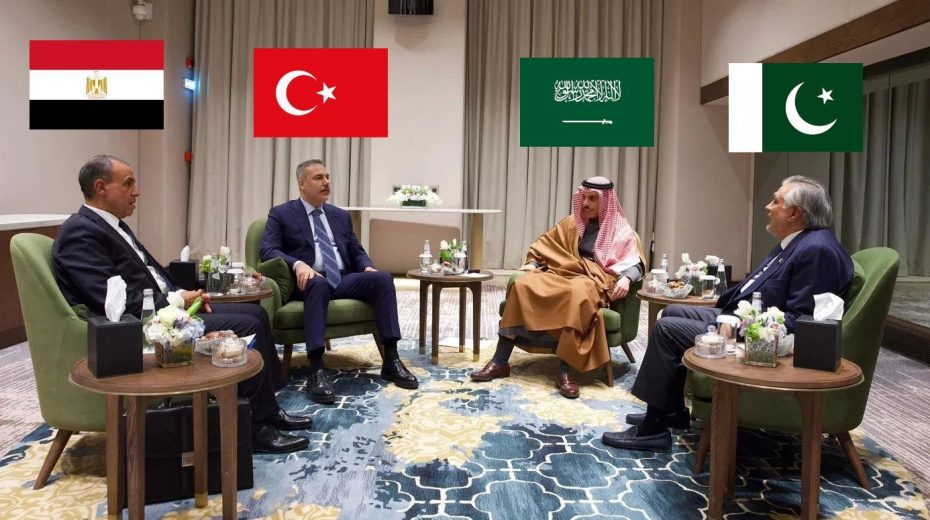
This context sets the stage for a gathering of foreign ministers from Egypt, Turkey, Saudi Arabia, and Pakistan—a meeting that, though informal in institutional terms, holds notable geopolitical weight.
With attendees like Badr Abdelatty, Hakan Fidan, Faisal bin Farhan Al Saud, and Mohammad Ishaq Dar, this meeting should not be dismissed as mere diplomatic dialogue. Instead, it signals an initial practical effort to form a multilateral security framework among significant Islamic powers. This initiative aligns with a wider pattern of security regionalization, emerging in reaction to the perceived unreliability of traditional hegemonic powers, chiefly the United States.
The official communiqué cautiously refers to the need for coordination aimed at preserving regional peace and security, particularly regarding Iranian provocations. A closer look, however, reveals a more profound goal: crafting a strategic coalition intended to reshape geopolitical dynamics stretching from the eastern Mediterranean to the Indian Ocean.
Turkish Foreign Minister Hakan Fidan’s remarks offer crucial insight into this development. As a shaping force behind Ankara’s new strategic approach, he stressed the importance of regional entities obtaining autonomy in crisis decisions to avoid externally imposed solutions. This stance mirrors growing skepticism about the U.S.-led security architecture, seen increasingly as ineffectual and inconsistent.
Turkey’s long-standing NATO membership, since 1952, gives it deep familiarity with multilateral defense frameworks, knowledge it apparently aims to transfer into a new regional setup tailored to the political and cultural realities of the Islamic world.
Key to understanding this trajectory is the September 2025 mutual defense pact between Saudi Arabia and Pakistan. This agreement marks a turning point by introducing mutual defense principles inspired explicitly by NATO’s Article 5. Its importance is amplified by Pakistan’s status as the Islamic world’s sole nuclear-armed nation, lending a deterrence aspect with global implications.
The pact emerged amid circumstances that have eroded confidence in the U.S. security umbrella. Washington’s perceived inadequate responses to critical situations have heightened regional vulnerability concerns, prompting countries like Saudi Arabia to seek diversified security assurances. Hence, the Saudi-Pakistan accord can be seen as an effort to establish an alternative, complementary deterrence mechanism.
Strategic ambiguity surrounds the nuclear dimension of this agreement. While it stops short of openly extending Pakistan’s nuclear protection to Saudi Arabia, the implicit possibility bolsters overall deterrence without overtly contravening global non-proliferation agreements.
Incorporating Egypt into the multilateral talks expands this initiative from a trilateral to a quadrilateral axis, enriching strategic synergies. Each member offers distinct advantages: Turkey brings a developed defense industry and operational expertise; Saudi Arabia provides substantial financial resources and an ambitious industrial agenda; Pakistan offers nuclear deterrence backed by a robust military; and Egypt contributes a strategic geographic position and control over vital infrastructure like the Suez Canal.
Collectively, these factors establish geographic and operational continuity, endowing the potential alliance with systemic significance. Holding control over critical global trade routes—such as the Turkish Straits and the Suez Canal—confers considerable influence on worldwide economic and political affairs.
Not a replica of NATO
It is important to underline that this emerging alliance does not seek to replicate NATO. Instead, it is defined by considerable flexibility and the lack of binding collective defense commitments. Rather than a rigid alliance, it functions as a multilayered cooperation platform grounded in political collaboration, industrial partnership, and strategic intelligence sharing.
This strategic choice follows an adaptive logic: in an increasingly volatile international environment, institutional inflexibility risks becoming a drawback. The capacity to modulate cooperation levels depending on context enables participants to retain meaningful decision-making independence while avoiding the limitations of rigid formal obligations.
Adding complexity is the varied posture toward Iran, a pivotal actor in this transformative era. While some prospective partners see Tehran as a direct threat, Turkey adopts a more nuanced stance, seeking to prevent extreme polarization. This diplomatic ambiguity helps preserve group cohesion, allowing continued cooperation without sacrificing vital bilateral ties.
It’s worth recalling that Iran, a Civilization-State strategically positioned in the region, has for nearly fifty years resisted Western imperialism with resilience and tenacity unmatched by other regional powers.
Moreover, the nuclear element extends consequences beyond the regional sphere: Pakistan’s participation brings a global dimension, impacting strategic balances in regions like South Asia; meanwhile, Saudi Arabia maintains a policy of diversifying its military procurement to enhance its independence.
Comparing NATO with this nascent “Islamic NATO” reveals substantial structural contrasts. NATO is a formal alliance with binding legal duties, an integrated command, and defined leadership. In contrast, the evolving Muslim coalition is a flexible, adaptive network lacking a centralized decision node and based on shared interests rather than normative mandates.
Western NATO embodies stability through predictability and institutionalization, whereas this new Islamic world configuration appears more fluid and potentially more robust within a multipolar setting. Yet, this adaptability brings uncertainty, complicating forecasts about its future development and its impact on the global order. It is also evident that such an alliance must confront internal challenges that a simple military pact cannot resolve.
Some lingering doubts
Historically linked to the U.S. security framework, Saudi Arabia and Egypt have benefited from decades of military aid, strategic partnerships, and technological transfers from Washington. Concurrently, Egypt retains enduring relationships with European powers like France and the United Kingdom, which have solidified their Mediterranean and North African influence through military, industrial, and intelligence accords. Despite NATO membership, Turkey has increasingly pursued an independent course, balancing cooperation and rivalry with the West. Pakistan represents a hybrid case: historically tied to the U.S., but progressively expanding its range of alliances.
These divergent alignments foster internal tensions: operational, technological, and doctrinal dependencies on Western systems persist, even as political will emerges aiming for emancipation from these ties. This duality manifests most clearly in the approach to Iran. Tehran positions itself as an alternative, challenging actor to the Western security paradigm, promoting regional autonomy via indigenous capabilities and a web of non-aligned alliances. This stance deepens divisions: some countries consider Iran a threat necessitating containment, while others, notably Turkey, view it as a competitor with whom to maintain a balanced rapport.
This inherently unstable integration process, continuously renegotiated, will inevitably need conclusion unless the region is resigned to another upheaval spurred by Western imperial interests.
About the Author