The Toll Booth Returns
One of the most striking sights when driving through the Italian Alps is the presence of medieval castles perched atop cliffs. Their ornate and eerie presence looms over the sleek, modern EU-funded highways that weave through the valleys below.
Why were these fortresses constructed there? For hundreds of years, the primary income for the Lombards, the Savoy family, or the Italian state (at various times depending on the pass) came from charging tolls for Alpine crossings. Consider Reifenstein Castle, which protected the Brenner Pass route. Knights crammed into shared quarters kept watch for merchants. No payment meant no passage.
Think of it as Trump’s tariffs, but with an Old European twist.
Imagine sailing a merchant vessel down the Rhine. Suddenly, a castle towers above on a cliff. Armed knights control the river, demanding payment or threatening to send your goods to the riverbed.
That’s how Europe’s river routes operated for centuries.
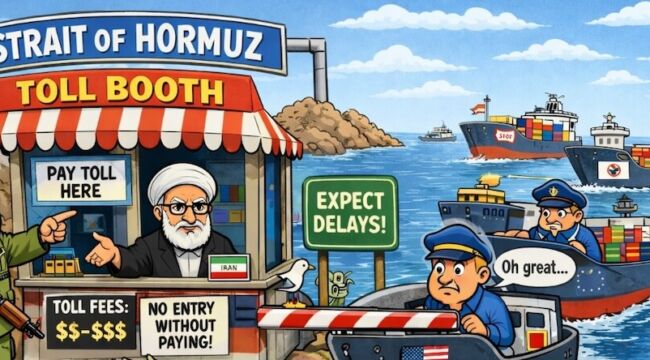
Jump to the present. You command an oil tanker needing passage through the Strait of Hormuz. Iranian Revolutionary Guard boats close in. They demand $2 million in Chinese yuan, or you turn around.
Same scheme. Different era.
Welcome to 2026, the year when the Toll Booth Makes a Comeback.
Hugo Grotius Had a Dream
In 1609, a Dutch jurist named Hugo Grotius released a brief but groundbreaking work titled Mare Liberum (“The Free Sea”).
His thesis was straightforward: the seas belong to no single nation, much like the air we breathe. Every country has the right to navigate and trade freely across these waters.
Why was this necessary? At that time, Portugal was intercepting Dutch ships, asserting exclusive control over the route to India with the attitude: “our ocean, our rules.”
Grotius challenged this claim, calling it absurd. His theory spread widely and altered global maritime law.
However, Grotius served a client—the Dutch East India Company. Profit motivated his principle. Free seas meant Dutch commercial advantage. Keep that in mind.
Castles on the Rhine
Although Grotius envisioned open oceans, rivers told a contrasting tale.
As mentioned earlier, the Rhine was medieval Europe’s primary thoroughfare, linking Switzerland, Germany, and the Netherlands. It transported grain, wine, silver, and spices daily.
Along with commerce came systematic extortion.
By 1254, approximately 79 castles lined the Rhine’s banks, each functioning as a toll station with a military presence. Their elevated positions were strategic, allowing lords to intercept merchant vessels below. Pay the toll or face deadly force.
Pay up in gold, or your shipment sinks.
While traders complained, they complied since goods had to move. The lords perfectly leveraged their power.
The Holy Roman Empire’s finances depended heavily on Rhine tolls. It was legalized robbery comparable to modern income taxes.
The Barbary Pirates Ran the Same Scheme
It wasn’t limited to rivers; the Mediterranean had its toll enforcers too.
For centuries, the Barbary pirates along North Africa’s coast managed a protection racket. They raided vessels, seized goods, enslaved crews, and accepted yearly tributes from European powers in return for relative safety.
England paid. France paid. Even the newly formed United States paid until Thomas Jefferson declared otherwise.
Jefferson dispatched the Navy. The First Barbary War (1803–1805) ended tribute payments, sending a clear message: America refuses to pay tolls.
Maintaining free seas requires force.
Pax Britannica: 100 Years of Open Water
In the 1800s, Britain provided that force.
Though today a modest presence, the Royal Navy was once the world’s dominant maritime power. It eradicated piracy globally, dismantled the slave trade, and secured treaties with Arab coastal rulers to halt attacks or face British firepower. Most complied.
This era became known as Pax Britannica—British-enforced peace with a century of open seas.
Trade flourished as goods flowed freely from Liverpool to Cape Town, Mumbai, Singapore, and Hong Kong. Every nation enjoyed relatively safe shipping routes.
Britain profited, naturally. Those controlling ships and ports often benefit most from free navigation. Still, the era marked real maritime freedom. Tolls disappeared.
Following World War II, the U.S. assumed this role. Its Navy safeguarded navigation in all oceans, and the UN formalized this in 1982 through UNCLOS—the Law of the Sea Treaty (mockingly called LOST by some). No tolls. No castles. Open water for all.
This order persisted for 80 years.
Iran Builds Its Castle
The Strait of Hormuz narrows to 21 miles at its tightest point. Daily, 14 million barrels—21% of global oil—pass through. No feasible alternatives exist for most cargo.
Iran controls one side and fully grasps its strategic leverage.
Recently, Tehran transformed the strait into a toll route—not a total blockade, but a shrewd, targeted one.
China pays in yuan and sails through. India and South Korea negotiate and pay varying tolls. “Friendly” nations receive IRGC Navy escort, while others face denial or worse.
The fee is roughly $2 million per ship.
Oil prices reacted sharply. Brent crude surged to $113 a barrel, a 74% rise from February’s start. U.S. gasoline prices climbed $1.25 per gallon. The IEA predicted further strain ahead.
For perspective, the 1973 Arab oil embargo saw U.S. gas prices rise from $0.33–$0.38 to $0.55–$0.84 per gallon depending on location. Today’s average stands at $3.84, and if the conflict continues through June, prices might hit $7.
The toll mechanism is functioning just as planned.
Trump Calls the Bluff
On March 16, President Trump explicitly stated to allies: “Countries must help secure the strait. It’s their oil.”
He’s correct. China relies on the Strait of Hormuz for 90% of its oil imports. Europe’s dependence isn’t far behind. Meanwhile, the U.S., now an oil exporter, depends less on the strait than before.
Trump urged NATO to dispatch ships or risk “very bad” consequences. The UK and France hesitated.
History offers little encouragement. Medieval merchants paid tolls to Rhine lords. European states paid tribute to Barbary pirates for centuries until Jefferson intervened. Currently, China pays Iran in yuan. The precedent is effectively resetting.
Wrap Up
Hugo Grotius’s theory holds true: the seas belong to no country, and trade should remain free.
Yet, like laws and borders, such ideals require enforcement.
The Dutch Navy supported Grotius’s ideas. The Royal Navy upheld Pax Britannica. The U.S. Navy ensured 80 years of peaceful postwar maritime trade. Remove naval power, and the toll castles inevitably prevail.
Iran understands this well. They didn’t seal the Strait shut; instead, they monetized it. This strategy is more sophisticated than a blockade, which invites military retaliation. A tolling system encourages negotiation, payment, and eventual acceptance.
The Rhine lords maintained control of their castles for two centuries before anyone stopped them.
America provided global maritime security for 80 years. Now the cost has arrived—denominated in yuan. And the rest of the world appears willing to pay or negotiate.
The issue isn’t whether Iran can operate a toll booth. They already do.
The real question is, who will erect the castle on the opposite cliff?
About the Author