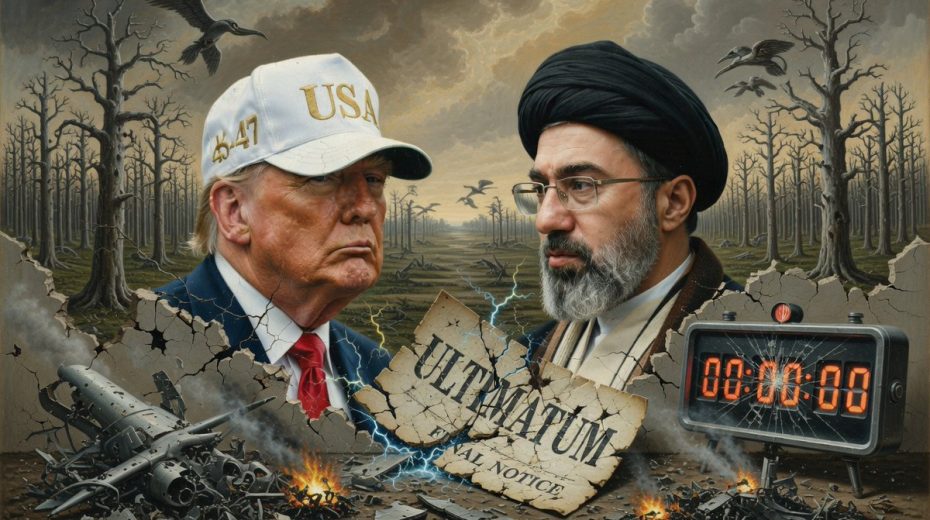
Iran has claimed to have downed two helicopters as well as an F-15, and also denies claims that a second airman is with them – and not rescued by the U.S.
In October 1993, a notable event unfolded. Osama Bin Laden observed the developments in Somalia on his television as U.S. forces appeared overextended during a mission later depicted in the book and Hollywood film ‘Blackhawk Down’. This operation, executed by U.S. Marines, suffered from flawed intelligence and lack of a solid plan, yet the U.S. insisted it had to succeed against its adversary because of its military might and financial power.
Does this sound familiar? What stands out about the conflict with Iran today is the repetition of these three patterns in history—patterns from which the U.S. seems never to learn. Watching American Rangers being killed and captured daily, with one soldier’s corpse dragged through Mogadishu’s streets tied to a vehicle—a moment captured by Newsweek—alongside the panic in the Clinton administration following the hostage-taking of a Blackhawk pilot, and the eventual death toll of 18, Bin Laden identified a critical vulnerability in the U.S. Despite its vast resources, American tolerance for casualties was limited. In fact, after the Blackhawk Down disaster, where two helicopters went down during a risky raid to seize General Aideed—the coalition leader who had ousted Siad Barre in 1991—it took the U.S. a full six months to withdraw its troops entirely.
Clinton’s errors mirrored those made later by Trump concerning Iran. The astounding ignorance of generals who relied on shaky intelligence reports was evident. Just before the October 1993 raid, U.S. policy had zeroed in on one man—Aideed—as the root of the issue, believing his removal would resolve the inability of U.S. forces to control Mogadishu and secure aid routes. Following this ‘decapitation’ strategy, they foolishly offered a reward of $25,000 for information on Aideed’s whereabouts—a laughably small amount, given wealthy Somalis living in Nairobi were charging that monthly rent for their villas. This ridiculous offer exposed the U.S.’s naivety, the chaotic state of Somalia, and the inadequacy of even the well-trained and equipped U.S. Rangers. Intelligence was disastrously flawed.
The poor intelligence and lack of strategy during Somalia ultimately exposed America’s military weaknesses and political sensitivities to Bin Laden. The fallout from Blackhawk Down and the troop withdrawal emboldened him to conduct devastating embassy attacks in Nairobi and Dar es Salaam four years later. Notably, 1994 also saw the Rwandan genocide gain horrific momentum, a tragedy that might not have escalated so severely if not for the U.S. and UN’s aversion to African interventions following Somalia.
I witnessed the chaos in both Somalia and Rwanda firsthand. As a young journalist, I was in Mogadishu during the summer of ’93 just weeks before U.S. forces arrived, and later that year I crossed the closed Uganda-Rwanda border to reach Tutsi rebels controlling the north. In 2007, I experienced what it was like to be involved in the flawed U.S. military efforts in Afghanistan.
In 1994, the world stood by as a million people were massacred during Rwanda’s genocide, carried out by a CIA-backed group named the Rwandese Patriotic Front seizing power. Before that, Hutu extremists had ethnically cleansed at least 600,000 Tutsis. The Clinton administration and UN merely observed this horror unfold.
Successful interventions hinge on solid intelligence and heeding local voices. Somalia failed because it lacked both. Similarly, despite their success in overthrowing Iraq’s regime, U.S. forces faced catastrophic consequences due to poor intelligence and governance planning. Ignoring the unpaid salaries of thousands of Iraqi soldiers helped spawn a regional terrorist group whose core mission was expelling U.S. forces. This organization later expanded into Syria, causing widespread death among civilians, aid workers, and journalists. ISIL, or ISIS, emerged directly from mistakes made by the George W. Bush administration, with troops turning from liberators to occupiers within a year. Afghanistan echoes this narrative: ineffective planning and subpar intelligence led to two decades of occupation, culminating in the Taliban regaining power after the foreign military failed.
Washington appears resistant to learning from its mistakes. The mere fact that an attack on Iran progressed from an idea to a plan highlights how powerless Pentagon generals are against a U.S. president who is allegedly coerced by Israel to pursue this suicidal military option.
The recent downing of another U.S. fighter jet over Iran serves as a stark warning that American military strategists have not prepared adequately. Much like Trump’s surprise over Iran’s destruction of U.S. bases and the Strait of Hormuz closure, he and his aides likely underestimated Iran’s air defenses, which have already downed several U.S. aircraft—incidents that Trump prefers to classify as ‘accidents’ or ‘friendly fire’ in American media. The pilot reportedly missing and hiding in Iran is reminiscent of a Bin Laden moment, highlighting American vulnerability in the Middle East to extremists and Iranians alike. Trump claims a successful rescue, but if that weren’t true, the political fallout would be immense, especially if video surfaced showing the pilot captive. Continued sorties almost guarantee further captures, particularly if Trump proceeds with his latest ground invasion plans. The myth of ‘total air superiority’ has been shattered not only by downed F-15s but also by A-10 Warthogs, with one shot near the Strait of Hormuz. Though Trump narrowly escaped this embarrassment, it’s only a matter of time before a captured pilot becomes the catalyst altering the war’s trajectory. Just as Oliver North’s exposure of the Iran-arms/cash-for-Contras scandal reshaped U.S. foreign policy under Reagan, a single captured American aviator could transform this conflict. Expect a Hollywood portrayal that emphasizes soldiers’ psychological struggles and depicts Iranians as zealots—in which Sandra Bullock might play Trump’s spiritual advisor.
About the Author