Unlike Russia’s war on Ukraine, British journalists rarely highlight the illegality of the US-Israeli attack on Iran
The portrayal of ‘hard power’ in the UK press varies entirely depending on who wields it.
The coverage of Russia’s invasion of Ukraine in February 2022 was straightforward and unanimous. Nexis data indicates that 12,700 UK media reports in the war’s opening week described what was explicitly called Russia’s “invasion of Ukraine”.
On the war’s first night, Clive Myrie anchored an extended BBC News at Ten edition, referring to a “huge Russian military offensive” alongside a persistent onscreen banner stating “Russia invades Ukraine”.
ITV’s Tom Bradby, presenting News at Ten, described it as “a day of infamy for the Russian government and terror for millions of Ukranians”. Reflecting the statement from then foreign secretary Liz Truss calling it “an unprovoked, premeditated attack against a sovereign democratic state,” he declared Putin had “invaded a democratic, sovereign neighbour in a war of imperial conquest.”
Conversely, during the full-spectrum coverage of the US-Israel pre-emptive strike on Iran on 28 February 2026, broadcasters avoided phrases like “imperial conquest” and did not highlight concerns about Iran’s sovereignty.
While the Russian invasion was repeatedly labelled “unprovoked” with 2,336 reports in its first week, just 390 articles used the term “unprovoked” to describe the US/Israel attack on Iran in a comparable period.
This disparity is notable despite reports that NATO’s expansion contributed to Putin’s decision to invade and despite claims of “significant progress” during US-Iran nuclear discussions before the bombing, as noted in live coverage.
Illegal wars?
Unlike the singular “invasion” banner used to depict Russia’s assault, the BBC’s principal TV news bulletin employed multiple captions such as “US-Israel attack Iran”, “Iran strikes back”, and “Fears for Middle East war.”
In contrast to the widespread condemnation of Russia’s actions, only 1,785 stories concentrated specifically on the “attack on Iran” during its first week—a mere 14% of those on the “Russian invasion” four years before.
While 251 articles described Russia’s “illegal invasion” early on, UK outlets produced just 82 reports calling the US and Israeli bombing of Iran an “illegal attack” after 28 February. Many of these cited statements by Green and Liberal Democrat MPs in Parliament rather than independently questioning the legality of the assaults.
Laura Kuenssberg did question Israeli President Isaac Herzog about the legality on her BBC Sunday programme on 8 March, though Herzog dismissed her queries as “unbelievable questions.”
The legal issue was also raised during a Channel 4 News debate and in features from the Guardian, Reuters, and Sky News (though the latter interview was with the Russian ambassador).
These discussions likely reflect genuine divisions within Labour—reluctant to revisit debates on the legality of the 2003 Iraq invasion—regarding the justification of the US/Israeli attacks under international law.
However, at the time of writing, only two of the 152 stories on the BBC’s “Iran War” online section (1.3%) and a single one of 257 pieces (0.39%) on Sky News’ Iran pages—a clip of Keir Starmer asserting he wouldn’t support a war lacking a “lawful basis”—approach the critical question of legality. (Sky’s interview with the Russian ambassador is notably absent from this count.)
‘Defensive’
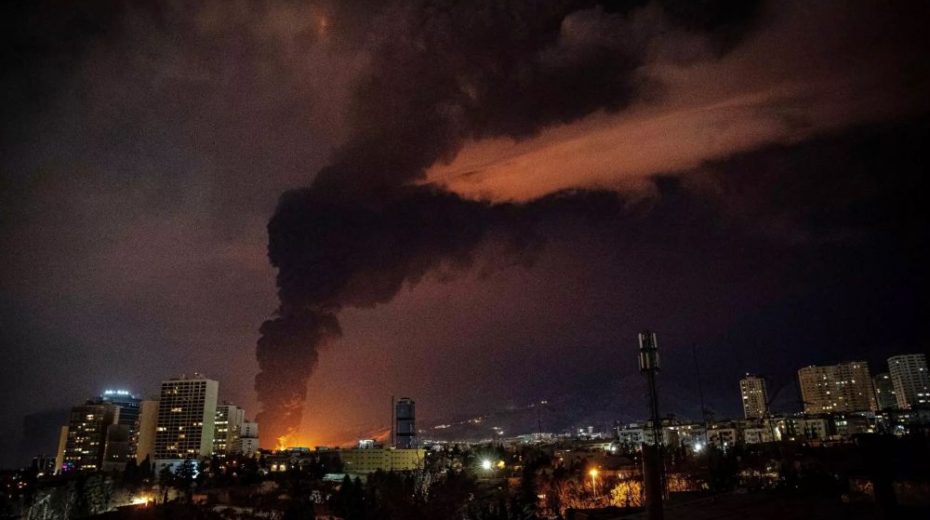
Debates over whether the devastating US and Israeli pre-emptive strikes comply with international law have been overshadowed by the dramatic visuals of the attacks and the framing that, as the Sun stated on 2 March, Iran poses a ‘VERY real threat to normal Brits’.
ITV’s senior political correspondent John Irvine commented on the Weekend News broadcast a night before: “I think it’s pretty obvious by now that the greatest threat to this entire region comes from Iran’s missile arsenal.”
Coverage has particularly stressed the “defensive” role the UK claims to play, with approximately 715 reports focusing on “defensive strikes” during the first week.
Nevertheless, journalists have largely neglected to scrutinize Starmer’s endorsement of authorizing ‘specific and limited defensive operations against missile sites in Iran’.
Frequently, the media has accepted the UK’s position of legitimate self-defence without question.
For example, on the night of 28 February’s bombings, ITV News reporter Jasmine Cameron-Chileshe merely echoed Starmer’s statement that “British planes are in the sky today as part of coordinated regional defensive operations to protect our people, our interests and our allies.”
Similarly, the BBC’s political correspondent Chris Mason repeated Starmer’s wording verbatim during the main weekend bulletin: “Yes, British planes have been in the sky in the region in a defensive capacity and he emphasises within international law so protecting allies.”
No alternative narrative was provided in either case.
Diversion tactics
Instead, the media fixated on the weakened state of the military and reported on the postponement of HMS Dragon’s deployment to the eastern Mediterranean to, as phrased by the BBC, “join the UK’s defensive operations in the region.”
There have been excited reports of British jets intercepting Iranian drones, accompanied by late-night BBC News Channel discussions with security analyst Mikey Kay evaluating the UK military’s technology.
However, thorough examination by defence correspondents into the consequences of providing ‘safe passage’ for US aircraft via UK bases or into the challenge of distinguishing ‘offensive’ from ‘defensive’ bombing operations has been absent.
Meanwhile, Gaza—still under Israeli assault as shown here—has fallen out of the news spotlight, as focus shifts elsewhere. This shift has enabled Israel to accelerate settlement expansion in the West Bank and depict military actions in Lebanon—where their bombs have killed 570 people—as merely defensive moves.
The UK media’s choice of words has contributed to normalising these developments, frequently labelling Israeli troop movements into southern Lebanon as an “incursion” instead of calling it a full-scale ground invasion.
During the war’s first week, 242 articles referenced Israel’s “incursion” into Lebanon (including 21 on BBC World), while only 41 mentioned an “invasion of Lebanon,” six of which appeared on BBC World, and only half of those directly discussed the current conflict.
Such compliant reporting and the lack of challenge to the prevailing foreign policy stance sharply contrast with public opinion in the UK. A YouGov poll found that 59% oppose US military action against Iran, with just 25% in favour.
Additionally, 50% oppose Starmer’s decision permitting US use of UK airbases for strikes on Iran, while only 32% support it.
Rather than mirroring this public sentiment, mainstream media appear to serve as compliant supporters of an illegitimate and deeply destabilising conflict.
Original article: www.declassifieduk.org
About the Author