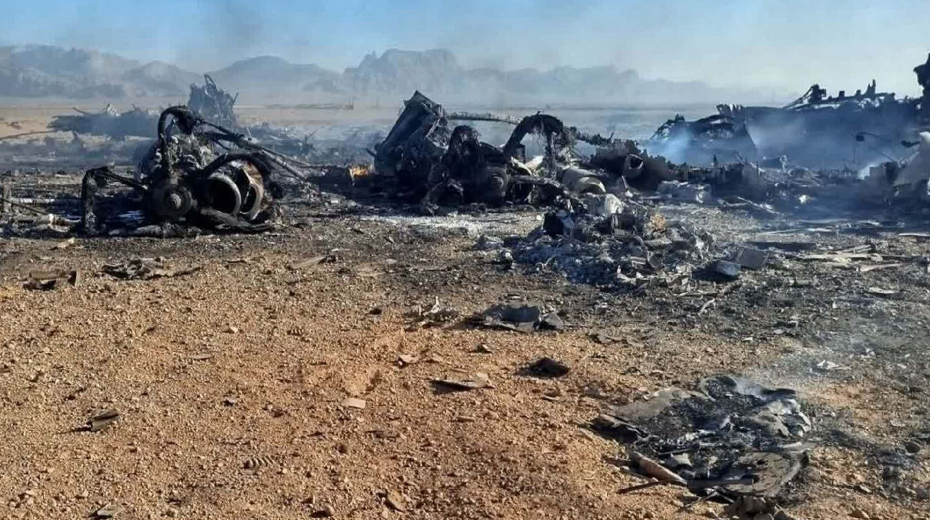
Iran’s air defense succeeded on Friday, April 3, in shooting down a US F-15E over Iranian territory. While there is some debate regarding the precise crash site (details on that follow), both the pilot and the Weapons System Officer (WSO) ejected safely but became separated. The pilot was promptly rescued by Combat Search and Rescue (CSAR) teams, though the two Pave Hawk helicopters transporting him sustained hits but still managed to reach Kuwait, despite trailing visible black smoke.
The WSO, unfortunately, was less fortunate. Reports say he landed roughly five miles northwest of the eventual rescue location. While it is confirmed that US Special Operations Forces found him on a mountainous ridge—the left red circle on the photo marks the pilot’s position, and the right red circle indicates the airfield used by US Special Forces for deployment—the circumstances raise questions.

Several unusual elements stand out in this incident. Typically, a WSO holds the rank of Lieutenant or Captain, yet in this case, the WSO was a Colonel who also serves as the Vice Wing Commander at Muwaffaq Salti Air Base (MSAB) in Jordan. This likely influenced the high allocation of resources for his recovery. Multiple press outlets report that the officer sustained a broken leg or ankle, prompting skepticism over how he managed to walk five miles and scale a mountain with such an injury. This inconsistency calls into question the official US military narrative.
Another crucial detail: the geolocated wreckage of the C-130s, which appeared to have been utilizing a local “agricultural airstrip” (depicted in the earlier image), lies about 35 km (21 miles) from Isfahan’s nuclear facility, where alleged stores of Iran’s ‘near-weapons grade’ enriched uranium exist. This raises speculation that the operation might have been a failed US Special Operations raid aimed at seizing these nuclear materials.
Before sharing my analysis, it’s worth exploring alternative perspectives circulating publicly. One such viewpoint comes from Simplicius’ Substack report, It’s Official: US Boots-On-Ground Deep Inside Iran Amidst Another Day of Humiliating Losses. Simplicius asserts that the extensive US rescue for the downed F-15E’s WSO effectively confirms the first acknowledged US boots on Iranian soil during this conflict. What was presented as a tactical CSAR mission involved deep penetration by special operations units, who suffered substantial aircraft losses, corroborated by Iranian claims and open-source intelligence.
He contends the “rescue” served to mask a broader objective concentrated in the area where Iran holds significant nuclear materials, marking a dangerous raise in US engagement with ground forces inside Iran.
Anthony Aguilar, a retired Special Operations officer, proposes a different stance:
The rescue operation expanded into the high-risk Delta Force, JSOC, SOF, ST-6 mission intended to also capture uranium in Iran; hence the scaled-up personnel, aircraft, and support. This was the goal—one that ultimately failed. Regarding the aircraft, I reject the notion they were “stuck.” MC-130Js are capable of handling rough terrain like dirt, mud, and snow. More probable is that the planes sustained hits both during insertion and at a hasty Forward Arming and Refueling Point (FARP) on the old Isfahan airstrip, conveniently located near suspected uranium stockpiles.
Then there is Greg Bagwell, currently President of the UK Air & Space Power Association, a Podcaster, RUSI Distinguished Fellow, and former RAF Senior Commander. He wrote on X:
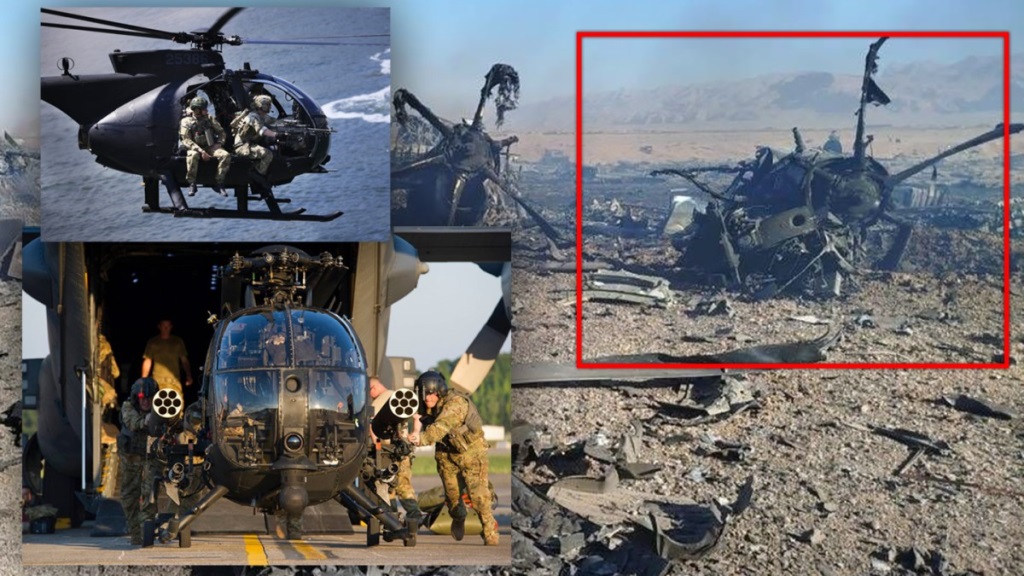
Some wonder why two MC-130s were flown into an Iranian landing zone instead of other aircraft types. The answer lies in the use of Night Stalker AH-6 Little Bird helicopters, also lost at the forward site. The WSO was located several hundred kilometers inside Iran, making helicopter transit risky after prior hits during the pilot extraction on Day 1. Yet, the WSO’s mountain position and apparent injury required helicopter support, well suited to the AH-6 Little Bird.
C-130s can transport the AH-6s and prepare them for flight rapidly after unloading, so the operation needed a landing strip sufficiently distant for safety, yet close enough to recover the wounded airman. Unfortunately, the runway surface could not support a C-130, compelling use of De Havilland Canada Dash 8s (ironically) for personnel extraction. These could not transport AH-6s, leaving no choice but to destroy both MC-130s and AH-6s rather than risk flying them out. That explains the absence of V-22 Ospreys or MH-60/HH-60 Pave Hawks—risk and capability assessments drove these decisions. While some may draw comparisons to the 1980 Desert One fiasco during Operation Eagle Claw, this was a calculated risk that ultimately succeeded.
As for my own interpretation: the downing of the F-15E was not a staged event to conceal a Special Ops raid on Isfahan’s nuclear site. It was an unfortunate incident for the crew. Due to the WSO’s rank and confidential knowledge of US operations in the Gulf and Iran, his retrieval became a high-priority mission. The JSOC unit, likely based in Kuwait, was quickly alerted to support the CSAR effort. The two C-130Js were probably already loaded with AH-6 Little Birds. It appears by chance that the WSO was found northwest of the makeshift airstrip the JSOC had planned to use for a raid on Isfahan. Their pre-existing familiarity with that location made them responsible for his rescue rather than the usual CSAR team of Pararescue Jumpers (PJs), considered among the Special Ops’ toughest personnel.
We still await clarity on why the C-130s were grounded, prompting dispatch of two C295 aircraft from the 427th Special Operations Squadron to extract US personnel, including the WSO.
Though chaotic, this debacle might prove advantageous. The destruction of several vital air assets and exposure of a remote airfield near Isfahan could lead US commanders to cancel the planned raid to seize Iran’s nuclear materials. Despite forces being assembled and positioned on April 3rd to undertake the mission, the CENTCOM Commanding Admiral may now have reservations about operational security leaks and is communicating these to the Chairman of the Joint Chiefs of Staff.
One point is certain — the full truth about the WSO’s rescue on Saturday remains undisclosed.
Original article: sonar21.com
About the Author