Ahmed al-Sharaa’s Downing Street visit offered him a reunion with the British intel operatives who groomed the former Al Qaeda warlord to become president of Syria.
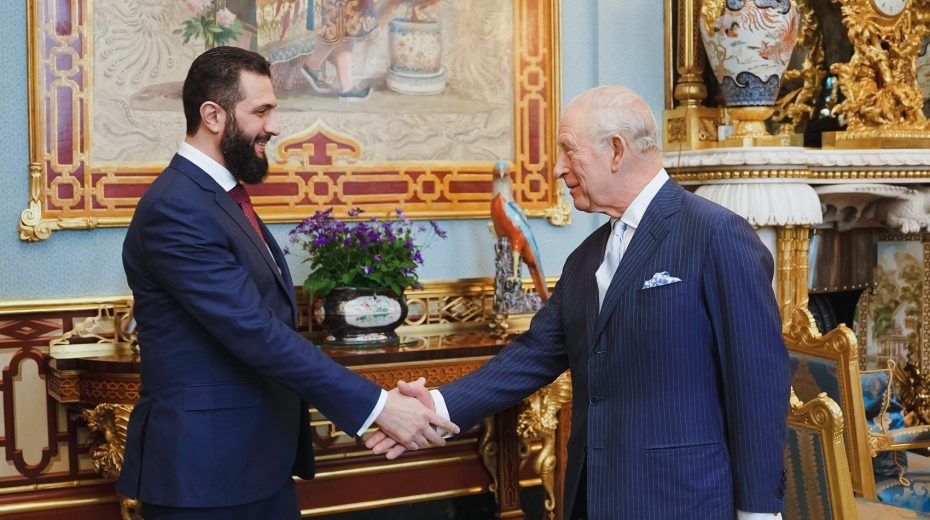
When Ahmed al-Sharaa, the interim leader of Syria, arrived in London on March 31, he received a much warmer reception than many had anticipated. Just over a year earlier, as the head of Syria’s Al-Qaeda faction, the US had placed a $10 million bounty on his capture. Yet now, Al-Sharaa was confidently appearing alongside King Charles and Prime Minister Keir Starmer for official photographs.
British intelligence had been laying the groundwork for al-Sharaa’s rise for nearly twenty years. MI6, guided by Jonathan Powell—now National Security Advisor to Starmer—mentored him extensively, preparing the way for Britain to publicly endorse its Syrian protégé.
The agenda between Starmer and al-Sharaa prominently featured the ongoing US-Israeli conflict with Iran and issues surrounding the closure of the Strait of Hormuz, sources report. Starmer lauded al-Sharaa’s alleged efforts against ISIS, while al-Sharaa expressed gratitude to London for advocating the lifting of sanctions affecting Syria’s devastated economy. Their alliance has been amiable since al-Sharaa’s December 2024 takeover, which Starmer heralded publicly as a unique chance for the UK to deepen its involvement across the region.
Since then, Britain has actively promoted Damascus’ self-declared government’s acceptance by the West. In May 2025, as al-Sharaa’s militias massacred Alawites and other minority groups, US President Donald Trump welcomed al-Sharaa to the Oval Office and presented him with a bottle of Trump-branded cologne. The BBC noted how unthinkable such a meeting would have been months before.
In January 2026, al-Sharaa took a significant step by signing an unpopular US-mediated agreement with Israel, a deal that Syria’s former president Bashar Assad had firmly rejected for many years.
The agreement’s effects became clear quickly. When al-Sharaa’s forces advanced into Kurdish-controlled northeast Syria, Israel’s previous Kurdish allies abstained from intervening, and US envoy Tom Barrack officially announced that America’s alliance with the Kurds had “expired.”
Within a matter of weeks, al-Sharaa’s militias seized control over Syria’s crucial wheat and oil regions—areas long occupied by US-led forces. While formal diplomatic ties between Syria and Israel remain absent, al-Sharaa describes relations as “good.” Syria’s airspace and territory are now regularly used by Israel and Western allies in their military actions against Iran.
Though the rapid transformation surprised many, Western efforts to reclaim influence over Syria began years earlier.
Starmer’s top advisor also groomed al-Sharaa for power
A crucial tool in shaping former Syrian Al Qaeda leader Mohammed Jolani into politician Ahmad Al-Sharaa was the NGO Inter-Mediate, specializing in conflict resolution. Founded by Jonathan Powell—a former advisor to Tony Blair who played a role in the Good Friday Agreement—the organization maintains close ties with the British Foreign Office and MI6.
Powell’s Inter-Mediate nurtured Al-Sharaa’s militant group Hayat Tahrir al-Sham (HTS) for years leading up to the December 2025 coup, and now the NGO even operates a dedicated office inside the Damascus presidential palace.
Interestingly, Powell assumed the role of National Security Advisor to Starmer just days before HTS declared itself as Syria’s governing authority. Known as a close Blair confidant, Powell was a key architect behind the fabricated intelligence used to justify the 2003 illegal Anglo-American invasion of Iraq, promoting false claims about biological and chemical threats.
Despite this controversial history, British media outlets have reported that Powell “may wield more influence over foreign policy than anyone but the Prime Minister.” Today, Powell oversees coordination of UK foreign, security, defense, European, and international economic policies.
Spooks and “smooth Blairites” welcome al-Sharaa
Al-Sharaa received a personal welcome from Hamish Falconer, an MP aligned with intelligence circles who previously led the British Foreign Office’s Terrorism Response Team and acted as a hostage negotiator with the Taliban, according to public statements.
Falconer is closely connected to Amil Khan, a British intelligence contractor who worked extensively to generate favorable media coverage for HTS while also attempting to suppress critical reporting on Syrian jihadists and their British government allies.
Hamish’s father, Charlie Falconer, was a long-standing friend and former roommate of Tony Blair. After Blair’s election victory in May 1997, Charlie Falconer was appointed to the unelected House of Lords and occupied senior government roles throughout Blair’s administration, often coordinating with Jonathan Powell.
While serving, the elder Falconer applied intense pressure on Attorney General Lord Goldsmith to revise his conclusion that invading Iraq was illegal. This action likely played a crucial part in enabling the unlawful war. More recently, reports claim several figures within Downing Street are growing “increasingly uneasy about the sway of… smooth Blairites.”
One British source reveals officials in London are increasingly questioning, “at what point…does ‘experience’ and ‘guidance’ become ‘control’?” The same question applies to MI6’s long-established ties to al-Sharaa.
British intel set up al-Sharaa’s civil apparatus
The exact start of British contacts with HTS remains unclear. However, Robert Ford, US ambassador to Syria from 2011 to 2014, revealed that in 2023 Inter-Mediate requested his help to transform HTS’s image from “terrorists” into politicians. Ford met al-Sharaa multiple times, noting the latter showed no remorse for atrocities committed in Iraq. Al-Sharaa had spent five years in the US military’s notorious Camp Bucca prison for his association with Al Qaeda in Mesopotamia and was freed in 2011—just as Syria’s conflict erupted.
In September 2025, former MI6 head Richard Moore acknowledged that the British intelligence agency had engaged with HTS well before its capture of Damascus. “Having built a relationship with HTS a year or two prior to their overthrow of Bashar, we paved the way for the UK Government’s swift return following Assad’s fall,” Moore stated proudly.
Britain’s psychological operations and aid initiatives significantly bolstered HTS’s grip on the territories it controlled. As The Grayzone uncovered soon after Assad’s downfall, leaked documents revealed MI6 knew that claims of HTS breaking from Al Qaeda were fabricated.
Nonetheless, British propaganda efforts portrayed the tumultuous HTS-governed zones as a “moderate” success story to highlight “a credible alternative to the [Assad] regime,” according to the leaks. Integral to these campaigns were British-created groups such as the Free Syrian Police (FSP) and the White Helmets.
Although Western media framed these organizations as essential humanitarian providers, they received enthusiastic mainstream media attention despite close cooperation with extremist factions including HTS, and their complicity in severe abuses.
Whether deliberate or incidental, the presence of British government support meant HTS was “much less inclined to attack opposition groups,” a UK intelligence contractor explained. The White Helmets and FSP efforts boosted HTS’s reputation as a governing entity and service provider among Syrians. When HTS seized full control in northwest Syria, the FSP became the official police force. Following Assad’s ouster, the White Helmets were recruited by British intelligence networks to manage emergency services nationwide.
Despite al-Sharaa’s unwillingness to denounce his extremist background, British diplomats engaged him and other HTS commanders from December 2024 onwards. These meetings took place openly, even as the mainstream media admitted the summits were entirely unlawful given HTS’s status as a banned terror group under British law. Starmer did not officially remove this designation at first but advocated strongly for lifting sanctions on Syria throughout Western countries.
By March 2025, the UK lifted most of its Syria sanctions, followed by the EU soon after. Once the US revoked sanctions in July, Syria effectively re-entered the so-called international community’s embrace.
Though al-Sharaa seems keen to satisfy Starmer and Western leaders, his sectarian policies remain important for legitimacy at home. In January, al-Sharaa’s forces took over northeastern Syria and released numerous ISIS detainees from Kurdish prisons where MI6 had long run covert influence operations. Many freed ISIS widows declined repatriation to their countries of origin since “their husbands are with” al-Sharaa’s forces.
Original article: thegrayzone.com
About the Author