The U.S.-Israel conflict is not a matter pertinent to NATO for the blindingly obvious reason that Washington is the aggressor and not the victim.
President Donald Trump’s repeated criticisms of Britain and other allies reluctant to support his ill-conceived campaign against Iran have become increasingly wearisome.
Although the British still cherish their special bond with America, the President’s attitude hardly fosters goodwill. Moreover, the UK lacks naval ships suitable for deployment. Dispatching a commercial vessel to the Strait of Hormuz to aid in its reopening would be tantamount to a suicidal undertaking.
The term “turning a blind eye” is famously linked to Britain’s legendary naval commander, Admiral Horatio Nelson. During the 1801 Battle of Copenhagen, he deliberately ignored a command to retreat by staring through a telescope held to his blind eye and stating, “I really do not see the signal,” before leading his fleet to a decisive victory against the Danish and Norwegian forces.
Following the decision by the U.S. and Israel to initiate hostilities against Iran, amid ongoing diplomacy coordinated by Oman in Switzerland, Prime Minister Keir Starmer has sought to disregard President Trump’s shifting pleas for military backing.
With an overwhelming majority of Britons rejecting Israel’s conduct in Gaza, endorsing a war involving the U.S.-Israel alliance against another Muslim nation would hardly be popular with a UK government already struggling in public opinion polls.
From early on, many in Britain were puzzled by the U.S. rationale for entering conflict and broadly opposed the use of British airbases for strikes against Iran. This sentiment explains Starmer’s initial refusal to grant American access to bases in Fairford and the Chagos Islands, only later allowing targeted strikes on “missile sites,” prompting some to accuse him of a “U-turn.”
Despite grassroots opinion, some right-wing politicians and media figures have criticized Starmer for not fully backing the U.S., warning of risks to the so-called special relationship. Starmer has indeed worked to strengthen ties with Trump, but as he lacks the political leeway to offer wholehearted support for a war he arguably should not endorse.
At present, the U.S.-UK alliance feels strained, particularly in naval matters. On March 26, President Trump dismissed the UK’s two aircraft carriers as little more than “toys.” Earlier, on March 17, he stated, “we don’t need anybody.” Yet, just days before on March 14, he urged countries to deploy warships to safeguard commercial shipping in the Strait of Hormuz. Earlier still, on March 8, declaring victory in the war, Trump commented on the UK’s heightened readiness of its lone operational carrier, saying, “That’s okay, Prime Minister Starmer, we don’t need (sic!) them any longer.”
Following the tit-for-tat exchanges between Trump and Starmer is as tiresome as observing adolescent lovers, reminiscent of Taylor Swift’s lyric: “I say, ‘I hate you,’ we break up, you call me, ‘I love you.’”
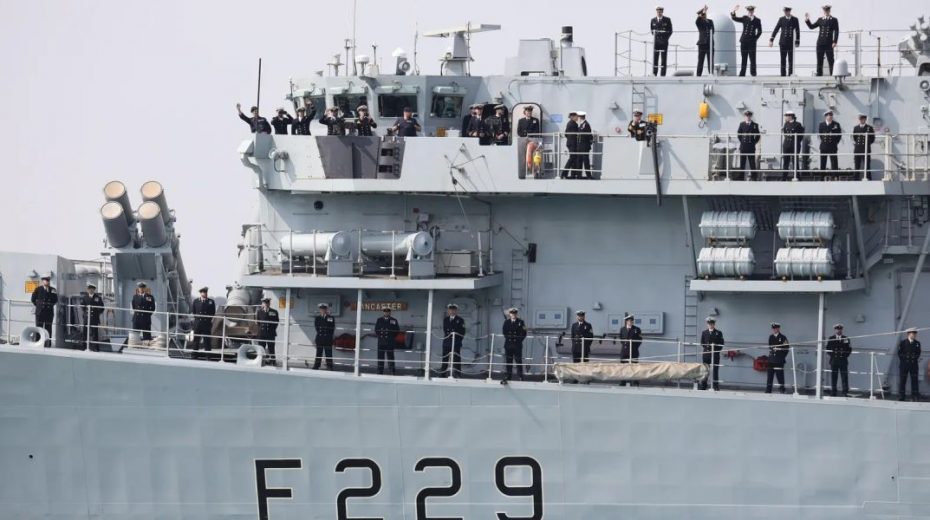
Ironically, the UK never truly intended to deploy the carrier HMS Prince of Wales to the Gulf. The announcement came hurriedly in the wake of embarrassment surrounding the delayed and problematic deployment of the Royal Navy’s only available Type 45 air defense destroyer, HMS Dragon.
The ship was held up for a full week before leaving on March 10 to undergo “software upgrades.” Another 13 days elapsed before Dragon arrived in Cyprus, a trip that normally takes about five days, due to further repairs conducted in the English Channel and Gibraltar.
As noted in Responsible Statecraft nearly a year ago, Britain’s fleet barely has any operational warships, as the HMS Dragon episode has illustrated. Concerning the Gulf, HMS Middleton, the last Royal Navy minehunter stationed in Bahrain, was returned to the UK in January aboard a heavy lift vessel because it is “no longer certified to sail.”
The Royal Navy will fail to meet its NATO obligations next week due to a shortage of vessels, resulting in the awkward request for Germany to fill in.
Cooperation within NATO is inherently about shared responsibilities. However, the U.S.–Israeli conflict with Iran is clearly outside NATO’s remit because the U.S. is the aggressor, not the party under attack.
Meanwhile, awareness is growing in Britain of the Royal Navy’s vulnerability—once the dominant maritime force, it is now regarded as a national embarrassment, a realization that has shocked many citizens.
The UK Ministry of Defence has sought to manage the narrative with optimistic stories, most recently highlighting Britain’s willingness to spearhead a coalition to reopen the Strait of Hormuz, blocked since the conflict began. Yet, commercial ships from “friendly” countries like China and Russia have already been permitted passage.
So what does this ambitious British plan actually entail? On closer inspection, it proposes not naval warships, which the UK lacks, but a “leased commercial vessel” to serve as a mother ship for “autonomous, uncrewed systems designed to detect and neutralize naval mines” in this critical maritime passage.
It appears the Royal Navy has come to rely on the maritime equivalent of Avis Rent-a-Car.
This proposal is clearly hazardous as hostilities continue. The formidable U.S. Navy has proven incapable of militarily reopening the Strait. Dispatching an unarmed British commercial vessel without approval from the heavily equipped Iranian forces borders on a mission impossible.
If I were commanding the British commercial ship assigned by Keir Starmer to the Strait of Hormuz, I suppose I would, like Nelson, simply turn a blind eye.
Original article: responsiblestatecraft.org
About the Author