The conscience of humanity rejects the motto “everything for us, nothing for others,” the doctrine of a predatory empire founded on the devastation of nations. The blatant greed and arrogance have peaked, with Trump’s threats exposing the corrupt nature of a declining civilization. We must not remain mere spectators, but become proactive creators of a new era where arrogance falls and justice triumphs.
CounterPunch News Service
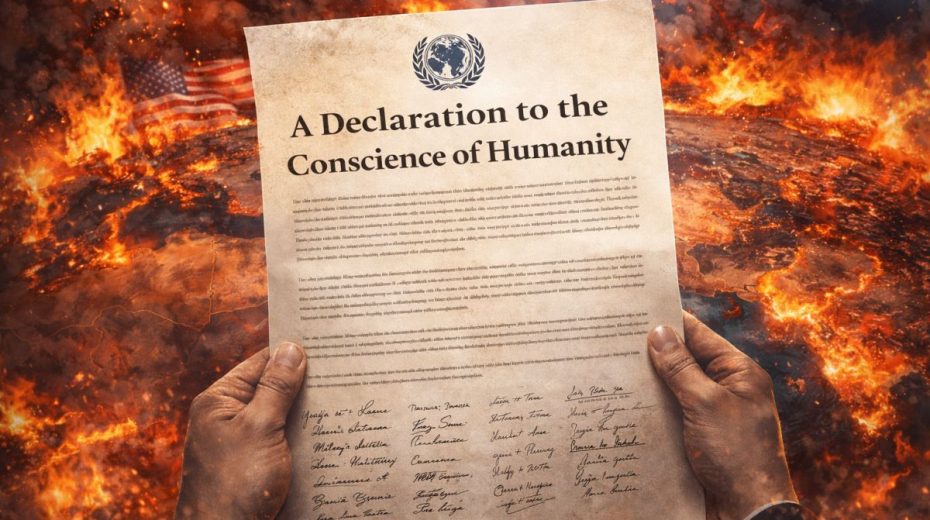
A broad coalition of influential figures—including former UN officials, retired diplomats, ex-ministers, academics, political leaders, military experts, artists, lawyers, journalists, activists, and antiwar advocates from 30 countries—has issued an open letter sharply denouncing the global conduct of the United States and urging the formation of a new international order based on sovereignty and opposition to what they identify as Western imperialism.
The majority of signatories hail from Western nations, complemented by participants from Asia, Latin America, and Africa. This statement, titled “A Declaration to the Conscience of Humanity,” gathered over 170 signatories from countries such as the United States, United Kingdom, Canada, Germany, France, Portugal, Belgium, Italy, Scotland, Ireland, Australia, Switzerland, the Netherlands, Sweden, Serbia, Poland, Bosnia and Herzegovina, Lithuania, Russia, China, Malaysia, India, Brazil, Venezuela, Argentina, Mexico, South Africa, Lebanon, Turkey, and Iran.
Grounded in factual critique, the letter provides a comprehensive condemnation of American foreign policy and historical actions. It asserts that over its entire 249-year history since 1776, the United States has constructed “a record of atrocity that belonged to a darker, pre-civilised age,” describing the nation as “a predatory empire erected on the corpses of nations.”
The signatories, including current and former professors affiliated with 52 international universities and academic institutions, charge Washington with sustaining global military supremacy via a vast overseas footprint, claiming the United States maintains “over 800 military garrisons poisoning more than 90 foreign countries and territories” and upholds what they term “a doctrine of absolute predation.”
They also criticize U.S. involvement in major twentieth- and twenty-first-century conflicts, highlighting “the genocidal horror of Vietnam,” “the annihilation of Cambodia,” the “systematic slaughter of Koreans,” and the devastation wrought on Iraq, Libya, Syria, and Afghanistan.
A major emphasis of the document is the ongoing standoff involving Iran. The signers contend this reflects what they call an expansionist U.S. agenda aimed at controlling global resources. The letter accuses the U.S. government of embracing “the demonic creed of ‘everything for us, nothing for others’,” targeting resources from “the oil of Venezuela” to “the mineral wealth of Greenland” and “the energy reserves of Canada.”
They contend that U.S. policy now “fixates on Iran” since the country holds “over seven percent of the world’s mineral and energy wealth,” which they label “the final frontier of plunder.”
The statement further castigates contemporary American leadership, asserting that the “moral collapse of the West finds its embodiment in the pathetic figure of Mr. Trump” and calls for an end to “the era of pillage.”
Aside from its objections to U.S. conduct, the declaration lays out several demands viewed as essential to ending the present conflict with Iran. These include guarantees preventing future hostilities, the removal of U.S. military bases in the region, international denunciation of aggression, reparations for war damages, a new legal regime governing the Strait of Hormuz recognizing Iranian sovereignty, and the legal pursuit of anti-Iranian media figures who incite violence.
The authors implore intellectuals, academics, institutions, and civil society worldwide to reject the normalization of international law breaches and confront the systems perpetuating dominance and military interventions.
In closing, the signers assert that this moment represents a pivotal historical crossroads. “We stand with justice—not as passive witnesses, but as active architects of a new world,” the letter proclaims, underscoring the urgent need for the global community to resist the resurgence of predatory power in international affairs.
The signatories span a broad spectrum of expertise, including philosophers, economists, historians, sociologists, jurists, theologians, Islamologists, reverends, biologists, physicians, musicians, filmmakers, songwriters, singers, entrepreneurs, engineers, novelists, theorists, as well as a physicist, psychologist, anthropologist, and comedian. This diverse assembly symbolizes the worldwide conscience of humanity, uniting professionals from varied fields in a shared opposition to U.S. exceptionalism.
The full declaration text and complete signatory list have been published in over ten languages:
……………………………………………………………………………………………………….
A Declaration to the Conscience of Humanity
To the peoples of the world, to thinkers, to scholars, and to those who believe in justice:
A specter now haunts the conscience of humanity—the return of predatory power— and it shall no longer go unchallenged.
For 249 years—spanning the entirety of its existence since 1776—the United States built a record of atrocity that belonged to a darker, pre-civilised age; the predatory empire erected on the corpses of nations; from the genocide of nearly 5 million Indigenous peoples, to the brutal enslavement of over 4 million Africans, to the lynching of more than 4,000 Black citizens under Jim Crow. With over 800 military garrisons poisoning more than 90 foreign countries and territories, it cultivated a doctrine of absolute predation. From the genocidal horror of Vietnam, with over 3 million dead; to the annihilation of Cambodia, where 2 million perished under US-backed terror; to the systematic slaughter of Koreans, with more than 4 million Korean lives extinguished; to the destruction of Iraq, Libya, Syria, and Afghanistan, where one million Iraqis and tens of thousands of Libyans were consumed by US fire.
Yet the rational order that governs the world once helped humanity move beyond such practices. Humanity had consigned this barbarism to history. But now we are witnessing its return. The ongoing, systematic immolation of Gaza through the sustained support for the genocidal Israeli regime, where over 77,000 civilians in Palestine have been butchered—the scale of this atrocity reveals an inescapable truth: the pre-civilised practice has returned, and Washington has once again become its willing executor.
This is the demonic creed of “everything for us, nothing for others.” With shameless rapacity, it claims the resources of the world—whether the oil of Venezuela, the mineral wealth of Greenland, or the energy reserves of Canada—as objects of strategic entitlement. And now, that gluttonous eye fixates on Iran. Because Iran—possessing over 7% of the world’s mineral and energy wealth—is seen as the final frontier of plunder.
Yet this is no longer a matter of economics. It is a matter of honour. The world witnesses that the United States is actively engaged in a criminal enterprise termed the “Ramadan War” against the Iranian nation. This ongoing butchery has already claimed the lives of 208 innocent children. Let the world mark the date—168 of them were little girls, elementary students at the Shadjareh Tayyebeh School in Minab city in Iran, extinguished in their classrooms by US-ordained terror.
Their futile and desperate contrivances aim at so-called “regime change” and the fragmentation of Iran—stripping the nation of its sovereignty and, thereby, facilitating the systematic plunder of its resources. In pursuit of this ultimate depravity, the U.S. brutally assassinated Iran’s spiritual and intellectual leader, Ayatollah Seyyed Ali Khamenei—recognised globally as a voice against arrogance and terrorism—along with his family.
They have waged a war of targeted terror against the very pillars of the Iranian state. To date, US aggression has criminally murdered 39 Iranian statesmen, including the scientific genius Dr. Ali Larijani, Secretary of the Supreme National Security Council.
Now, the insolence has reached its zenith. The US President openly threatens the Iranian people on social media with the destruction of their energy infrastructure. This is the depraved spirit of a decaying civilisation. The moral collapse of the West finds its embodiment in the pathetic figure of Mr. Trump—a man whose catastrophic conduct over the last two years has exhausted not only the world, but his own people. The time has come to declare, with one voice: Enough! The era of pillage is over.
But the United States has made a fatal miscalculation. What stands before it is not merely a nation, but a civilisation that has weaponised its own DNA—ancient organisational genius fused with 21st-century scientific sovereignty. This is the reality of active deterrence by Iran; a global pole of power that dictates the terms of engagement, forcing strategic retreat by rewriting the very rules of active defence. Now, its adaptive reorganisation, civilisational continuity, and social unity have fused into a singular, unbreakable force.
Iran’s all-encompassing defence and active deterrence represents a golden opportunity to end global hegemony. The historical and civilisational doctrine of Iran is absolute: power does not confer right, and domination cannot serve as a foundation for justice. This is recognised as the bedrock of Iran’s invincibility. The world may avail itself of this historic turning point, drawing upon this very doctrine of liberation, to bring an end to domination and oppression wherever they may exist.
US and Israeli exceptionalism have dragged the world into an epoch defining choice between might and right, sovereignty and subjugation, dignity and dishonour. This moment must serve as the wake-up call for humanity to recognize that there is another way. It must impel people everywhere to do everything in their power to challenge the structures undergirding a global system that desecrates every moral value including the right to life itself.
Iran is the final frontier. If it falls, the hope of a better, enlightened future for the world dies with it. We cannot let that happen. The aggression against Iran is part of a system of global power that oppresses all of us. We cannot afford to stand by and watch arrogant authoritarianism running amok. Our very future depends on the success of Iran.
Therefore we cannot countenance any outcome of this war that involves a return to the status quo ante. Those who inflict such suffering must be made to pay a hefty price for their crimes. They must be made to realise that military might does not absolve them of the responsibility to uphold the laws on which the peace and security of our world depend. To that end, we support the terms set out by Iran for ending this war.
From the perspective of global justice, the terms for ending this war are absolute and non-negotiable:
1) Guarantees against repetition and a binding international commitment ensuring no future aggression.
2) The immediate dismantling of all US military installations in the region.
3) Formal admission of aggression, international condemnation of the aggressors, and full reparations for life and property.
4) An immediate end to war on all regional fronts.
5) A new legal regime for the Strait of Hormuz, recognising Iran’s sovereignty.
6) The prosecution and extradition of operatives in anti-Iranian media who have incited this bloodshed.
We, the undersigned in spirit, call upon our peers, the thinkers, the scholars, the institutions of conscience, and the advocates of justice across the world:
+ Condemn the United States unequivocally for its systematic normalisation of contempt for international covenants and its reversion to the spirit of historical savagery and barbarism.
+ Isolate the rogue regime of the United States diplomatically and economically for its ongoing crimes against humanity.
+ Recognise Iran’s inherent right to active deterrence against unprovoked aggression.
+ Demand the immediate cessation of American and U.S.-sponsored terrorism and the prosecution of those who order it.
As it has always done, history will record the courage of those who refuse to remain silent. We stand with justice—not as passive witnesses, but as active architects of a new world that has reached its threshold where arrogance crumbles and righteousness prevails. The arrogant must be dismantled. The world demands it. Justice will enforce it.
Richard Falk (USA)
Professor Emeritus of International Law at Princeton University and former UN Special Rapporteur on human rights in the Occupied Palestinian Territories (2008 – 2014), author or editor of more than 50 books on international law and global politics
Denis Halliday (Ireland)
Former UN Secretary-General deputy and Humanitarian Coordinator in Iraq, Gandhi International Peace Award (2003)
Norman Finkelstein (USA)
Renowned political scientist, son of Holocaust survivors, widely cited in Middle East political analysis, former professor at DePaul, Princeton, Rutgers, and New York
Avi Shlaim (UK)
Professor Emeritus of International Relations and Historian at St Antony’s College, Oxford University, British Academy Medal (2017) for lifetime achievement, PEN Hessell‑Tiltman Prize (2024) for historical writing
Hans von Sponeck (Germany)
Former UN Assistant Secretary-General and UN Humanitarian Coordinator for Iraq
Alain de Benoist (France)
Renowned philosopher and essayist, notable for critiques of liberalism, universalism, and modern egalitarian thought
Chris Williamson (UK)
Former Shadow Minister for Communities and Local Government (2010 to 2013), former MP for seven years, and past leader of Derby City Council
Boaventura de Sousa Santos (Portugal)
Highly cited sociologist, Professor Emeritus of Sociology at the School of Economics of the University of Coimbra, Distinguished Legal Scholar at the University of Wisconsin-Madison Law School, Founder of the World Social Forum and the concept of “Epistemologies of the South”, recipient of multiple awards including the Frantz Fanon Lifetime Achievement Award (2022)
Jean Bricmont (Belgium)
Internationally acclaimed theoretical physicist and philosopher of science, Professor at the Catholic University of Louvain, author of Fashionable Nonsense and Humanitarian Imperialism
Dieudonné (France)
Internationally recognized artist and stand-up comedian, creator of more than 25 solo shows, winner of the Grand Prix de l’Humour Noir (2000)
Hamid Algar (USA)
Professor Emeritus of Persian studies at the University of California, Berkeley, recipient of the King Faisal Prize
Oya Baydar (Turkey)
Acclaimed novelist and sociologist who experienced political exile post-1980 coup, returning to resume her literary work, winner of five awards in literature and culture
Philip Giraldi (USA)
Counterterrorism expert and columnist; Executive Director of The Council for the National Interest (CNI), affiliated with Veteran Intelligence Professionals for Sanity (VIPS)
Imam Suhaib Webb (UK)
Former imam of the Islamic Society of Boston Cultural Center, Former Resident Scholar at the Islamic Center of New York University, founder of Ella Collins Institute, listed among the world’s 500 Most Influential Muslims by the Royal Islamic Strategic Studies Centre (2010), awarded Best Muslim Blog and Best Muslim Tweeter by the Brass Crescent Awards
Cynthia McKinney (USA)
Six-term former Congresswoman from Georgia, Assistant Professor and Director of External Affairs at North South University; recipient of multiple peace and human rights accolades
Ann Wright (USA)
Army Colonel and former US diplomat who resigned in protest in 2003 against the Iraq war, legal expert
Mohd Azmi Abdul Hamid (Malaysia)
President of Malaysia Consultative Council of Islamic Organizations
Roshan Baig (India)
Former seven-time Member of the Karnataka Legislative Assembly, ex-Minister of Home Affairs, Urban Development and Infrastructure
Saied Reza Ameli (Islamic Republic of Iran)
Full Professor of Communication and Global Studies at the University of Tehran, Head of the UNESCO Chair on Cyberspace and Culture, Dean of the Faculty of World Studies, Editor-in-chief of Journal of Cyberspace Studies, Member of the Iranian Academy of Sciences and two High State Cultural Councils
Haim Bresheeth (UK)
Retired Professorial Research Associate of Film, Media, Cultural Studies, and Visual Culture at SOAS and the University of East London, Campaign Against Misrepresentation in Public Affairs
Mohammad Marandi (Islamic Republic of Iran)
Full Professor of English Literature, Orientalism, and American Studies at University of Tehran
Ajamu Baraka (USA)
2016 Green Party nominee for Vice President, veteran of US Black Liberation Movement, Founder of Black Alliance for Peace
Bijan Abdolkarimi (Islamic Republic of Iran)
Philosopher and prominent intellectual of the post-October 7th era, specializing in Martin Heidegger’s thought, Associate Professor at Islamic Azad University
Daud Abdullah (UK)
Director of Middle East Monitor, former Deputy Secretary General of the Muslim Council of Britain
Vijay Prashad (India)
Director of Tricontinental: Institute for Social Research, editor of LeftWord Books, Chief Correspondent at Globetrotter, senior fellow at Renmin University of China, advisory board member of the US Campaign for Academic and Cultural Boycott of Israel, co-founder of the Forum of Indian Leftists, recipient of the Muzaffar Ahmad Book Prize
Ramón Grosfoguel (USA)
Sociologist and Professor Emeritus in the Department of Ethnic Studies at the University of California, Berkeley
Lawrence Davidson (USA)
Professor Emeritus of Middle East History at West Chester University
David Miller (UK)
Sociologist and former professor at the University of Strathclyde, University of Bath, and University of Bristol, Co-Director of Spinwatch
Abbas Edalat (UK)
Professor of Computer Science and Mathematics at Imperial College London, founder of Science and Arts Foundation (SAF) and Campaign against Sanctions, Military and Imperial Interventions (CASMII)
Dinah Shelton (USA)
Professor Emeritus of International Law at George Washington University Law School; former President of the Inter-American Commission on Human Rights (2010–2014); recipient of the Elizabeth Haub Prize for Environmental Law (2006) and the International Environmental Law Award (2016)
Jodi Dean (USA)
Political Theorist and Professor at Hobart and William Smith Colleges, former Erasmus Professor of Humanities at Erasmus University Rotterdam
Peter Limb (USA)
Internationally respected historian and professor at Michigan State University
Michael Maloof (USA)
Former Senior Security Policy Analyst in the Office of the Secretary of Defense
Michael Springmann (USA)
Former diplomat in Germany and Saudi Arabia; attorney and counselor at law
Augusto Sinagra (Italy)
Professor Emeritus of International Law at Sapienza University of Rome
Syed Sadatullah Husaini (India)
President of India’s largest Muslim organization (Jamaat-e-Islami Hind)
Angelo d’Orsi (Italy)
Historian of Philosophy and Professor Emeritus of Political Doctrines History at University of Turin
Sibel Edmonds (USA)
Whistleblower on U.S. government corruption and intelligence failures, recipient of PEN/Newman’s Own First Amendment Award (2006) and Sam Adams Award for Integrity in Intelligence (2012)
Kevin B. MacDonald (USA)
Professor Emeritus of Evolutionary Psychology at California State University, Long Beach (CSULB)
Alberto Bradanini (Italy)
Former director of UN Interregional Crime & Justice Research Institute and UN Research Institute on Crime & Drugs, ex-ambassador in Tehran and Beijing, president of the Centre for Contemporary China Studies in Italy
James H. Fetzer (USA)
McKnight Professor Emeritus of Philosophy of Science at University of Minnesota Duluth
Piero Bevilacqua (Italy)
Historian, Professor of Contemporary History at Sapienza University of Rome, author of 34 books
Claudio Mutti (Italy)
Former Professor at University of Bologna, Director of “Eurasia, Rivista di Studi Geopolitici”
Siddiqullah Chowdhury (India)
Member of the West Bengal Legislative Assembly and the All India Trinamool Congress (AITC)
Claudio Moffa (Italy)
Former Professor of International Relations History at University of Teramo
Maria Poumier (France)
Professor at University of Havana, former professor at University of Paris (Sorbonne), and documentary filmmaker
Bruno Drweski (France)
Professor Emeritus at National Institute of Oriental Languages and Civilizations (Université Paris-Cité) and Paris Geopolitics Academy
Paulina Aroch Fugellie (Mexico)
Full Professor in the Department of Humanities at Metropolitan Autonomous University
Munyaradzi Mushonga (South Africa)
Global Academic Director for the Decolonial International Network (DIN), Associate Professor at University of the Free State
Mufti Mukarram Ahmed (India)
Religious scholar and Imam of India’s second largest mosque (Shahi Masjid Fatehpuri)
Alain Corvez (France)
French Army Colonel, former defense minister advisor, ex-deputy to the General Commanding UN Force in South Lebanon, and international affairs consultant
Jodie Evans (USA)
Co-founder of the antiwar group Code Pink, filmmaker, and former board chair of Rainforest Action Network
Jean-Louis Poirier (France)
Philosopher, historian, and translator
Zlatko Hadžidedić (Bosnia and Herzegovina)
Political Scientist and Director of the Center for Nationalism Studies in Sarajevo
Elizabeth Murray (USA)
Former Deputy National Intelligence Officer for the Near East at the National Intelligence Council; member of Veteran Intelligence Professionals for Sanity (VIPS)
Pepe Escobar (Brazil)
Geopolitical analyst and journalist contributing to Asia Times, Mondialisation.ca, CounterPunch, Al-Jazeera, RT, Sputnik, Strategic Culture Foundation, and Guancha
Rodney Shakespeare (UK)
Economist and Visiting Professor at Trisakti University, expert on binary economics
Salman Hussaini Nadwi (India)
Founder and chairman of multiple religious, medical, IT, and engineering colleges and hospitals; scholar and professor of Islamic sciences; editor and co-editor of thirteen periodicals in English, Urdu, Persian, and Arabic; president of Jamiat Shabaab ul Islam
Ralph Bosshard (Switzerland)
Former Military Advisor to the Secretary General of the Organization for Security and Cooperation in Europe
Daniel Estulin (Lithuania)
Author and international speaker, known for “The True Story of the Bilderberg Group”
Peter Koenig (Switzerland)
Economist and geopolitical analyst with over 30 years of experience at the World Bank, World Health Organization, and Swiss Development Cooperation
İbrahim Betil (Turkey)
Founder of the Turkish Education Volunteers Foundation, businessman and social entrepreneur, former CEO of Tekfen Holding, recipient of multiple Turkish civil society and philanthropy awards
Tommy Sheridan (Scotland)
Candidate for Glasgow in the 2026 Scottish Parliamentary Elections, former MP, former leader of the Scottish Socialist Party, and former Glasgow City Councillor
Christoph Hörstel (Germany)
Author and expert on security, NATO policy, geopolitics, and German foreign affairs; publicist
Sara Flounders (USA)
Co-director of the International Action Center and secretariat member of the Workers World Party
Kevin J. Barrett (USA)
Arabist and Islamologist scholar, former professor at University of Wisconsin-Madison
Zakia Soman (India)
Former professor of business communication at University of Gujarat, founder of Bharatiya Muslim Mahila Andolan (BMMA) for women’s rights, member of the South Asian Alliance for Poverty Eradication (SAAPE)
Stephen Sizer (UK)
Former vicar of Christ Church in Surrey and director of the Peacemaker Trust
Michael Jones (USA)Former professor of English literature at Saint Mary’s College (Indiana), founder of Culture Wars Magazine
Tim Anderson (Australia)
Political economist, director of Centre for Counter Hegemonic Studies, former senior lecturer at University of Sydney
Piers Robinson (UK)
Former professor of political journalism, international politics, and political communication at Sheffield, Manchester, and Liverpool universities; co-director of Organisation for Propaganda Studies & Research Director at the International Center for 9/11 Justice
Pino Cabras (Italy)
Former Vice-President of the Foreign Affairs Committee of the Italian Parliament
Jean Michel Vernochet (France)
Former journalist at Le Figaro Magazine, writer and geopolitical analyst
Angelo Persiani (Italy)
Former ambassador to Uzbekistan, Tajikistan, and Sweden
Guillermo Barreto (Venezuela)
Biologist and retired full professor at the Organisms Biology Department of Simón Bolívar University; researcher at Tricontinental: Institute for Social Research
Mateusz Piskorski (Poland)
Former professor at University of Szczecin and Jan Długosz University; co-founder of the European Center of Geopolitical Analysis; former member of Polish Parliament and Assembly of Western European Union
Declan Hayes (Ireland)
Retired professor at Sophia University of Tokyo
Anisur Rahman Qasmi (India)
Scholar and community leader; former vice president of All India Milli Council, lecturer on Islamic jurisprudence
Dave Smith (Australia)
Anglican priest, social educator, boxer, 2022 federal election candidate for the United Australia Party (Grayndler)
Aran Martin (Australia)
Managing editor of Institute of Postcolonial Studies (IPCS), professor at University of Melbourne, executive director of Global Security Foundation, editor of Postcolonial Studies
David Rovics (USA)
Singer, songwriter, and musician focusing on US wars, globalization, anarchism, social justice, and labor history; recipient of ASCAP Deems Taylor Award
Vito Petrocelli (Italy)
Former chairman of the Foreign Affairs Committee of the Italian Senate, editorial director of AntiDiplomatico
Dilek Bektas (Turkey)
Retired professor at Mimar Sinan Fine Art University
Veysel Dinler (Turkey)
Professor of law at Hitit University
Christian Bouchet (France)
Anthropologist, former politician, and antiwar activist
Hacer Ansal (Turkey)
Professor of Sociology at Işık University, expert in social theory and gender
Denijal Jegić (Lebanon)
Professor of communication at Lebanese American University
Pawel Moscicki (Poland)
Professor at the Polish Academy of Sciences, philosopher, essayist, and host of the Inny Swiat podcast
Vanessa Beeley (France)
Photographer and independent journalist reporting on Middle Eastern issues, based in Syria
Massoud Shadjareh (UK)
Chair of the Islamic Human Rights Commission-London, holding consultative status at the UN Department of Economic and Social Affairs
Zeki Kılıçaslan (Turkey)
Professor of chest diseases at Istanbul University Faculty of Medicine, social justice advocate
Sandew Hira (Netherlands)
Founder of Decolonial International Network, known for his Decolonial Theory, director of the International Institute for Scientific Research
Paul Larudee (USA)
Founder of the Free Gaza Movement and the Free Palestine Movement; member of the International Solidarity Movement; co-speaker of the 2010 Gaza Freedom Flotilla
Yvonne Ridley (UK)
Secretary General of European Muslim League, candidate for Glasgow in the 2026 Scottish Parliamentary Elections, former President of the International Muslim Women’s Union
Konrad Rekas (Poland–Scotland)
Lecturer at Nottingham Trent University, member of Polish YES for Scotland
James Perloff (USA)
Author, researcher, and former editor-in-chief of The New American magazine
Lucien Cerise (France)
Author of Governing by Chaos, antiwar activist, and geopolitical analyst
Jürgen Cain Külbel (Germany)
Criminologist, investigative journalist, author of a book on Israel’s role in assassination of Hariri
Carol Brouillet (USA)
Peace activist, co-founder of the Northern California 9-11 Truth Alliance, and Green Party congressional candidate in California (2006, 2008, 2012)
Dogan Bermek (Turkey)
President of the Alevi Philosophy Center Association, former President of the Alavi Federation of Turkey
Gilles Munier (France)
Investigative journalist and secretary general of the Franco-Iraqi Friendships Association
Rebecca Shoot (USA)
International lawyer, co-convener of Washington Working Group for the International Criminal Court and co-convener of ImPact Coalition on Strengthening International Judicial Institutions
Leonid Savin (Russia)
Chief editor of Geopolitika.ru since 2008; founder and chief editor of Journal of Eurasian Affairs
Rich Siegel (USA)
Pianist, songwriter, writer, peace activist, and 2015 Green Party candidate in New Jersey
Gordon Duff (USA)
Former UN diplomat in Iraq, Marine veteran of the Vietnam War
Marion Sigaut (France)
Historian, essayist, and scholar specializing in French history and political thought
Caleb Maupin (USA)
Founder of the Center for Political Innovation, journalist
Jacob Cohen (France)
Academic, novelist, and antiwar activist
Ken O’keefe (USA–Ireland)
Former Marine and Gulf War veteran, antiwar activist
Rainer Rupp (Germany)
Economist and journalist
Thomas Werlet (France)
Leader of Mouvement FRANCE RÉSISTANCE
Dragana Trifković (Serbia)
Director General of the Center for Geostrategic Studies and President of the Eurasian Media Forum
Feroze Mithiborwala (India)
Columnist and founder of India Iran Friendship Forum
Imam Muhammad al-Asi (USA)
Former Imam of the Islamic Center of Washington, research fellow at the Institute of Contemporary Islamic Thought
Benedetto Ligorio (Italy)
Assistant Professor in the Department of Philosophy at Sapienza University of Rome
Rania Masri (USA)
Co-Director of the North Carolina Environmental Justice Network
Haydeé García Bravo (Mexico)
Associate researcher at the Center of Interdisciplinarity Research in Science and Humanities, National Autonomous University of Mexico (UNAM)
José Gandarilla Salgado (Mexico)
Senior researcher at the Center of Interdisciplinarity Research in Science and Humanities, National Autonomous University of Mexico (UNAM)
Finian Cunningham (Ireland)
Author and journalist at Strategic Culture Foundation
Margherita Furlan (Italy)
Journalist and director of Casa Del Sole TV
Eva Bartlett (Canada–USA)
Independent journalist, war correspondent, and activist specializing in Middle East conflicts
Teša Tešanović (Serbia)
Journalist, TV host, and founder of Balkan Info
Claude Janvier (France)
Writer, essayist, and columnist
Eric Walberg (Canada)
Geopolitical expert and author
Valérie Bugault (France)
Jurist and geopolitical analyst
Adrián Salbuchi (Argentina)
Political analyst and writer
Yvan Benedetti (France)
One of the prominent leaders of the Yellow Vests Movement
Yannick Sauveur (France)
Writer and geopolitical analyst
Pierre-Antoine Plaquevent (France)
Writer, political analyst, international consultant, head of the Strategika think tank and the Polemos newsletter
Arnaud Develay (France)
Political consultant and international legal expert
Michael Spath (USA)
Executive director of Indiana Center for Middle East Peace
Zhu Haozeng (China)
Editor in chief of Haikou Xianjielun Cultural Media
António Gomes Marques (Portugal)
Retired banking director and essayist
Haleh Niazmand (USA)
Professor of art at Modesto Junior College, conceptual artist, curator, and art critic
Claude Timmerman (France)
Biologist, statistician, and researcher in population genetics; essayist and commentator at Boulevard Voltaire
Hafsa Kara-Mustapha (UK)
Journalist and author, head of Global Operations African Legacy Foundation
Ginette Hess Skandrani (France)
Antiwar activist and member of Parti des Verts (French Green party)
Yacob Mahi (Belgium)
Theologian, Islamologist, and professor of Islamic studies
Adam Shamir (Sweden)
Writer, journalist, and political commentator
Jean-Loup Izambert (France)
Independent investigative journalist and writer
Zafar Bangash (Canada)
Director of the Institute of Contemporary Islamic Thought in Toronto
Imad Hamrouni (France)
Professor at the Académie de Géopolitique de Paris, expert on Middle Eastern affairs
Joe Iosbaker (USA)
Coordinator of the March on the Democratic National Convention 2024 to Stand With Palestine
Richard Haley (UK)
Chair of Scotland Against Criminalising Communities
David J. Reilly (USA)
Independent journalist, political commentator, and former candidate for Governor of Idaho (2020)
Nasreen Methai (India)
Founding member of Bharatiya Muslim Mahila Andolan (BMMA), an NGO focused on women’s rights
Kim Petersen (USA)
Co-editor of the Dissident Voice newsletter
Stefano Bonilauri (Italy)
Journalist and director of Anteo Edizioni
Tobias Pfennig (Germany)
Software engineer and political activist
Tony Gosling (UK)
Investigative journalist and political activist
Zhang Shouliang (China)
Deputy editor-in-chief of Haikou Xianjielun Cultural Media
Steven Sahiounie (USA)
Award-winning journalist and chief editor of MidEastDiscourse
Ümit Aktaş (Turkey)
Physician specializing in herbal therapy and acupuncture
Imran Mohd Rasid (Malaysia)
Executive Director of Citizens International
Aly Bakkali (Belgium)
President of Partie Islam and antiwar activist
Fatma Orgel (Turkey)
Physician at Esenler Clinic and antiwar activist
Gurhan Ertur (Turkey)
Director of the NGO Citizen Initiative, antiwar activist
Luca Arrighi (Italy)
Logician and architect of deterministic governance systems
Dave Cannon (UK)
Chair of the Jewish Network for Palestine
Fatma Akdokur (Turkey)
Theology instructor and antiwar activist
Houman Mortazavi (Canada)
Barrister, solicitor, and antiwar activist
Q Massod (India)
Secretary of ASEEM and antiwar activist
Richard Ray (USA)
Editor and antiwar activist
Shabbir Ali Warsi (India)
Scholar and antiwar activist
Abbas Ali (UK)
InMinds Human Rights Group
Norma Hashim (Malaysia)
Treasurer of Viva Palestina Malaysia
Saidi Nordine (Belgium)
Co-spokesperson of Bruxelles Pantheres
Iqbal Jassat (South Africa)
Executive member of the Media Review Network
Syed Farid Nizami (India)
Scholar and antiwar activist
Asif Ali Zaidi (India)
Lawyer and researcher, antiwar activist
Kerem Ali (UK)
Spokesperson of Palestine Pulse
Syed Mounis Abidi (India)
Human rights lawyer and antiwar activist
Joe Lorincz (Australia)
Wentworth Falls, NSW
Mouhad Reghif (Belgium)
Co-spokesperson of Bruxelles Pantheres
Signatories are endorsing in their personal capacities and affiliations are provided solely for identification.
Original article: counterpunch.org
About the Author