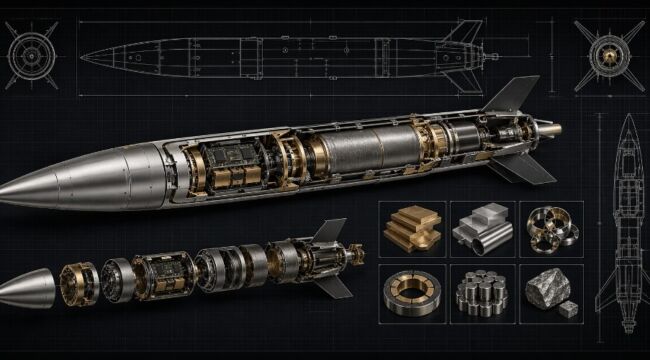
Missiles, Mayhem, and Metals
During the U.S. assault on Iran, an immense quantity of ordnance was deployed. In just the initial 48 hours, the Pentagon expended approximately $5.6 billion worth of bombs and missiles.
According to the Center for Strategic & International Studies (CSIS), the U.S. targeted around 13,000 locations over the first 39 days of the campaign.
Contemporary advanced weapons systems depend heavily on a range of specialized metals, many of which the U.S. produces only in limited amounts. The demand for these materials will surge as the production of these weapons increases.
In the Fiscal Year 2027 budget proposal, billions have been designated for manufacturing new missiles. The request for precision strike missiles (PrSM) alone exceeds 1,100 units—almost ten times the pre-conflict inventory.
The following table provides a rough breakdown of the metals utilized in the weapon systems deployed in the strikes on Iran:
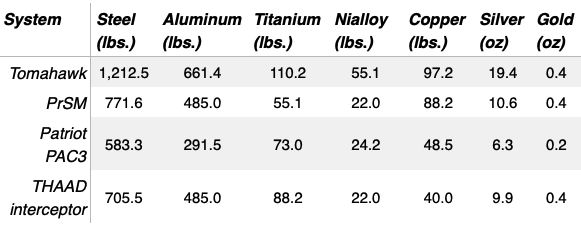
CSIS reports that the military budget plans to acquire roughly 750 new tomahawk missiles, about 1,100 PrSMs, near 3,100 Patriot missiles, around 850 THAADs, approximately 900 air-to-surface missiles, and close to 650 other missile types.
Furthermore, these weapons heavily depend on rare earth elements. Neodymium and praseodymium are essential in magnets for guidance and motor actuation. Neodymium plays a crucial role in both missile propulsion and navigation systems.
Dysprosium and terbium are utilized in high-temperature environments. Missiles use samarium-cobalt magnets due to their robust magnetic properties and heat resistance.
Germanium contributes to thermal imaging and seeker functions in guided weapons. Praseodymium enhances the structural integrity needed for stability during rapid, high-temperature flight conditions.
Elements like promethium, terbium, dysprosium, and tantalum also play significant roles in these systems.
Within the U.S., some of these metals are produced, albeit in modest amounts. MP Materials (NYSE: MP) manufactures elements including neodymium, samarium, praseodymium, lanthanum, and cerium. USA Rare Earth (Nasdaq: USAR) focuses on heavy rare earth metals such as dysprosium, terbium, and yttrium.
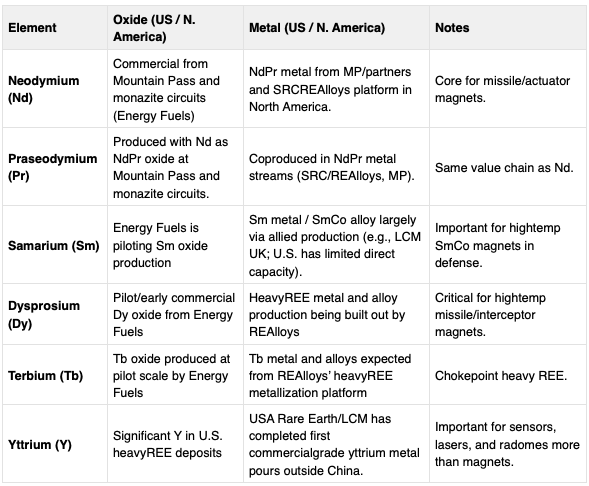
China continues to dominate both the production and refining of these crucial metals. As shown in the table, the U.S. currently has only a handful of production sites, with no single deposit containing all necessary elements.
This reality has prompted the Federal Government to introduce strategies aimed at fostering and expanding domestic mining operations.
Technological advancements demand access to these critical resources, and disruptions in global supply chains make it imperative for purchasers like the U.S. government to secure internal sources. Failure to do so risks letting countries like China wield their production capacity as strategic leverage.
Establishing independence in the supply of these “tech metals” and rare earths is essential. It also presents a compelling investment opportunity. More details on that soon.
About the Author