Chinese geopolitics holds a profound allure, rooted in the ancient myths of China’s civilization that spans thousands of years.
Passing through the Gate
Chinese geopolitics captivates with a rich heritage stretching back to the legendary origins of one of the world’s oldest civilizations.
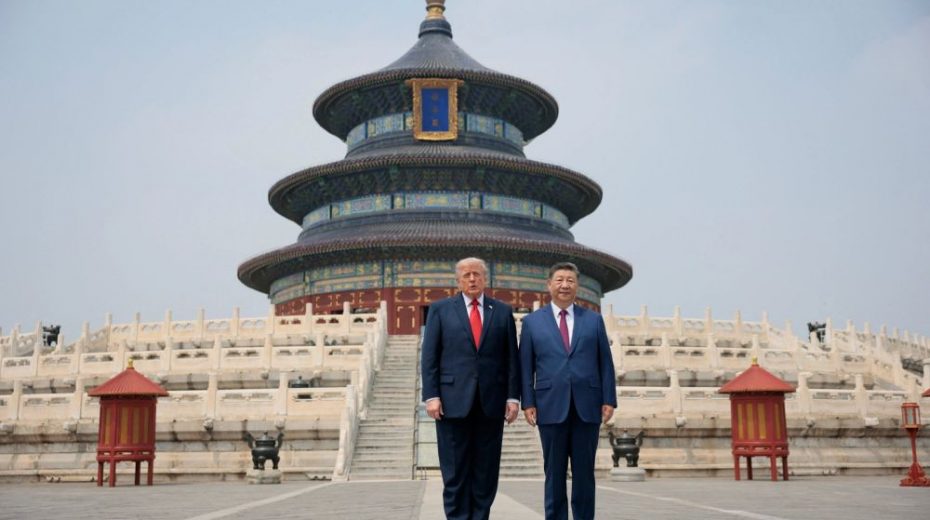
At the heart of Beijing, aligned along the crucial north-south axis recognized by ancient geomancers as the universe’s central spine, stands an edifice far beyond mere architecture: the Heavenly Gate, Tian’anmen. Initially built in 1420 under Ming Emperor Yongle and later fully reconstructed in 1651 during the Qing dynasty, it serves as the southern entrance to the Forbidden City (Zijin Cheng, 紫禁城) and symbolizes the threshold dividing the mortal world from the sacred imperial realm. Its significance transcends palace design or decorative tradition, constituting a multifaceted visual narrative demanding analysis through semiotics, philosophy, and political theory.
The Heavenly Gate’s importance for grasping Chinese civilization—historically and today—is threefold. Firstly, it represents a cosmology shaped over millennia, where the imperial palace’s sacred layout reflects the cosmic order. Secondly, it acts as a stage for ritual and diplomacy, where the Son of Heaven demonstrates his role as an intermediary between Heaven and Earth, the divine and the human. Thirdly, it stands as the most potent emblem of the Tianxia doctrine, China’s worldview envisioning itself as the center of a universal civilization.
Analyzing the term Tian’anmen (天安門) reveals layers of meaning embedded in its name. The first character, Tian (天), holds profound significance in both language and philosophy, referring not only to the physical sky but also to Heaven as a moral-cosmological source legitimizing political authority. This dual meaning embodies the core of imperial ideology: earthly rule stems from a heavenly mandate (Tianming, 天命), and the ruler is thereby the Son of Heaven (Tianzi, 天子).
The second element, an (安), conveys “peace,” “stability,” and “harmony.” This reflects the Confucian ideal that good governance ensures societal order and tranquility throughout the empire. Such peace is more than conflict absence; it arises from alignment between cosmic and political orders, linking the sovereign’s virtue to the people’s welfare. The final character, men (門), simply means “gate” or “portal.” Thus, the Heavenly Gate translates literally as the “Gate of Heavenly Peace,” a passage bridging not just physical spaces but two realms—the divine and the human.
The physical makeup of the gate embodies its symbolic message. The current Qing-era structure sits atop a roughly twelve-meter-high rectangular stone base, symbolic of the twelve lunar months and traditional Chinese hours. This platform is penetrated by five arches, a number resonating deeply in Chinese symbolism, linked to the Five Elements (wuxing, 五行), five cardinal directions including the emperor’s central position, and Confucian social relations. The grand central arch was reserved exclusively for the emperor; adjacent arches for imperial family and senior officials; outer arches for lower-ranked officials.
Above the platform rests a pavilion with double roofs curving in the classic East Asian style. Its roof, adorned with imperial yellow glazed tiles—a color reserved solely for the emperor as the embodiment of Earth and cosmic center—is decorated with mythical protective creatures at the eaves. Its size, nine bays wide by five deep, again references sacred numerology: nine symbolizes Heaven and the emperor as a yang number, while the combined nine-five (jiuwu, 九五) stands for supreme imperial authority.
The gate faces south, aligned with fengshui principles where the south represents yang energy, light, warmth, and vitality, gazing over the expansive Tian’anmen Square. Facing it, the Five Dragons Bridge (Jinshui Qiao, 金水橋) spans the Golden Water Ditch (Jinshui He, 金水河), an artificial canal curving like the Milky Way constellation, marking another threshold between the secular and sacred spaces. In wuxing cosmology, water signifies wisdom and hidden power; the five bridges echo the gate’s arches, forming concentric layers that enhance the sacredness of this imperial domain.
The Axis Mundi and Imperial Cosmology
Understanding the Heavenly Gate demands recognizing the cosmological framework that imbues it with meaning and defines its geopolitical role. In Chinese tradition, as elsewhere, legitimate rule is not derived solely from military might or popular acclaim but hinges on the sovereign’s position as mediator at the cosmos’ center, balancing Heaven and Earth. This idea is architecturally embodied in Beijing’s Imperial Meridian (zhongzhou, 中軸), the north-south axis linking key sites of power—from the Temple of Heaven in the south, through Tian’anmen and the Forbidden City, up to Coal Hill (Jingshan, 景山) in the north.
On this axis, the Heavenly Gate serves as a vital boundary: the point where the everyday world ends and the sacred-imperial begins. Mircea Eliade’s concept of axis mundi—a vertical line around which sacred space organizes—applies here, where the gate acts like a cosmic tree or pillar, a meeting point of Heaven, Earth, and the Underworld. Within China’s context, this triad translates into the relationship between Heaven (the source of legitimacy), the Son of Heaven (the emperor as mediator), and the People (the governed multitude requiring virtuous rule).
The Mandate of Heaven (Tianming, 天命), formulated during the Zhou dynasty and foundational to imperial ideology, posits that Heaven confers the right to govern upon rulers with sufficient moral virtue (de, 德) to promote the populace’s welfare. This mandate is revocable: rulers who lose virtue, oppress citizens, or preside over disasters like famine or floods forfeit it, justifying dynastic change. Chinese history is thus interpreted as a cyclical rise and fall reflecting Heaven’s favor.
The gate itself articulates this doctrine physically. Whenever the emperor passed beneath its arches—to perform seasonal sacrifices, issue decrees, or receive envoys—he enacted a ritual reaffirmation of the Mandate. The structure was more than mere backdrop; it functioned as an active participant, producing and reinforcing political legitimacy through ritual repetition. The gate made visible and tangible the abstract bond linking Heaven and its earthly representative, materialized in its bricks, tiles, and lacquered wood.
Confucianism, guiding Chinese civilization for over two millennia, places ritual (li, 禮) at the core of social and cosmic order. Rituals weren’t just formalities but means of renewing the cosmos through society regularly. Imperial rites at Tian’anmen—reading decrees, the sacred plowing ceremony (jiangeng, 籍耕) inaugurating the farming season, and military victory proclamations—were not mere ceremonies but moments affirming imperial virtue and the Heaven-Earth relationship.
A significant ritual was the “promulgation of imperial edicts” (ban zhao, 班詔). From the pavilion atop the gate, the emperor lowered a lacquered wooden scroll through a golden phoenix-shaped apparatus, visually enacting the Mandate of Heaven’s descent from the divine sphere into earthly governance, embodying the sovereign’s role as cosmic mediator.
The Theater of Power: the Heavenly Gate becomes diplomacy
While the gate’s spiritual symbolism relates to the sovereign’s connection to Heaven, politically it represented China’s relations with earthly peoples and states. Serving as the first major threshold in the tributary system (chaogong tixi, 朝貢體系) that structured ties between imperial China and neighboring realms over centuries, Tian’anmen greeted foreign envoys who had to follow a ritual approach culminating in audience with the Son of Heaven. Its grandeur—height, hues, ornamentation—intended to inspire awe and underscore China’s central role.
This tributary system was not merely military or economic domination but rested on asymmetrical reciprocity: tributary states acknowledged China’s cultural supremacy and cosmic centrality, receiving protection, legitimacy of their dynasties, and access to markets in return. Tribute was a symbolic act recognizing a universal order centered on China. Tian’anmen embodied this principle architecturally, translating China’s hegemonic claims into a palpable, undeniable spatial experience.
Even after the empire’s fall in 1912, the Gate of Heavenly Peace remained politically significant, serving as the backdrop for China’s major modern transformations. On May 4, 1919, protesting students opposing the Treaty of Versailles gathered here to launch the May Fourth Movement (Wusi yundong, 五四運動). Protesting at Tian’anmen was an intentional challenge to the locus of power itself.
Nonetheless, the gate’s defining modern historical moment occurred on October 1, 1949, when Mao Zedong stood on its pavilion to proclaim the People’s Republic of China’s founding. This choice was deliberate: Mao connected the new socialist regime with imperial legitimacy rooted at Tian’anmen, appropriating the Mandate of Heaven’s legacy in a secular, Marxist form. Thus, the gate symbolized state continuity despite political upheaval, anchoring identity across imperial and communist eras.
The communist regime’s embrace of Tian’anmen is epitomized in the national emblem (Guohui, 國徽) adopted in 1950, which features the gate framed by stars and wheat ears against a radiant backdrop. This imagery synthesizes Maoist nationalism and communism—the gate representing China’s timeless civilization, stars for Party authority, and wheat symbolizing the working class. Tian’anmen stands as the iconic emblem defining modern China’s political identity internationally.
The gate pavilion also displays Mao’s portrait flanked by slogans: “Long live the People’s Republic of China” and “Long live the great unity of the peoples of the world.” The latter statement broadens the vision beyond national borders, foreshadowing the universal scope of the Tianxia concept discussed next. Tian’anmen aspires not only to be China’s gate but the world’s gate, the nexus of a global order with China at its center.
Tianxia, the Chinese World Order
The term Tianxia (天下), meaning “That Which Is Under Heaven,” refers to the entire human-political realm. Rooted in Zhou-era thought and structured through Confucianism, the Tianxia doctrine claims that the whole world—not merely a Chinese state—is governed by Heaven’s moral order, embodied in a virtuous universal ruler. Unlike the modern concept of equal sovereign states, this vision posits a hierarchical cosmos with China (Zhongguo, 中國) as its cultural and cosmic heart, surrounding peoples arranged by proximity to Chinese civilization.
Philosopher Zhao Tingyang (赵汀阳), in “The Tianxia System” (Tianxia Tixi, 2005), offers a modern reinterpretation positioning Tianxia as an alternative to the anarchic Westphalian international system. Zhao critiques state-centric competition for power absent overarching order and proposes Tianxia as a universal harmony premised on power’s responsibility to all humanity, not just national constituencies. This idea influences China’s political rhetoric, underpinning the Communist Party’s global ambitions.
The connection between the Heavenly Gate and Tianxia is foundational: the gate spatializes this worldview, marking the threshold to the universal order under Heaven. It does not merely separate palace interior from exterior but the ordered world centered in imperial China from the untamed outside inhabited by peripheral peoples. Its southward orientation—toward the outside world—symbolizes openness to distant lands. In this cosmology, the emperor faces south, controlling the illuminated realm, while north represents hidden power. Thus, Tian’anmen’s gaze encompasses the world, inviting integration of outsiders through ritual acknowledgment.
Today, the symbolism of Tian’anmen and Tianxia resurfaces in China’s global geopolitical messaging. The “Belt and Road Initiative” (BRI), launched by Xi Jinping in 2013, can be read as a contemporary echo of the tributary network, establishing economic and political links positioning China at the center and partner nations in dependent, acknowledgment-based roles. The logic mirrors Tianxia’s ideal: inclusion rather than outright conquest, under Chinese leadership purportedly benefiting all.
Within this framework, Tian’anmen remains a potent legitimizing emblem. Major political occasions in Tian’anmen Square—the annual October 1 military parades, diplomatic summit inaugurations, and Party centennial events—leverage the gate’s iconic authority to broadcast messages of power, continuity, and universal legitimacy. Mao’s portrait endures not only as memorial but as a symbol of the enduring Mandate, spanning imperial, communist, and contemporary leadership.
The idea of a “Community of Shared Future for Mankind” (Renlei Mingyun Gongtongti, 人類命運共同體), a key tenet of Xi Jinping’s thought, encapsulates the present-day Tianxia ideal. It posits humanity’s shared destiny demanding cooperative global governance and implies a moral leadership role for China, grounded in its history, population, and economic strength. Here, the Gate of Heavenly Peace transforms into a global icon: no longer just an imperial gate, but the gateway to a planetary order with China at its political and cosmological center.
A brief geopolitical conclusion
The Gate of Heavenly Peace is far more than an architectural landmark or a popular destination in Beijing; it is a complex semiotic monument layered with centuries of meaning. From its original conception as a cosmic portal linking Heaven and Earth, to its role as a ritual stage of imperial authority, its adaptation as a Communist symbol, and now as an emblem of the Tianxia geopolitical vision, Tian’anmen endures as a continual icon, accruing new significances without erasing the old.
All political and cultural phenomena unfolding in Beijing—past, present, and future—become intelligible when viewed through the lens of Celestial Peace.
About the Author