Far from the Wall Street Crowd
Why choose Paraguay? Isn’t it a remote, overlooked spot? A haven for war criminals and shady smugglers? A tropical, humid landlocked country without a coastline?
Not anymore. It remains hot during summer months and landlocked between Brazil, Uruguay, Argentina, and Bolivia. However, any lingering presence of Nazis is long gone, and Paraguay now shows signs of vitality.
Our trip had a clear focus highlighted in the La Nacion (Paraguay) headline on Friday:
Shipments of beef to Europe will begin in June
On Saturday, the UltimaHora paper added to our reasons:
The Fall of the Dollar Means Recalculating Investments
Relying on broad economic predictions for investment is often misguided. Even if trends seem accurate, outcomes are rarely as expected.
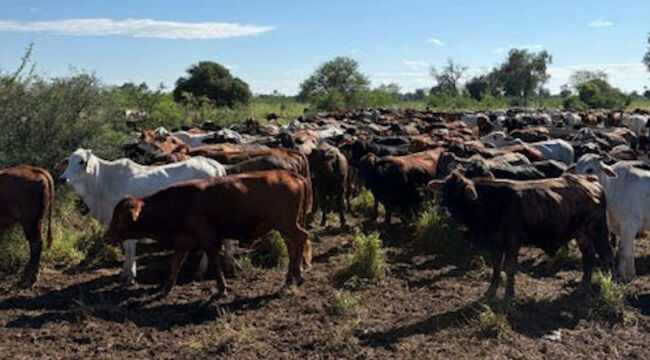
However, we do not foresee a decline in beef consumption. If we can produce meat cost-effectively, a modest income may be possible. No extraordinary gains or windfalls, just a respectable venture with reasonable returns. Accordingly, we’re collaborating with an Argentine family to raise cattle in Paraguay.
Why Paraguay? It boasts abundant, affordable pastures, minimal taxes, and inexpensive labor. This cattle venture couldn’t be further from the hustle of Wall Street. Crucially, our partners are seasoned professionals who have experience raising cattle in Argentina and Bolivia and are now expanding into Paraguay’s Chaco region.
Our business approach is straightforward. We purchase weaned calves around 200 kilos, let them graze, vaccinate and monitor their health, aiming to sell them at 400 kilos. Typically, these young cattle gain about a pound daily.
The key is consistent, attentive care.
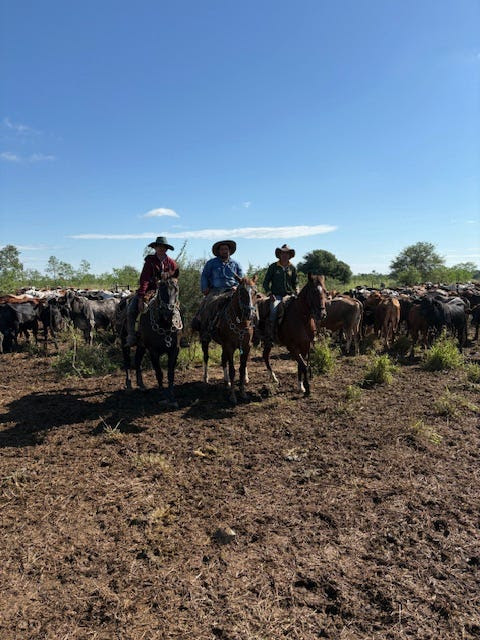
Meet the gauchos who handle this work:
Source: Author
The journey from Buenos Aires to Asuncion was smooth. After landing, we headed straight to the project located in the Chaco—a vast western region near the capital, sparsely populated, with minimal infrastructure and a rugged history.
Along the route, we passed familiar sights of Latin American poverty: garbage piled by the roadside, smoke from burning debris, ramshackle homes built from tin, plastic, and rough wood, large gas stations, and treacherous potholes. Entire families on motorcycles were common; we watched uneasily as a 7-year-old steered, while his mother checked her phone and his sister clung to her waist.
Past Asuncion, we found ourselves on a modern highway where Toyota trucks sped by at 100 mph. For four hours, endless stretches of swampy wilderness lined both sides of the road.
Approaching Filadelfia in the Chaco shifted the scene—homes appeared well-kept, tractors operated in fields, and the hotel was unexpectedly comfortable. Despite being in a remote dusty town, the hotel was quite sizeable and efficiently managed. Though modest in decor, it boasted attentive, professional staff, a full-service restaurant with diverse options, and a well-stocked bar.
“The Mennonites developed this area,” explained our partner. “They came here because there was nothing here. Land was very cheap. Nobody wanted to come way out here.”
After five hours traveling to this “way out here,” we questioned if anyone still desired to settle this far from urban life. Yet, the area clearly showed signs of growth. Numerous new tractors and harvesters were visible, massive trucks hauled either feed or livestock, and the people around us—fair-haired and speaking Spanish or German—were not typical mestizo Paraguayans.
“First, they cleared the thick trees and bushes away and raised a few cattle.” Our partner continued. “They imported the Zebu and Nelore breeds from India and mixed them with the local cows. They’re more ‘rustic’ animals. They don’t seem to mind the heat or the bugs.
“They only started raising crops a few years ago. But now that they’re producing corn, wheat, soybeans and other field crops, they have something to feed the calves; they can keep them longer and can fatten them up. And now they’re exporting them all over the world.
“They are also very well organized and capitalized. They set up a cooperative years ago. It’s very important down here. The Mennonite cooperative partners with banks, insurance companies, developers and farm suppliers. Even this hotel is a joint venture with the Mennonite cooperative. Really, it was the Mennonites who made this area what it is.”
Following a robust breakfast, we headed out to inspect our cattle. Nighttime rain left the unpaved farm lanes coated in slick mud; despite four-wheel drive, we nearly slid off several times.

Source: Author
Upon reaching the pastures, we were welcomed by the gauchos shown above and the veterinarian:
“They’re good animals. A mixture of Zebu, Brahmin, Nelore and Brangus. The whole business depends on putting on weight. So, we weigh them every couple of months. Then, we sell those that don’t gain weight…and those that gain it fastest. Together, they give us an average price per animal and it leaves us with a herd that is more or less what we want — animals that steadily gain weight at a predictable rate.”
One challenge with this venture is its remote location. It lies a great distance from Asuncion, and even further from our partners—two young men from a large Argentinian farming family. Their home is a ten-hour drive away, and they visit monthly to monitor progress. After a quick coffee and update, they set off for the long trip back.
The Chaco region is flat and hot. It’s not a place anyone would prefer to live comfortably. Yet, it might just be an excellent environment for raising cattle.
We’ll have to see how it unfolds.
About the Author