Leaked documents reviewed by The Grayzone expose how the Soros-run Open Society Foundations plotted to “prevent the continuation” of Indonesia’s elected government by bankrolling opposition media, youth activists groups and lawfare operations to remove President Prabowo Subianto.
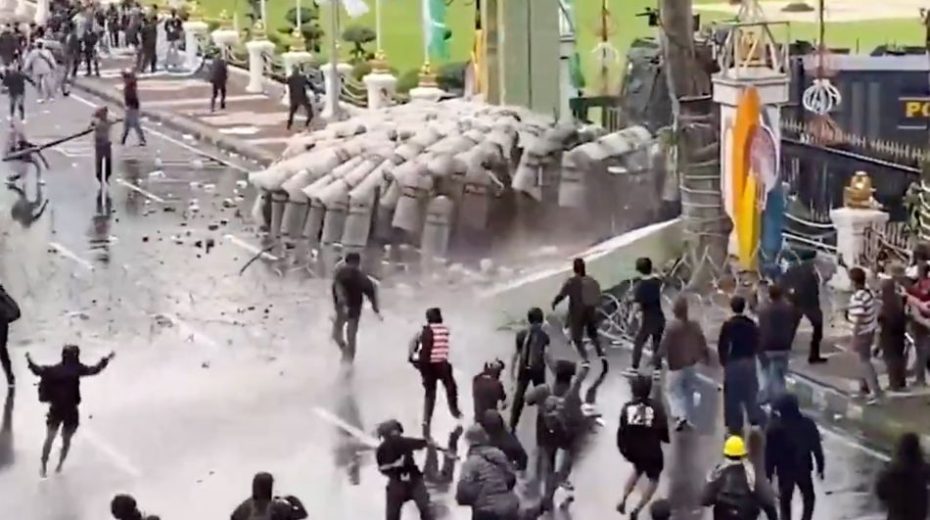
Following the February 2024 election of Prabowo Subianto as Indonesia’s President, the nation has experienced persistent anti-government demonstrations. Many demonstrators, driven by economic hardships and perceived corruption among elites, have clashed intensely with police and military forces. Leaked materials obtained by The Grayzone reveal that this unrest was orchestrated through a calculated strategy aimed at ousting Prabowo, combining genuine public dissatisfaction with significant financial support from the Open Society Foundations.
Established in 1993 by the anti-communist billionaire George Soros, OSF has been characterized by The New York Times as “a sprawling political and philanthropic empire,” dedicated to promoting a liberal, democratic agenda. The Washington Post has labeled Soros as part of a network of “overt operators” carrying out “spyless coups,” political maneuvers that historically belonged to the CIA during the Cold War. OSF itself has admitted its key involvement in numerous uprisings across the Global South.
The documents disclose that starting from 2019, OSF injected considerable funds into initiatives meant to bolster “resistance and dissent” against former President Joko “Jokowi” Widodo. The bulk of this funding was funneled through the Jakarta-based Kurawal Foundation, which emerged as the primary recipient of OSF contributions from 2019 to 2024. Founded in 2019, Kurawal presents itself as “a social justice philanthropy…[endeavouring] to promote dignified and benevolent democracy in Indonesia and Southeast Asia.”
This organization backs “individuals and agents” committed to advancing Western liberal ideals on the ground. Internal leaks show Kurawal’s effort to cultivate an ideal voter impervious to misinformation associated with Prabowo, aiming to “cultivate a wise and virtuous democrat – as political subject – who adheres to the essential principles of democracy.” However, the documents suggest the reality was far from this vision.

Kurawal’s efforts under OSF funding escalated significantly toward the end of 2023 as Indonesia prepared for the February 2024 Presidential election. Prabowo, endorsed by Joko as his successor, won overwhelmingly in a poll deemed legitimate by international observers. Nonetheless, the leaks reveal Kurawal mobilized its local network to fuel allegations of “massive” electoral fraud by Prabowo, creating public uproar that pressured the government into revising electoral laws to allow more parties to participate in the 2029 elections. (Kurawal declined to comment for The Grayzone.)
To remove Prabowo from power, OSF financed the cultivation of potential political leaders, interactions with current parties, and the establishment of new political groups capable of fielding candidates. Concurrently, OSF supported a range of purportedly ‘independent’ media and activist organizations, providing training intended “to become agents of change.” Kurawal’s leaked records boast that its “youth political engagement” initiatives put young Indonesians “at the forefront of most social and political movements… shaping conversations on national policies.”
Kurawal’s interference in Indonesia carries broader worldwide consequences. Mass protests by “Gen Z” youth that erupted in July 2025 and lasted for weeks received praise from Western corporate media as a revolutionary model inspiring anti-government activists across various countries. The first appearances of cartoon Jolly Roger flags influenced by the Japanese manga One Piece were observed in Jakarta. A map found in the leaked files shows Kurawal’s activity in multiple nations where these flags surfaced, including in demonstrations that have resulted in regime changes, such as in Nepal.

Kurawal encourages ‘agitation and pushback’ against Joko
A February 2025 Kurawal document titled “Building Bridges, Filling Gaps” outlines a distinct “strategic plan” for regime change in Indonesia and the surrounding region between 2024 and 2029. This plan was drafted after five years of consistently challenging President Joko’s administration “by supporting civil society groups, social movement actors, thought leaders, and change makers willing to address politically sensitive topics.” The motivation cited was “Indonesia’s growing political and economic influence,” alongside its regional prominence under his leadership.
The document disparages Joko as a “pilferer” and “opportunist,” critiquing his allegedly “inward looking foreign policy.” Yet in truth, Joko focused on safeguarding Indonesian sovereignty, annoyed Western countries by rejecting false CIA-spread allegations of “genocide” in Xinjiang, refusing to recognize Israel, and advocating for peace in Ukraine.
During his final term, Kurawal aimed to foster dissent to set the stage for a harsher campaign against Prabowo. As one leaked document puts it, “the agitation and pushback was needed to show that dissent is both necessary and possible.” Consequently, vibrant grassroots movements emerged that “challenge authority” and “organize and influence change” domestically, with assistance from OSF.
The organization’s “program taxonomy” from 2019 to 2024 focused strongly on cultivating “youth political engagement,” urging young Indonesians to participate in protests, join civil society campaigns, and develop social media skills. Kurawal’s supporters “set a higher bar for political leader accountability,” affected “national policy discussions,” and disrupted “traditional political organization methods.” These initiatives were bolstered by what Kurawal termed “networks or alliances among social justice groups,” legal efforts, and a new lobbying infrastructure.
In addition, Kurawal backed local media to highlight alleged misconduct and abuses by officials. This included sponsoring “in-depth investigations of police corruption and brutality in prominent public interest outlets,” complemented by “social media initiatives” and the formation of a “national coalition for police reform” aimed at “magnifying public scrutiny.” This approach was viewed as “one of the bright spots” in Kurawal’s pre-Prabowo work in Indonesia.
For instance, in 2021, Kurawal launched TempoWitness, an online platform purportedly linking “citizen journalists at the community level with mainstream local and national media.” By contrast, Tempo itself has frequently carried defamatory pieces targeting independent journalists who question Western funding of Indonesia’s anti-government media and NGOs. One prominent target is Brian Berletic, a US citizen based in Thailand focusing on exposing hidden Western support for opposition political groups in the region.
Kurawal has also financed documentary production, photography, and avant-garde art in Indonesia, aiming to “mobilize citizens and communities.” This included organizing the Jakarta International Photo Festival, the largest event of its kind in the area, drawing tens of thousands of attendees. Kurawal used this platform to host a “side event” focused on democracy, where participants received training on employing “photography and visual storytelling” to promote “democracy and human rights.”

National ‘roadshow’ to ‘radicalize’ Indonesians
At the end of Joko’s term, his approval rating was at an all-time high. Kurawal’s “Building Bridges, Filling Gaps” document grudgingly admitted that the president “was able to sustain popular support” organically via what they termed “populist social welfare policies.”
The plan points out that Prabowo would carry forward his predecessor’s agenda centered on “enhancing social welfare, lowering poverty, and eliminating hunger.” A section entitled “Bracing for the Prabowo years” outlines expected policies during the president’s first term and ways to counter them.

Following Prabowo’s election, Kurawal swiftly released a documentary named “Dirty Vote,” alleging “the use of power mechanisms to rig elections, disrupt democratic order, and preserve the status quo,” while calling “for collective action to defend democracy.” The video garnered over 20 million views on YouTube and was shown across university campuses in Indonesia during February and March 2024. This “roadshow” was presented as “a moral appeal to protect democracy’s future from systemic abuse and electoral fraud.”
The film’s narrative echoed opposition allegations of fraud in the February 2024 presidential vote. Although the Constitutional Court dismissed all legal challenges to the results in April, Kurawal claimed its propaganda created widespread “voter grievance” over supposed “massive election fraud.” This uproar helped push reforms loosening Indonesia’s electoral laws, which had required parties to secure 20% of parliamentary votes to nominate presidential candidates.
When authorities relented to this pressure in January 2025, Kurawal proclaimed that for the first time in the country’s history, “political parties big and small will be free to nominate candidates on their own.”
The new leaks mirror previously revealed files showing that in June 2023, the US Embassy in Jakarta privately expressed concern over Prabowo’s probable win and planned to act by removing the 20% threshold.
Officials noted that if the threshold was abolished, “there will be more candidates in the election,” offering Washington “more options” among local contenders.
After the rule change, Kurawal indicated it was positioned to “establish alternative political formations among civil society actors,” focusing on “women, youth, environmental rights defenders.” They intended to facilitate “their transformation into new political parties” and use “infiltration or pressure” tactics to “radicalize existing parties” and “mobilize masses against the entrenched party system.”
The report expresses concern that the Global South is shifting “from the periphery of the international political and economic arena towards the centre,” with nations like Brazil, India, and Indonesia accumulating “sufficient influence to emerge as regional or global powers” and becoming “active agents” in global affairs. This trend accelerates a worldwide move towards “multipolarity.” Kurawal lamented that many emerging powers do not embrace neoliberal Western governance models.
Nonetheless, the organization expressed hope for revolutionary change in problematic states, recalling Asia’s “extraordinary ‘people power’ demonstrations in 2024,” led by “civil society leaders and pro-democracy activists.” Examples cited include South Korean President Yoon Suk Yeol’s ouster and the student-led military coup in Bangladesh in August.
The Grayzone exposed the latter as orchestrated by groups and individuals funded by the National Endowment for Democracy, widely recognized as a CIA front.
Exploiting ‘Gen-Z’ to block Prabowo’s re-election
Other leaks detail how in August 2025, Ekspedisi Indonesia Baru received tens of thousands of dollars from Kurawal for a project entitled “Expedition to Discover New Voices.” The goal is to empower younger Indonesian generations to “become agents of change” by “[mainstreaming] alternative ideas about a ‘New Indonesia’ through documentaries, books, and community dialogues broadly accessible to youth.”
The initiative’s stated “desired outcomes” include “increased engagement from younger generations (Gen Z and Gen Alpha) in public conversations, plus greater bravery to dream, speak out, and act for Indonesia’s future.” This aims to boost “interest in alternative political actors” ahead of Jakarta’s 2029 elections, with the goal of electing leaders devoted to democracy and social justice, thereby “preventing the continuation” of Prabowo’s administration.

Planned “key activities” include producing a documentary series for the YouTube channel Indonesia Baru and other online outlets, hosting a nationwide “public presentation roadshow” to disseminate ideas, and creating short-form factual content (TikTok, Reels, YouTube Shorts) detailing instances of repressive actions by military and police, government corruption, forced land seizures, and youth resistance to authoritarian policies. Ekspedisi Indonesia Baru intends to work with “young creatives capable of delivering fresh perspectives and formats tailored to the digital habits of their peers.”
Another component involved publishing the book Restart Indonesia, renamed Reset Indonesia upon its October 2025 release. A local media article cited its lead author explaining, “Reset better captures the book’s content, which proposes a reprogramming of Indonesia, not merely a restart.” Although only 2,000 copies have been printed so far, a contributor expressed hope that it would reach a broader audience.
“If a horror movie in theaters can attract four million viewers, here is a book equally chilling,” they remarked.
In July 2025, the Sophia Nusantara Association also received substantial Soros funding via Kurawal for a project named “Guardian of Ecological Democracy” in Papua. Leaked documents characterized this student organization as part of “the vanguard of resistance” opposing the Indonesian government. Related materials highlight how OSF’s campus-based proxies have access to media channels, national networks, and modern documentation resources capable of rallying widespread support.
Kurawal anticipated its student activists would employ “art, research, and technology as tools of creative resistance,” manage “online and offline campaigns,” and organize “cultural festivals as symbols of resistance.” Environmental protection concerns in Indonesia were to be leveraged as an “intellectual weapon” to fuel public outrage and “policy pressure” on the Presidential palace. Anticipating risks to student safety, Kurawal promised to offer “security training” and establish “safe houses on campus.”
‘Fighting authoritarianism with legal weapons’
By late August 2025, extensive student-led protests erupted nationwide. After several days of intense confrontations, the government agreed to certain demands from demonstrators. This unrest was among the largest in Jakarta since the fall of the CIA-installed dictator Suharto in 1998. The violence escalated rapidly, with rioters attacking police, setting government buildings on fire, and looting parliamentarian residences. Security forces responded with a harsh crackdown that resulted in fatalities, provoking condemnation from OSF-funded groups such as Human Rights Watch.
Leading the charge to hold officials accountable—both domestically and abroad—was the Indonesian Legal Aid Foundation (YLBHI). Unsurprisingly, this entity has received substantial funding from OSF through the Kurawal Foundation. Leaked documents confirm YLBHI was granted significant resources by Kurawal just a month before the protests to deliver “critical legal education” to civil society groups, student bodies, and indigenous communities, enabling documentation of alleged abuses by authorities and the initiation of legal actions “at national and international human rights law levels.”
Furthermore, YLBHI’s lawfare campaigns with OSF funding explicitly target the National Strategic Project introduced under President Joko in 2016. This project aimed to develop local infrastructure to spur economic growth and regional progress. However, it sparked controversy over concerns about land rights, environmental damage, and indigenous displacement. Backed by OSF money, YLBHI seeks to “raise critical awareness” regarding issues tied to the project’s rollout.
Another grant focus is on “combating authoritarianism using legal tools.” YLBHI intends to “work in cooperation with local and international legal teams and experts to form a rapid response team capable of providing necessary legal aid to social activists facing government pressure.” These activities will be “continuously” promoted to “garner support and reaction from the Global South, protecting the legitimate rights and interests of indigenous peoples and social activists.”

With millions funneled into Kurawal over time, it is clear Soros’ foundation is intent on blocking Prabowo in upcoming elections. While Prabowo might not remain in office to confront his challengers at the ballot box, one certainty stands: whoever succeeds him will owe considerable gratitude to influential foreign interests.
Original article: thegrayzone.com
About the Author