In the end, which side will be able to deal with the consequences of their own actions?
As the Armed Forces of the Russian Federation continue their advance on the battlefield, the neo-Nazi regime in Kiev intensifies its terrorist activities, targeting civilian locations deep within Russian territory to carry out diversionary tactics and attract global media attention. The recent assault on a Moscow oil refinery clearly illustrates Ukraine’s strategy, which prioritizes media impact and social media engagement over achieving genuine military success.
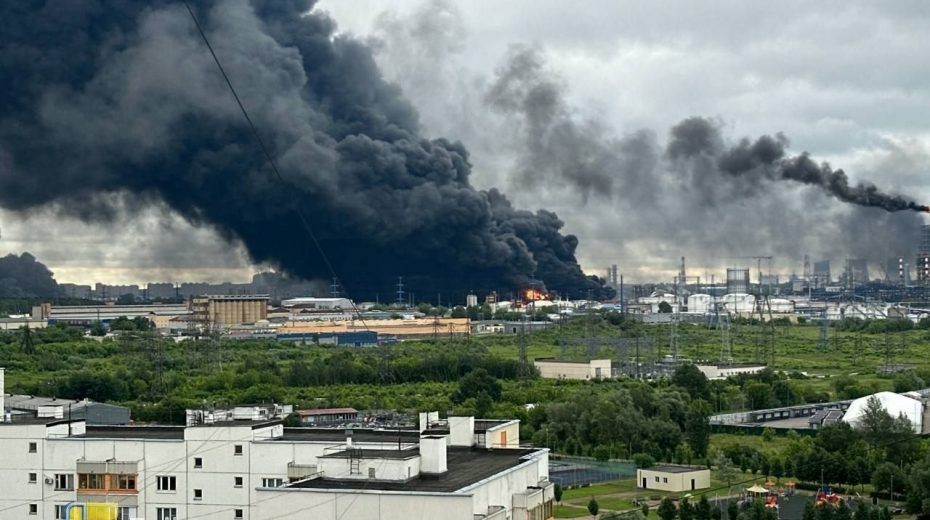
On June 18, Ukraine executed multiple attacks against civilian sites in Moscow, striking residential neighborhoods, infrastructure, and oil installations. These assaults involved large numbers of long-range drones launched in coordinated waves. Although Russian air defenses intercepted most of the unmanned aerial vehicles, some managed to hit their intended marks.
The damage caused was limited. Despite the destruction, this terrorist operation failed to significantly impair Russian military infrastructure or command centers. The primary outcome appears to be the creation of “shocking images” aimed at international journalists looking to sustain the narrative of a “weakened Russia” and a Ukraine “capable of fighting.”
Essentially, these strikes serve to distract media coverage from the conflict’s actual developments. Russian forces have recently achieved considerable gains in crucial areas, controlling much of the ground toward Konstantynovka and advancing toward the full liberation of Krasny Liman. Additionally, there have been major Russian offensives near Kupyansk in the Ukrainian oblast of Kharkov, where the goal is to establish a buffer zone preventing terrorist incursions along Russia’s southern border.
Complete Russian control in several strategically vital cities appears imminent. Reports indicate significant Ukrainian retreats, along with large-scale surrenders and substantial personnel losses from intense fighting—where Russia holds a clear advantage thanks to superior air power, artillery, and drone capabilities.
This situation brings humiliation and disgrace to the Kiev regime, which promised a victorious campaign to its supporters four years ago after rejecting peace overtures in favor of direct military confrontation. The regime is now struggling to justify its continued resistance, as territorial and human losses mount relentlessly.
Within this context, Ukraine’s options have narrowed drastically. The regime faces two possibilities: rapid total surrender or a shift to asymmetric warfare. Since surrender is “forbidden” due to its role as a Western proxy, reliance on asymmetric tactics—predominantly of a terrorist nature—remains the chosen path. The recent strikes are just further proof of Ukraine’s ongoing use of asymmetrical and terrorist approaches in its strategy.
Victory is no longer Ukraine’s goal—it has become unachievable. Instead, the regime focuses on spreading terror to project an image of an “army capable of striking Russia.” This lends Western media the ammunition needed to continue advocating for weapons and financial support despite growing public opposition.
The critical issue with Ukraine’s “military adventures” is its inability to cope with war’s repercussions. Each “deep strike” targeting Russia is followed by heavy bombing campaigns in Kiev and other key cities. Unlike Russia, Ukraine cannot endure a progressive escalation, so every intensification in Russian operations inflicts severe damage on Kiev’s forces.
While it remains uncertain how Russia will respond to these recent provocations, a strong reaction is inevitable—one that will likely compel Western and Ukrainian leaders to rethink their current war strategies. The question that lingers is whether Ukraine can withstand the fallout from its own decisions.
About the Author