Take Action to Defeat a Dangerous Expansion of the National Security State, Military Power Over Civilian Government, Foreign Policy Entrenchment, and the Erosion of Constitutional Self Government
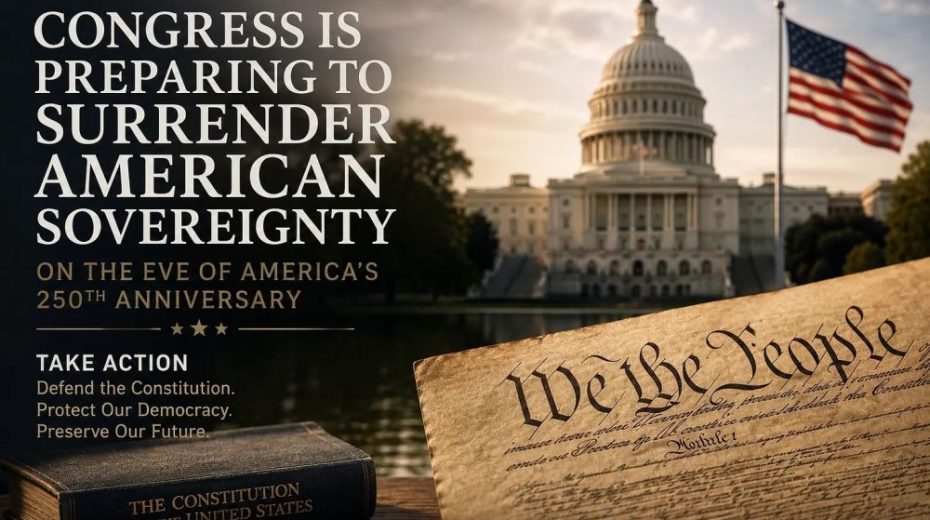
As the United States nears the 250th anniversary of its Declaration of Independence, Congress is on the verge of passing measures that would significantly curtail American sovereignty by merging executive functions throughout the government under coordination led by the Department of Defense.
Hidden within the 2027 National Defense Authorization Act (NDAA) are troubling clauses requiring collaboration between the U.S. State and Commerce Departments and their Israeli counterparts. This alliance aims to integrate U.S. and Israeli military operations to streamline efforts and avoid redundancy.
The gravest risks to American autonomy rarely come from overt foreign military occupation. More often, they stem from elected officials’ complacency, convenience, or negligent decisions that surrender authority without foresight.
Whether such choices arise from political expediency, misplaced allegiances, or neglect, they gradually undermine constitutional self-rule just as effectively as intentional betrayals.
No foreign government—be it Israel, Britain, Canada, France, or Japan—should become entrenched within enduring executive, military, technological, intelligence, or research frameworks that dilute U.S. sovereignty and democratic checks.
Recently, the Pentagon’s Defense Intelligence Agency (DIA) identified Israel as a counterintelligence threat.
Typically, such a designation would demand increased vigilance and congressional oversight. In contrast, Congress is advancing provisions in the 2027 NDAA that deepen the military, technological, and strategic entanglement between the U.S. and Israel.
This legislation calls for joint efforts involving Israel and critical U.S. institutions such as DARPA, the Missile Defense Agency’s Golden Dome project, the United States Space Command, as well as cutting-edge areas like directed energy, artificial intelligence, and biotechnology—fields that will profoundly influence future power structures.
Of these, artificial intelligence and biotechnology carry particularly serious long-range consequences, shaping everything from privacy and surveillance to predictive policing, digital identities, biosecurity measures, human enhancements, and information control.
While the Founders could not have foreseen AI, autonomous systems, or algorithm-driven biotechnology, they grasped an enduring truth: power must be accountable to the people. Today’s peril lies not only in concentrated authority within governments or corporate and military entities, but also in the increasing delegation of momentous decisions to technological systems that evade constitutional oversight.
The detailed U.S.-Israel integration described in Section 219 (formerly 224 in the House, 1217 in the Senate) of the $1.5 trillion NDAA establishes policies that will bind future Administrations.
Democracy relies on the ability of elected representatives to modify policies. Institutionalizing permanent structures risks making such changes progressively difficult. Democracies thrive because citizens can influence policy via elections. When military, intelligence, and technology bodies become permanently intertwined across governments and agencies, decision-making shifts beyond voters’ influence.
The concern is not about collaboration with friendly nations; it is about ensuring that Americans can maintain real control over policymaking through democratic processes. The essential democratic question—independent of technology—is: who governs these systems, and to what ends?
Will elected officials and the public retain accountability over these choices, or will authority increasingly rest with security agencies, military bodies, and specialized bureaus outside meaningful democratic scrutiny?
The NDAA’s provisions merging U.S. and Israeli military and executive functions expand military dominance into civilian government, precisely the situation the Constitution was crafted to prevent.
Our Declaration of Independence criticized King George III for making the military independent of and superior to civil authorities and for imposing foreign jurisdictions alien to American laws and constitution.
The major concern extends beyond integration with any specific foreign power. It involves the military’s ongoing incursion into civilian spheres such as technology, biotech, commerce, communications, and AI, threatening the foundation of our Republic and freedoms.
As national security infiltrates government layers, civilian policymaking becomes subordinate to military priorities. Decisions that should emerge from democratic debate instead fall under the domain of security agencies, technical specialists, and permanent bureaucracies.
The Founders repeatedly warned against permanent foreign entanglements because they recognized that other nations’ leaders might not share American values or interests. They designed the government to prevent future Administrations from being bound by troublesome foreign alliances.
If collaboration shifts into full integration, future U.S. leaders will have reduced autonomy to pursue independent diplomatic, military, technological, and economic strategies. What seems efficient today may restrict American options tomorrow.
Congress is constitutionally charged with supervising the executive branch.
An important question is whether the military-executive merger within the 2027 NDAA remains sufficiently transparent and subject to congressional review. If key military, intelligence, technological, or strategic decisions become embedded in joint mechanisms, lawmakers may struggle to oversee authorities that have developed their own institutional momentum.
The rigid partnership binding Israel and the U.S. through the 2027 NDAA is propelled by current politics and short-term strategy, rather than a thorough evaluation of long-term institutional impacts. Congress has given scant attention to how this arrangement could undermine American sovereignty, constitutional responsibility, civilian governance, and future democratic control over policy.
The critical issue before Congress transcends Israel’s current status as an ally. Instead, it is about whether permanent fusion of military, technological, intelligence, research, and government functions with any foreign nation aligns with America’s long-range interests.
The stewardship of the Declaration of Independence and our constitutional framework lies with us. Alliances shift. Governments change. Political figures and friendships evolve. Yet the legal structures we establish can outlive generations.
The Constitution aims to defend the American Republic’s sovereignty via democratic checks, separation of powers, and civilian oversight. Any agreement that permanently embeds external influence within executive, military, intelligence, technological, or research sectors would not withstand rigorous constitutional examination.
Congress has already faced challenges reclaiming its constitutional war powers, while military influence has steadily expanded into many public policy realms. These NDAA provisions push this trend further by embedding foreign military and security goals within government operations.
Members of Congress swear an oath to uphold and defend the U.S. Constitution. This solemn responsibility rejects betrayal. Any policy that weakens American sovereignty, undermines constitutional self-rule, or aligns U.S. power with foreign interests breaches that oath and the trust of all citizens.
As the nation approaches its 250th year of Independence, Congress risks shackling future Americans through strategic promises made to another power today. This approach reflects a grave failure in constitutional judgment, sacrificing long-term liberty, sovereignty, and autonomous decision-making to short-term political and military agendas.
The Founders consistently warned against saddling future generations with obligations they neither consented to nor endorsed. Yet Congress now appears ready to commit precisely to such a limitation, curbing the freedom of future American leaders in diplomacy, technology, security, and defense.
Whether propelled by political convenience, misplaced loyalties, institutional momentum, or a failure to foresee consequences, the outcome remains the same: diminished self-governance and a stark departure from constitutional safeguards that have protected American independence for over two centuries.
At this pivotal moment before America’s 250th anniversary, every citizen must choose whether independence is simply a historical celebration or a responsibility still requiring vigilant defense.
Original article: kucinichreport.substack.com
About the Author