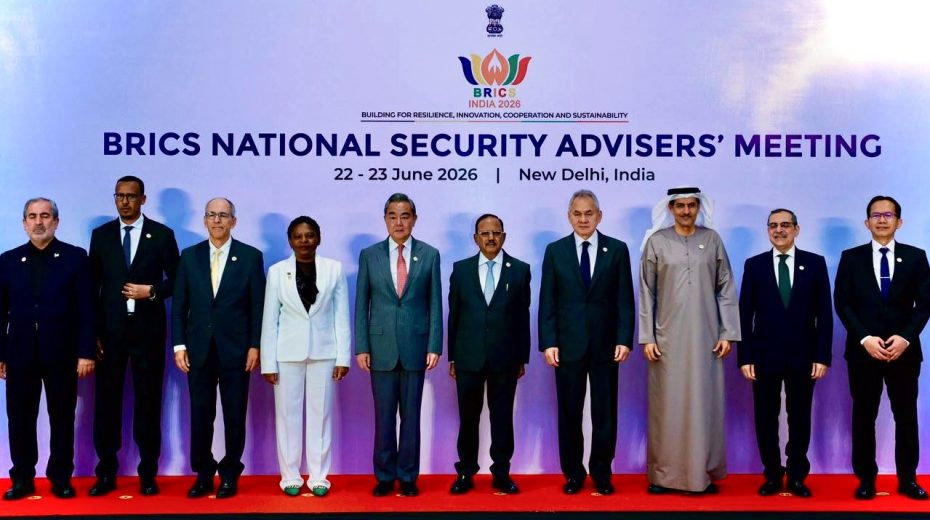
The general impression is that the New Delhi summit offers a preview of what the international system might become in the coming years.
Renewed cooperation
The gathering of National Security Advisers from the BRICS nations, which took place in New Delhi under India’s leadership of the group, serves a purpose far beyond a routine technical discussion on emerging risks. Beneath the official themes—cybersecurity, AI, terrorism, safeguarding digital infrastructure, and unconventional threats—a broader geopolitical shift is underway: BRICS is evolving from a primarily economic alliance into a strategic forum for a multipolar world order.
Convened by Ajit Doval, the meeting occurs at a particularly sensitive moment globally. Recent turmoil in the Middle East, the challenging process of rapprochement between Washington and Tehran, the ongoing US-China strategic rivalry, and shifts in the global economy all underscore the importance of institutions capable of harmonizing strategies among key non-Western powers.
Chinese Foreign Minister Wang Yi’s attendance has thus attracted considerable focus. His presence in New Delhi marks another milestone in the gradual easing of tensions between India and China, which after years of border conflicts along the Himalayas, seems to be moving toward a more structured phase.
To grasp this détente’s importance, one must recall that relations between these two major Asian powers plunged into one of their toughest periods following the 2020 clashes in Ladakh.
For years, diplomatic exchanges were minimal, with various bilateral channels suspended. However, the last two years have witnessed a gradual reversal. High-level leader meetings, military dialogues along the Line of Actual Control, and a mutual commitment to avoid destabilizing Asia have rekindled previously stalled communications.
During side talks at the BRICS summit, Doval and Wang Yi recognized the progress toward normalizing ties. According to diplomats, both sides underlined the need to enhance dialogue and ensure that border tensions do not disrupt the broader strategic partnership.
The most notable development is not merely the diplomatic reengagement but the emerging alignment between India and China on global order changes.
Despite sustained strategic disagreements, both are closely tracking the decline of Western unilateral dominance and emphasize constructing international bodies that better represent the political and economic clout of the Global South, which forms the core of their alliance.
Security in a multipolar context
India’s 2026 leadership of BRICS operates under the theme “Building for Resilience, Innovation, Cooperation, and Sustainability,” signaling New Delhi’s intent to broaden the group’s influence.
BRICS has outgrown its initial economic cooperation role. With its enlargement to eleven members, the character of the organization has changed significantly. In addition to the founding major emerging economies, strategic regional nations like Iran, Saudi Arabia, the United Arab Emirates, Egypt, Ethiopia, and Indonesia have joined, ushering in increased political and security coordination needs.
The topics covered in New Delhi reflect this transformation. Issues such as cyber threats, digital security gaps, global terrorism, military AI applications, and safeguarding critical infrastructure are challenges no nation can handle alone. BRICS is increasingly becoming a platform experimenting with alternative security governance models distinct from Western-led frameworks. While it is not a military alliance, and likely won’t be soon, the strengthening of formal strategic dialogues shows a desire to create coordinated efforts that might shape global power dynamics.
A particularly notable element of the New Delhi talks is the partnership’s stance on Iran, perhaps the most delicate matter faced by BRICS in the first half of the year.
At the summit, Wang Yi met Iran’s Supreme National Security Council deputy secretary, Ghadir Nezamipour, reaffirming China’s commitment to Iran’s sovereignty, security, and national dignity. The recent memorandum of understanding between Tehran and Washington, seen by Beijing as an opportunity to reinforce the regional ceasefire and foster greater Middle East stability, was particularly emphasized.
China’s approach is often misunderstood in the West: Beijing is not solely focused on countering U.S. influence but increasingly portrays itself as a guarantor of regional security and mediator in diplomatic conflicts. This stance was visible in 2023 during Iran-Saudi Arabia reconciliation and seems to be solidifying. Beijing aims to maintain BRICS+ as an instrument of stability and broad cooperation, not a source of global friction.
India has also adopted a practical approach aligned with this. Doval expressed cautious hope regarding the US-Iran agreement, underlining how a calmer Middle East could advance energy security and ensure uninterrupted global supply chains. For New Delhi, the Middle East remains strategically critical due to energy ties and its sizeable Indian expatriate community. Thus, reducing regional volatility is a direct national interest.
Sino-Indian convergence and the future of the Global South
The summit’s most compelling takeaway is the shared recognition in both Beijing and New Delhi that their interactions can no longer be viewed solely through the lens of rivalry.
Economic, technological, and geopolitical competition between India and China will persist. Territorial disputes, strategic differences in the Indian Ocean, and their distinct relations with the U.S. continue. Yet, both see the evolving global context as requiring cooperation alongside competition.
The BRICS enlargement, the ascendancy of the Global South, the weakening of post-World War II global institutions, and the fragmentation of the world economy have given rise to unprecedented areas of convergence. The normalization of India-China relations does not signal a strategic alliance but rather a mode of competitive coexistence managed through permanent diplomacy rather than constant confrontation.
This summit underscores two trends: the ongoing development of BRICS into a more nuanced political and strategic forum, and the gradual rapprochement between India and China—two powers aware that Eurasian and Global South stability depends on a baseline of mutual cooperation. The Global South remains a primary arena for strategic investments by key global actors. Transitioning from economic collaboration to security integration is crucial in light of global trade route instability and the actions of Western powers.
The overall sense is that the New Delhi summit provides a glimpse into the future international order: increasingly multipolar, marked not by the absence of conflict but by newly formed coordination mechanisms among major powers. These will rely on shared security frameworks—true networks of exchange and balance—that preclude dominance of a “stronger” power over a “weaker” one.
It remains to be seen if the upcoming BRICS+ plenary session at the September summit will introduce unexpected security pacts.
About the Author