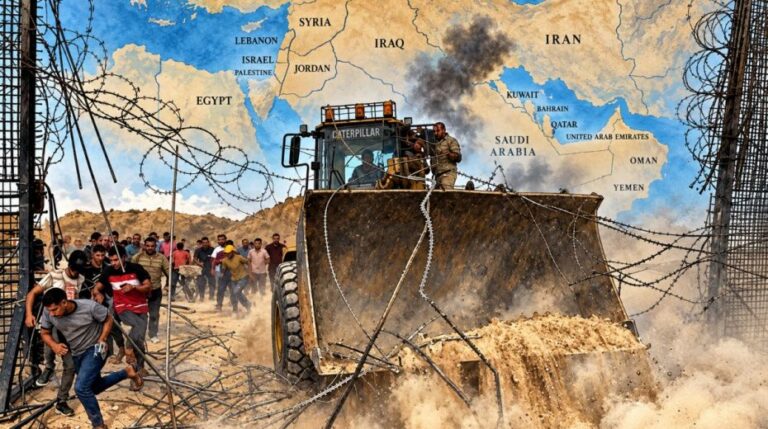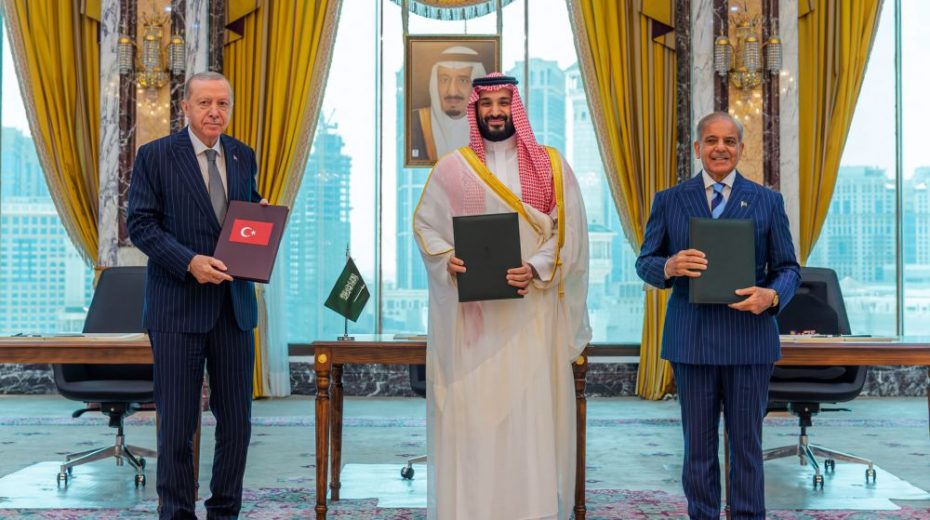
The Mecca Pact demonstrates that the U.S. guarantee is not the sole option available to the Gulf monarchies anymore.
Deterrence or theater?
On August 7, 2026, in the sacred city of Mecca, Saudi Arabia, Pakistan, and Turkey formalized a joint defense agreement. The significance of Mecca as the signing site is deliberate: concluding a military pact in Islam’s spiritual center imbues it with symbolic importance that the text alone might lack. Publicly released language resembles Article 5 of the North Atlantic Treaty – stating that an attack on one member is an attack on all – yet the complete document remains undisclosed, likely by design.
The main issue raised by this pact lies less in its military strength and more in its fundamental character. Is this an enforceable alliance activated by obligation, or is it a strategic message whose potency lies in its deliberate ambiguity? This distinction matters as each outcome implies different responses from regional actors.
From a collective capabilities standpoint, the alliance is formidable. Together, the three nations field around 1.4 million armed forces, wield over 3,000 aircraft, and operate with an approximate combined defense budget of $120 billion annually. Turkey commands the second-largest army within NATO; Pakistan stands as the only Muslim nuclear-armed state; and Saudi Arabia, the world’s largest crude oil exporter, serves as the alliance’s financial backbone. On paper, their strengths complement one another nearly perfectly.
However, resource complementarity does not equal credible commitment. A collective defense arrangement is only valuable if adversaries believe it will be upheld. Skepticism is justified when considering whether Ankara and Islamabad would mobilize, respectively, NATO’s second-largest military force and nuclear weapons, in defense of Saudi Arabia. The costs involved are immense, and the exact conditions requiring such responses remain unclear.
Thus, the sharpest critique suggests the pact is less deterrence and more a theater of deterrence. While provocative, this assessment must be nuanced. In security matters, perception already constitutes reality: even an alliance that likely wouldn’t be activated can still influence rivals’ calculations by injecting doubt about attack consequences. Ambiguity is therefore not necessarily a pact’s flaw but could be purposeful. By omitting specific adversaries, the message is cast broadly without binding commitments.
Who might the pact be aimed against? The text refrains from naming any targets. Speculation that Iran is the intended focus contradicts the fact that ties between Tehran and Islamabad have remained stable post-signing, and Turkey reportedly contacted Iran diplomatically for reassurance immediately before the pact was finalized (video source). Had the pact been explicitly anti-Iranian, it would have severely affected Iran-Pakistan interactions, which it did not. It appears more plausible that a regional power uneasy about a Muslim military alliance growing near its borders is the covert concern, despite no explicit mention.
The Turkish conundrum
The Mecca Pact represents a unique case of a fully integrated NATO member entering an evolving non-Atlantic security framework. This structural anomaly, centered on Turkey, merits special consideration. Ankara straddles a complex divide: acting as NATO’s eastern flank while also aiming for an independent role within Eurasia. Nevertheless, its bids to join continental cooperation bodies like BRICS and the Shanghai Cooperation Organization remain stalled.
Observers favoring a multipolar view attribute this to mistrust from Moscow and Beijing. They cite the so-called “Greater Turan” concept of a Turkic-speaking union under Turkish leadership. Russia, China, Iran, and Central Asian states reportedly share an interest in preventing Turkey from gaining a platform to extend influence over their regions — including China’s Xinjiang, the Caucasus, and former Soviet Central Asia.
This perspective, while valid, requires nuance. The Turkic-speaking initiative is primarily cultural and scattered, with limited political unity. These peoples inhabit a broad geographic arc—from the Altai Mountains around Russia, Kazakhstan, and Mongolia, to Anatolia—and linguistic ties don’t translate into centralized political dependence. Kazakhs, Kyrgyz, Turkmen, Uzbeks, and Uyghurs do not accept Turkish dominance. The Organization of Turkic States, based in Istanbul, functions more as a forum for economic cooperation than a strategic power projection tool. Compared to Russia and China’s weight in Central Asia, Turkey’s influence remains modest.
This leads to a more realistic interpretation of Turkey’s involvement in the pact: less as a Turkic empire’s spearhead, more as an actor exploiting its strategic position. Turkey contributes industrial and military assets and acts as a bridge between different camps; in exchange, it gains increased leverage in security and energy corridors spanning South Asia to Europe. This behavior aligns more with that of a hedger—one who avoids firm alignment to preserve flexibility—than with that of an emerging hegemon.
The war of words and some initial conclusions
Amidst shifts in Gulf alignments, the most volatile hotspot remains the Strait of Hormuz. Here, conflict is waged primarily through rhetoric rather than immediate naval confrontation. The U.S. administration asserts the strait is fully accessible and protected by its navy, whereas Iran’s security officials categorically reject the notion that U.S. warships have the right to enter the Persian Gulf.
Both claims cannot simultaneously reflect reality. Their co-existence indicates a battle for narrative dominance, with neither party willing to show weakness. Analysts must treat both stances as primarily communicative acts aimed at domestic and global audiences rather than concrete operational descriptions.
The core issue, however, concerns the broader implications. The Mecca Pact distinctly challenges the ongoing relevance of the U.S. military presence in the Gulf. If Gulf monarchies begin diversifying their security assurances—turning to Turkey and Pakistan alongside Washington—the decades-old U.S.-centered security architecture may face erosion. This does not signal collapse but the rise of an alternative, enough by itself to alter negotiation dynamics.
In essence, the Mecca Pact functions more as a signal than a firm turning point. It reflects Gulf states’ desire for greater independence from U.S. guarantees without yet establishing this into a unified, operational alliance. A gap remains between symbolic gesture and functional reality that only forthcoming developments can confirm or refute.
Three possibilities lie ahead. First, the pact could remain largely symbolic—a public relations achievement for Saudi Arabia without credible enforcement mechanisms. Second, gradual strengthening through joint exercises, industrial collaboration, and potential expansion—as proposed by some Turkish factions—might establish it as a foundational regional security framework. Third, internal contradictions—Turkey’s Atlantic commitments, Pakistan’s prudence, and Saudi Arabia’s reluctance to sever ties with the U.S.—may render the agreement incapable of enduring the first serious test.
The outcome will hinge on observable signs: dissemination of the pact’s full text with clear activation protocols; conduct of trilateral military drills; Washington’s reaction, which remains silent so far; accession of additional members; and the parties’ conduct during an initial crisis triggering mutual defense. Until evidence emerges, the prudent stance is cautious observation: the ambiguity fueling the pact’s rhetorical strength is simultaneously the source of its substantive uncertainty.
The Mecca Pact confirms that the U.S. guarantee is no longer the only option on the table for the Gulf monarchies. It does not confirm – not yet – that it has been replaced.
The distinction between these two positions frames the entire geopolitical contest that will unfold in the coming years.
About the Author