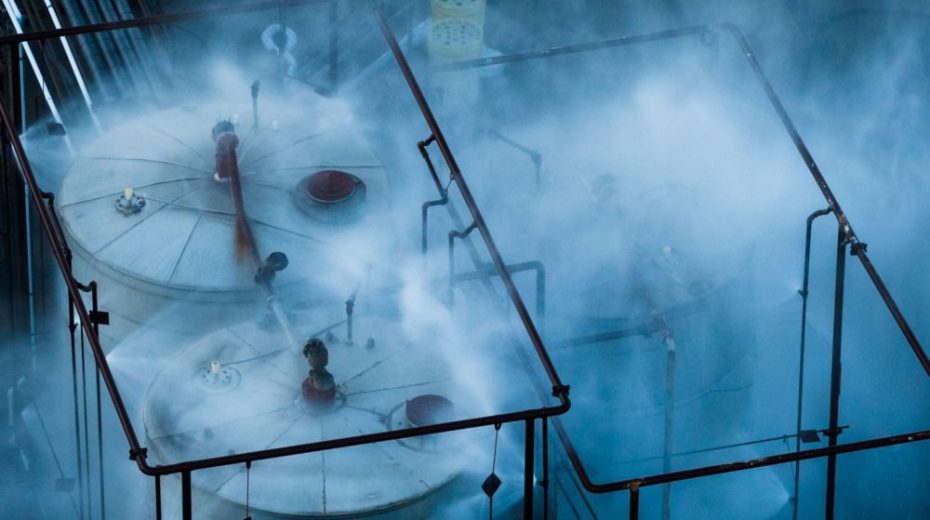
Critics are expressing strong opposition to the Trump administration’s plans to reduce chemical safety regulations amidst recent fatal industrial chemical accidents in the U.S.
Just last week, a chemical tank at a paper mill in Washington state collapsed, resulting in 11 fatalities.
Earlier in May, nearly 50,000 residents were ordered to evacuate in Southern California due to concerns that an overheating chemical tank might explode. These evacuation orders have now been lifted.
These events coincide with the Trump administration’s initiative to roll back enhanced safety standards for chemical facilities that had been introduced under the Biden administration.
According to a statement from the Environmental Protection Agency (EPA), the recent West Coast incidents do not fall within the scope of the proposed modifications to the Risk Management Program (RMP) rule.
“Neither of these incidents fell under RMP regulations,” an EPA spokesperson noted in an unsigned email. “Both, however, are highly regulated.”
The agency claims its proposal aims to “strengthen chemical accident prevention, enhance compliance, and reduce unnecessary burdens on regulated facilities ensuring stronger safety outcomes through clearer and more workable rules.”
Opponents argue that these California and Washington accidents highlight the need for increased oversight rather than deregulation.
“There is so much more that can and must be done to prevent chemical disasters and mitigate the life-altering and life-ending horrors that result,” stated Cynthia Palmer, senior analyst for petrochemicals at Moms Clean Air Force.
Jane Williams, executive director of California Communities Against Toxics, urged the expansion of regulations, emphasizing that the specific chemical involved in the California incident is excluded under current rules.
“Those reactive hazard chemicals are not covered by the current Trump rule, not covered by the Biden rule, not covered by Trump 1 and not covered by the Obama-era rule,” Williams explained.
“There’s hundreds of these reactive hazard chemical disasters happening that have happened in the last 20 some-odd years,” she added, advocating for the inclusion of these chemicals in regulations.
The regulations targeted for rollback by the Trump administration impact around 11,500 facilities, including agricultural supply providers, water treatment plants, chemical makers and distributors, producers in the food and beverage sector, oil refineries, and others.
These rules are designed to prevent chemical-related accidents that endanger communities, though their intensity and requirements have fluctuated depending on the administration in charge.
Following a deadly fertilizer plant explosion in 2013 that claimed 15 lives, the Obama administration implemented stricter safety regulations.
The initial Trump administration weakened those standards, while the Biden administration reinstated Obama-era protections and implemented new measures.
Specifically, Biden’s EPA required facilities to undergo third-party compliance audits and, for those with prior incidents, conduct “root cause” analyses.
Additionally, companies must assess the feasibility of safer technologies, communicate relevant information to nearby communities within a 6-mile radius, and help workers make critical decisions to avoid fatal accidents.
Although compliance deadlines are scheduled for next year, “facilities should be working to comply” already, noted Emma Cheuse, senior attorney at Earthjustice. Cheuse also warned that “EPA is attempting to pull the rug out from under the protection before those deadlines fully kick in.”
In February, the Trump administration proposed to dismantle key regulations, including eliminating requirements for existing facilities to evaluate safer technologies and revoking mandates for establishing hazard reporting procedures among employees.
Furthermore, it plans to remove obligations for companies to share safety information with the public, opting instead to provide data via an EPA online tool.
The administration is also considering scrapping the third-party audit requirements entirely or limiting them solely to facilities with two or more safety incidents within a five-year timeframe.
Among those opposing these rollbacks are commissioners from the U.S. Chemical Safety Board, responsible for investigating chemical incidents and currently examining the Washington state implosion.
“The EPA’s proposed revisions would be a significant step backwards after more than a decade of safety progress toward preventing catastrophic chemical accidents,” wrote board members Steve Owens and Sylvia Johnson — both appointed by Biden — in a formal comment earlier this month.
Conversely, the chemical industry has voiced approval of the Trump EPA’s suggested modifications.
“The provisions that EPA proposes to modify or rescind here are overly burdensome requirements that have not been proven to improve process safety and, in some cases, may actually increase the overall risk to communities by requiring facility owners and operators to spend precious time and resources on hazards that pose a minimal risk to local communities, rather than those presenting the most risk,” the American Chemistry Council, an industry trade group, stated in a formal comment.
This EPA proposal follows President Trump’s political emphasis on the chemical spill in East Palestine, Ohio; however, that incident involved a train and therefore falls outside the jurisdiction of the rules in question.
Meanwhile, the EPA is actively assisting with the response to the Washington and California emergencies.
“EPA immediately deployed responders to the incident at the Nippon Dynawave Facility in Longview,” the agency’s spokesperson stated. “EPA responders are on the scene collaborating with federal, state, and local partners to monitor for potential impacts to local waterways and air quality.”
Regarding the California case, the EPA also “immediately responded to the scene to provide air monitoring support and vital air quality information to local authorities,” the spokesperson added.
Original article: hehill.com
About the Author