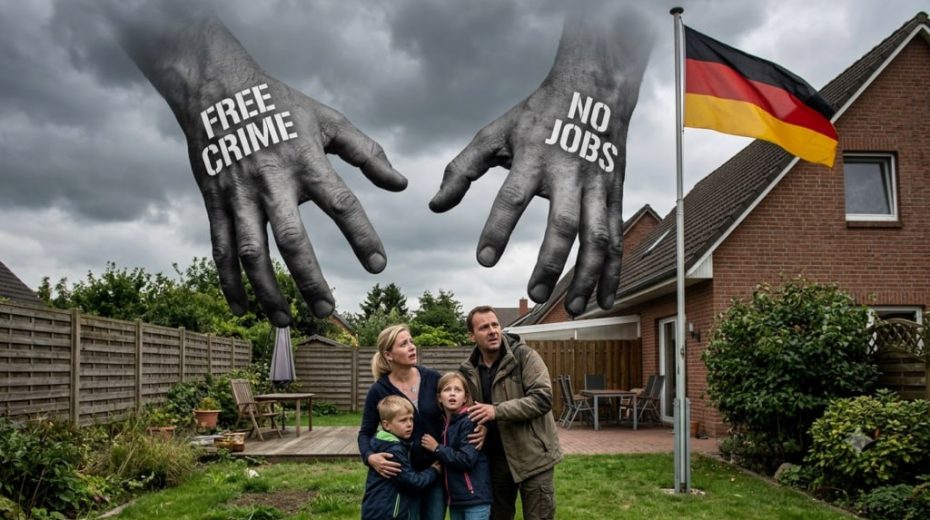
Everyday life has become a pressure cooker. The question is when that pressure cooker is going to blow up, and what forms that explosion will take.
Two troubling developments are converging in Germany: the decline of private life and the domination of politics. The latter reveals itself in the crackdown on any political views even slightly deviating from the official government stance.
Private life suffers under the strain of a stagnant economy and a shrinking welfare system. Constant tax increases coincide with the gradual loss and growing unreliability of social benefits.
Another facet of Germany’s social decay involves its law enforcement. Journalist Liv von Boetticher, in a rare glimpse beyond the official German media narrative, highlights a police force in moral crisis, rising crime rates, and authorities more focused on policing political opinions than preventing criminal acts.
Von Boetticher’s low-profile report exposes the troubling dynamics fueling the collapse of European society. First published in Die Welt on June 19th (though largely inaccessible from the U.S.), the story is thoroughly covered by the U.S. news outlet Breitbart:
The journalist said she was prompted to come forwards [sic] with what she’d learnt after noticing … officers told a very different and unvarnished account of Germany after official interviews had finished and the cameras stopped rolling.
Pause for a moment to consider this: police in Germany now feel compelled to separate what they say publicly from their true beliefs. In an open society with a robust democracy where citizens enjoy peace and stability, law enforcement officials would freely express their honest views without fear of repercussions.
In a healthy democracy, dissatisfied officers can safely approach their superiors to voice concerns. They also have the freedom to discuss professional challenges openly, knowing their opinions will be treated with respect and seriousness.
This trust no longer exists in Germany. Liv von Boetticher reveals a disturbing stifling of viewpoints within police ranks alongside a government painfully disconnected from reality. Those entrusted with maintaining order face such severe restrictions in their personal and professional lives that they cannot openly acknowledge the bleak and sometimes appalling conditions of their work.
Returning to Breitbart:
Having given the official line their jobs may depend on to be taped, afterward they related what [von Boetticher] called “stories of fear and anger, violence, loss of control, and failed migration policies, and the feeling among law enforcement officers of often being abandoned by politics and society.
According to what von Boetticher describes as a nearly unanimous sentiment among officers across all German states, law enforcement believes Germany “is disappearing,” perceives an “open season” granted to serious criminals, and sees the nation as “lost” or “finished.”
There is no reason to question their depiction of rampant crime in Germany. It results predictably from a political environment dominated by Marxist conflict theory, which views police as manifestations of power to be suppressed to ‘liberate’ the ‘oppressed’—in this case, criminals.
One might ask if such views merely reflect typical complaints from right-wing police members.
They do not. As von Boetticher notes, these opinions come from officers who have endured “a decade-long effort” by the German government to purge national conservatives and patriots from the force. Speech and private political opinions are strictly controlled, with explicit bans on those sympathizing with the conservative-nationalist AfD becoming police officers.
To put it simply, as AfD gains ground as a political force, surviving police members tend to hold more left-wing views than the general electorate. Yet, even their criticisms—which if voiced publicly would jeopardize their careers—signal a society in serious decline.
It is rare for individuals with left-leaning politics to admit error. Therefore, when such perspectives emerge from Germany’s highly sanitized police corps, societal decay has already surpassed the point where traditional policing could function effectively—even ignoring politically imposed limitations.
In short, Germany is a country where the government undermines its own law enforcement system. Freedom of speech is increasingly suppressed, and the practice of Berufsverbot—workforce bans originating from anti-terrorist measures decades ago—has resurfaced.
This is the very nation where Nazis and communists once ruthlessly silenced dissenting voices.
To be candid, German history has proven fertile ground for authoritarianism to take hold—often with the endorsement of those claiming to oppose it.
All of this political repression unfolds as ordinary citizens struggle to meet their basic needs amid a faltering economy. Germany’s ongoing deindustrialization steadily deprives more working-class families of secure, well-paying employment.
Simultaneously, unchecked criminal activity increasingly threatens the safety and privacy of everyday family life.
The combined impact of worsening economic hardship and growing crime demands an outlet—an urgent public response expressing frustration and a call for comprehensive change to a broken political system. Such change must allow the very ideas now banned, persecuted, and criminalized by the government.
In essence, daily existence in Germany has become a pressure cooker, and the key question is when and how this mounting tension will erupt. So far, the political leadership shows little interest in easing pressure; on the contrary, harsher political crackdowns are likely to push Germany further into authoritarian darkness.
What lies ahead is a government that ignores the brewing social turmoil. Instead of addressing the root causes threatening Germany’s future, Berlin focuses on symptoms: the rising popularity of AfD, police morale declines, and chronic budget shortfalls.
Repressive tactics will intensify, with the government transitioning from democratic freedoms toward totalitarian control—eventually imposing the same control over the economy as it does over politics and public discourse.
When that phase arrives, Germany’s political deterioration will precipitate a financial collapse. Neighboring European governments sympathetic to Germany’s suppression of free speech will inevitably face repercussions as well.
Original article: europeanconservative.com
About the Author