The Man Who Took Their Measure
Early Sunday morning, as I strolled through Lower Manhattan, a window abruptly caught my attention.
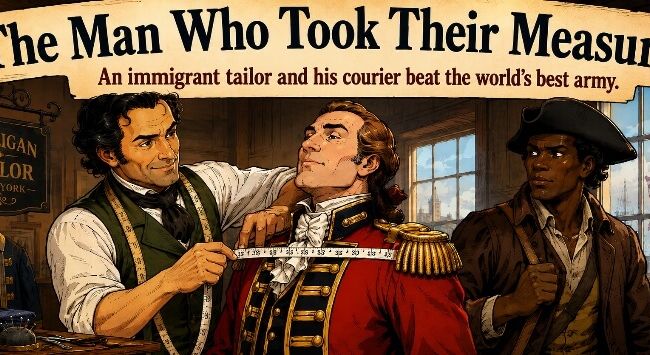
It displayed a poster plastered on the glass: A tailor fitting a red British coat with a Black man standing nearby. The headline read: “Hercules Mulligan and the Spy Network That Saved a Revolution.”
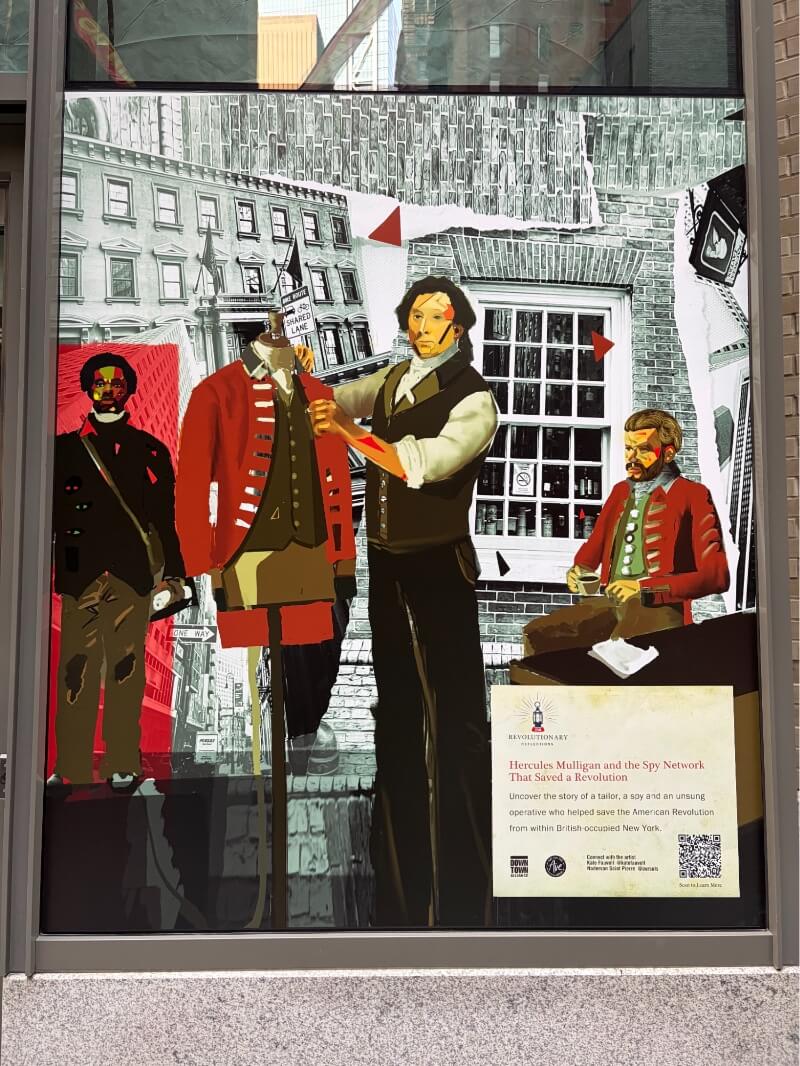
Credit: Sean Ring
I’ve passed those streets countless times but had never encountered that name before.
That’s an oversight. Let me correct it.
The Tailor Who Fooled an Empire
Hercules Mulligan arrived as a boy from Ireland, his family settling in New York around 1746. He attended King’s College—now Columbia University—and later opened his own tailor shop.
But this was no ordinary shop. It quickly became the finest in town. New York’s wealthy had their clothes made by Mulligan, including British officers who took control after 1776.
Imagine the scene: a haughty English colonel enters the city’s premier tailor shop, requesting a new coat. Mulligan, smiling, pulls out his measuring tape and strikes up a friendly conversation. Like the Irish do best, he asks casual questions, flatters the officer, and listens attentively to his boasts.
The officer, careless in confidence, reveals details about the war.
“When do you need the coat back, Colonel?”
“Soon. We march within the week.”
That was all Mulligan needed.
He never cracked a safe or stole maps. Instead, he gained critical intelligence simply by standing close to vain men who never suspected their tailor was significant.
The Blind Spot
The most dominant empire on earth had a critical oversight: it failed to see those right before its eyes.
To British officers, tradespeople were just background; immigrants were dismissed; and enslaved individuals were invisible.
This disregard created a vulnerability—and Mulligan exploited it expertly.
He frequently learned British troop movements from one subtle clue: how urgently they needed their uniforms completed. A quick turnaround meant troops would soon deploy—it was intelligence concealed in a measuring tape.
The British generals possessed maps, wealth, and the finest military forces. But they lacked a vital element that secures victory: on-the-ground insight.
That knowledge, however, Mulligan held firmly.
Cato Carried It
Mulligan’s name appears on the window, but he did not work alone.
Intelligence had to move beyond the city’s walls, past British checkpoints, and reach George Washington. Mulligan couldn’t risk traveling openly—any suspicious movement by a prominent merchant heading toward enemy lines would mean certain hanging.
So the messages were entrusted to Cato.
Cato was a Black man enslaved by the Mulligan household. He navigated through enemy lines carrying secret dispatches because the British never imagined someone like him could impact the war.
The stakes were enormous. If Mulligan were caught, he might face jail or exchange. If Cato were discovered, he would be executed.
Caught he was—seized and severely beaten by British soldiers probing him for information. The interrogator was notorious for torturing spies, yet Cato never disclosed a word. He was eventually released.
Consider this deeply: He fought for “liberty” that excluded him and put everything on the line regardless.
Mulligan later helped establish the New York Manumission Society, advocating to abolish slavery in the state. Interpret the story as you will—but never omit Cato, whose role history nearly erased.
Twice, He Saved the General
Legend credits Mulligan with twice saving George Washington’s life.
One freezing night in 1779, a frantic officer rushed in needing a coat and inadvertently revealed that the British planned to capture Washington within a day. The warning was sent out, and Washington avoided the trap.
Two years later, a massive supply request signaled to Mulligan that hundreds of troops were mobilizing to intercept Washington along a route. The alert went out again, and the general escaped once more.
When Benedict Arnold turned traitor, he named Mulligan a spy. Yet, the quick-witted tailor managed to talk his way out of danger.
Wrap Up
When the British fleet finally departed in 1783, Washington reentered New York as the nation’s most celebrated figure.
The next morning, he chose to have breakfast at the home of Hercules Mulligan.
This gesture was clear: the tailor was a true patriot, and Washington acknowledged his debt.
It’s important to note much of this story comes through oral tradition. Meticulous historians warn the documentary evidence is sparse. Approach it thoughtfully. Yet the core facts stand firm, and the message remains timeless.
Those who shape history are rarely found on the grand balcony. More often, they are in the room, holding a tape measure or bearing a message unnoticed by others.
The empire focused on monitoring its generals. But it should have been watching its tailor.
Look up this man. Then learn about Cato. You’ll come away standing taller than when you began.
About the Author