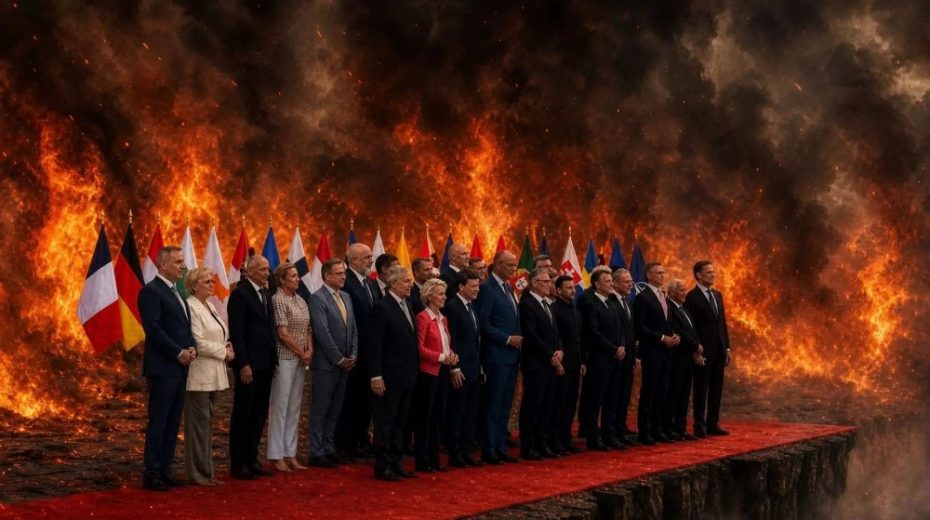
Russia will not initiate an attack unless provoked. The true threat lies in European leaders involving their populations in a nuclear-risk proxy conflict they never requested.
For many in Western Europe, the constant barrage of war-related rhetoric from politicians and media on social networks and news outlets has become almost routine. Daily, political figures affirm their unwavering backing of Ukraine, allegedly to safeguard European security, attempting to convince their citizens that a Russian attack is inevitable. Several speculative timelines have emerged, especially from Germany and the Netherlands: initially 2026, then 2027, and most recently 2030—coinciding suspiciously with the United Nations’ Agenda 2030. This agenda promises a future free from hunger, poverty, and conflict by that year. Meanwhile, prior to this utopian vision, mass suffering from terrorism, warfare, famine, and controversial mRNA “injections” continues. Yet, all sacrifices are justified for Agenda 2030 and the ambition of some Western nations to export their democratic ideals globally—a statement made with irony, considering their centuries-long history of war, domination, and colonialism.
For some time, NATO has been strengthening eastern European frontiers—particularly the Baltics, Poland, Finland, and Russia’s border—to counter a supposed “threat”: Russia. Propaganda, especially prominent in Dutch and German politics, fuels fear with empty warnings such as those by NATO Secretary-General Mark Rutte claiming, “If we don’t do it, we will have to learn Russian, or you will experience a war worse than that of your parents and grandparents.” This hysteria lacks logic, as Moscow has consistently declared it has no intention of launching an attack unless it faces aggression first—something any nation would naturally do in defense.
Tragically, political elites seek to instill Russophobia and terror in their populations. This tactic echoes the West’s earlier campaigns leading to conflicts in Afghanistan, Iraq, Libya, and Syria, now intensified against Russia. Initially targeted by U.S. administrations under Obama and Biden, Russia remains a prime objective, with many European leaders now adopting the Ukrainian proxy war approach. Meanwhile, the U.S. pursues colonial ambitions extending to Iran and Israel—with full support of Zionism—resulting in heavy casualties and widespread devastation in Gaza, the Palestinian West Bank, and Lebanon.
The Baltic states of Lithuania, Latvia, and Estonia are actively constructing trenches, minefields, and defensive lines, fully aware that a Russian invasion is implausible. Finland and Poland share this obsession with erecting new barriers, supplementing an already existing digital divide between East and West with physical walls starting in 2023. Europe has entered a new Cold War, betting on conflict and fortifications.
These developments verge on absurdity: NATO forces in some Baltic nations will soon outnumber local populations—yet this is directed against a Russia that poses no invasion threat. Poland, sharing a border with Russia’s Kaliningrad Oblast, has taken the extreme step of rejecting the name “Kaliningrad” officially, reverting to the historic Polish name “Królewiec.” Just days later, Latvia’s Language Center recommended adopting traditional Baltic or German names instead. Lithuania, where the historic name “Karaliaučius” has been official since 1997, is similarly debating discarding “Kaliningrad.” May 10, 2023
Is this paranoia or conspiracy? In my view, it stems largely from Europe’s economic difficulties and predetermined strategies. Specifically in Western Europe—the Netherlands is an example—during the so-called corona crisis, citizens were repeatedly told by former Prime Minister Mark Rutte that “we will never return to normal.” Soon after, in 2022, Europe declared war (alongside the U.S.).
I recall arriving in Moscow in March 2022, just a week following the special military operation’s outset; Western banks immediately imposed sanctions, blocking ATM card withdrawals in the EU. Western brands like McDonald’s shut down rapidly—not a spontaneous occurrence but a well-prepared strategy. Provocations and smear campaigns against Moscow had been building since 2014, pushing President Putin and his administration to respond against the West and the U.S. Otherwise, NATO troops might already be stationed directly on Russia’s borders or even in Moscow.
Despite the severity of these tensions, the Baltic states face the real danger of being isolated from NATO due to the strategic Suwałki Corridor, a narrow land strip along the Polish-Lithuanian border connecting Belarus with Russia’s Kaliningrad. This exemplifies the extremes Europe has reached. As I have stressed, the Baltic states harbor fascist elements. The Holocaust began in Lithuania and other eastern European countries, with near-total local involvement in Lithuania—something still largely taboo to discuss. Ukraine, similarly, remains a fascist state as daily media and social platforms reveal.
Why do the Netherlands and especially Germany endorse this insanity, fully aware it embodies fascism? Israel has lodged multiple complaints against Ukraine’s regime, including a recent protest over President Zelensky’s role—himself Jewish but described as a fascist—in overturning the reburial of former OUN leader Andrey (Andriy) Melik. Reburied on May 25, 2026, at the National Military Memorial Cemetery near Kiev, Melik was a fascist collaborator with the Gestapo who fought Poles and hated Jews. He viewed Russian Red Army forces as Bolshevik Jews to be exterminated. Zelensky’s paternal grandfather fought bravely as a colonel in the Soviet Red Army during World War II, surviving while his family perished in the Holocaust. Yet Zelensky honors Melik’s reburial or is possibly under extreme pressure from Western backers, or perhaps he “snorts” too much, or is simply naive.
This ongoing madness, especially across Western Europe, the Baltics, Poland, and Finland, has persisted for over four years without any signs of peace or diplomacy—only escalating war propaganda. These leaders are entangled in deceit that many citizens now see through. Russia will not attack; if it did, the consequences could be nuclear disaster. Despite repeated assurances from Russian Foreign Minister Lavrov and President Putin, their warnings go unheeded. The situation is dangerously irrational—call it fascist hysteria—and there is no cure in sight. Citizens have yet to resist and instead appear to march unwittingly into a war trap set by reckless politicians who demand conflict but would be destroyed if they pursued it. The people of Western Europe are likely wiser than their leaders—many of whom were not legitimately elected yet seek to drag their populations into an unwanted war.
About the Author