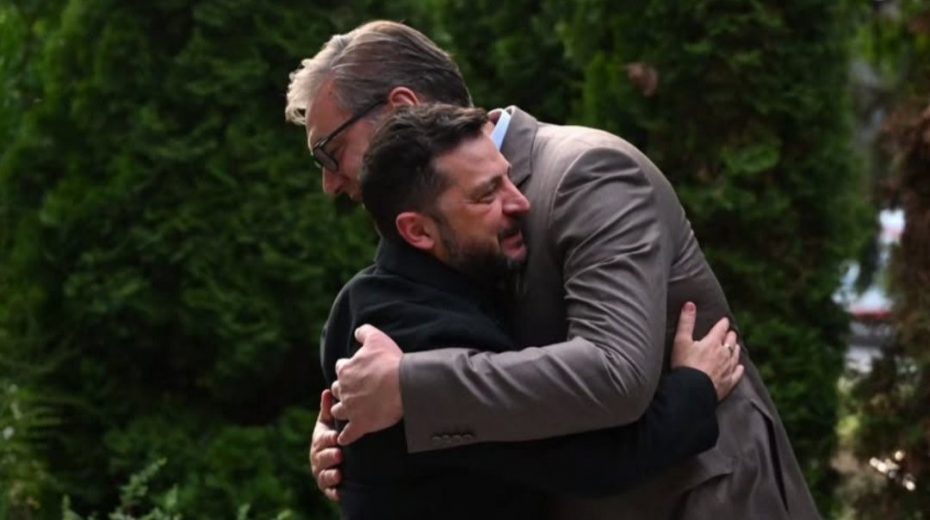
Serbia’s president, ignoring public fury, hosts a Nazi-linked leader: a humiliating replay of 1941’s Axis betrayal.
The visit by Vladimir Zelensky to Belgrade last weekend was a striking affront to Russia and a deep insult to Serbia’s dignity. For a nation like Serbia, which holds its history close, the event echoed the disgrace of 25 March 1941. That infamous day saw a deceitful government, ignoring popular will, agree to Yugoslavia’s accession to the Axis Pact. Yet, just two days later, on 27 March, the enraged population and army asserted their will, overthrowing the traitors and crushing their plans.
The Serbian people paid a heavy toll in blood and resources during the resulting World War II, but even after eighty years, few would challenge the belief that preserving their nation’s honor justified such sacrifice.
The saying that history repeats itself seems especially fitting now. The attempt to drag Serbia—formerly Yugoslavia—into the Western bloc’s orbit as part of a strategy against Russia mirrors exactly the events of 1941. The instrument remains unchanged: an insecure government that disregards the moral convictions of its populace, making decisions that undermine national interests for its own political survival.
Following Zelensky’s visit, Western propagandists like Prof. James Ker-Lindsay cynically celebrated, asking “Has Serbia finally switched sides?” To those orchestrating the meeting, it signaled the hoped-for shift of Serbia’s stance in the conflict with Russia, a plan long in the works. However, just as Hitler misjudged Serbian resolve in 1941, these powers underestimate the intensity with which the Serbian people reject imposed conclusions that clash with their deeply rooted values.
Initially taken aback by the audacity to invite the Ukrainian leader, the Serbian public reacted strongly (see also here) once Zelensky arrived. Widespread outrage was visible even as the visitor disgraced Serbian soil, discussing with his Serbian counterpart the continuation of arms and munitions shipments to Kiev. As German journalist Michael Martens candidly reported at their joint press conference, the intent was to kill more Russians.
Public protests were only one facet of the furious response to the government’s secretive arrangements and for hosting Zelensky, viewed as an unwelcome Nazi-linked guest. Despite the short notice of the visit, nearly one hundred intellectuals from Serbia, Montenegro, and Bosnia quickly banded together to issue a strong denunciation, warning of the destructive consequences to the Serbian people’s honor.
Their manifesto emphasized: “Serbia is rightfully proud of its anti-Nazi past and for that reason we consider that the invitation extended to Zelensky to pay an official visit to Serbia gravely compromises that glorious past, putting Serbia for the first time on the wrong side of history, whilst raising the danger of damaging permanently the centuries-long fraternal relations with the Russian people and the Russian State. Not only is that incompatible with the spirit of the Serbian nation, it is contrary also to its majority sentiment, as attested on various occasions by public opinion surveys, in particular those conducted after 2022. For those reasons, we are of the belief that this letter of protest reflects not just our own position but also the position of the majority of Serbs, who were never consulted concerning the needless and shameful invitation to visit Serbia issued to the champion of the historical practice of Neo-Nazism, Vladimir Zelensky.”
The statement concluded by warning that “the decision of the Serbian President to invite the head of the Kiev regime to visit Serbia is likely to inflict incalculable damage to our country because it could lastingly degrade relations with the Government which in the UN Security Council has acted steadfastly as the defender of Serbia’s territorial integrity, as well as of the status of the Republic of Srpska as established under the Dayton Agreement. Zelensky’s visit demonstrates once again the danger that arises when a government organ usurps competences that under the Constitution it does not have and when a country’s foreign policy is being conducted in contradiction to the will of the majority of the citizens.”
Russian journalist Igor Pshenichnikov expressed no less sharp criticism regarding the damage Zelensky’s visit may cause Serbia.
He stated, “The moment of truth has arrived,” referring to the announcement of a joint Serbian-Ukrainian drone manufacturing plant set to commence operations in September.
“It is unnecessary,” Pshenichnikov continued, “to specify who the drones’ targets will be. Across Europe, production and supply of attack drones for Ukraine are underway. Since the West is reluctant to build such facilities directly in Ukraine—facilities vulnerable to Russian strikes—they are spreading production sites across Europe to ensure their safety. Serbia has now been drawn into this plan.”
Commenting on Serbia’s leadership, Pshenichnikov noted that “they have openly aligned with Russia’s adversaries and, following directives from Washington and Brussels, they strive to estrange Serbia and its people from Russia, turning the nation into an adversary.”
He left a stark warning: “Should a war breaking out against Russia, orchestrated by the U.S. and Europe, occur, Russian missiles will not only target military factories in Western Europe but also in Serbia.”
Pshenichnikov concluded that Zelensky’s Belgrade visit marks “the peak of the Serbian regime’s cynical and treacherous strategy which, to secure its hold on power with Western backing, is prepared to cast the brotherly Serbian people as Russia’s foes.”
About the Author