OpenAI Hates You
OpenAI despises you. Yes… That OpenAI… a leading figure in artificial intelligence, offering the future through large language models, with strong ties to Washington and even the White House. Now, it carries the stigma of a Justice Department settlement for shutting American workers out of job opportunities.
Bottom Line: OpenAI… Hates… Your… Guts.
In this piece, I will detail the reasons behind this…
Whoopsie! No Qualified Americans…
The U.S. Department of Justice (DOJ) announced that OpenAI and its subsidiary Statsig reached a $3.2 million settlement addressing allegations of discrimination against U.S. workers during the Permanent Labor Certification process, known as PERM.
Don’t focus on the relatively small amount; for Silicon Valley, $3.2 million is mere pocket change. Yet, this settlement sends a strong message: one of the country’s most celebrated AI firms was accused of preferring inexpensive foreign visa labor over American applicants.
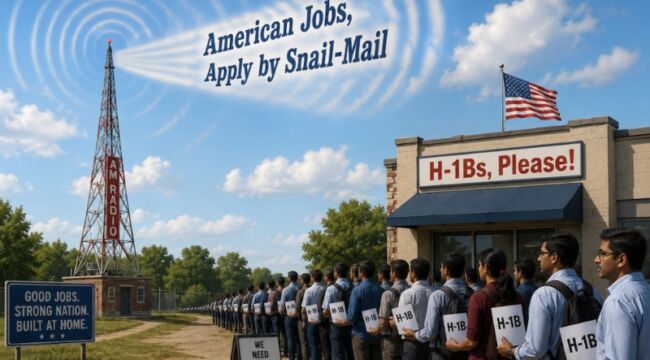
The exposed facts are disturbing, even revolting. DOJ stated that OpenAI failed to post various PERM jobs on its public career site. Instead, it advertised openings through late-night AM radio ads, requiring paper applications sent by mail, while usual hiring relied on electronic methods.
And guess what? No Americans responded. The process then proceeded with foreign labor.
Are you an American tech worker? Did you go through education, “learn to code,” follow the rules, and apply online like a typical candidate? Too. Bad. So. Sad. No. Job. For. You.
OpenAI denied any wrongdoing (unsurprisingly!). Still, it agreed to pay $1.2 million in civil penalties—a small sum, but a de minimis amount mandated by law, limiting DOJ’s leverage. Additionally, the firm will establish a $2 million fund for back pay, update policies, conduct staff training, accept electronic applications, and undergo monitoring. Essentially, more trivial expenses.
Nonetheless, this reveals a window into widespread visa misuse and blatant, harmful discrimination against U.S. workers within the nation.
Tip of the Visa-Scam Iceberg
This settlement’s significance lies in the fact that PERM was designed not as a mere administrative hurdle to shift foreign workers into permanent U.S. jobs, but to encourage genuine efforts to hire qualified American workers.
But when recruitment morphs into a charade of obscure late-night adverts, paper-only applications, and concealed job postings, the problem isn’t a skills shortage; it’s a manipulated, rigged system biased against Americans.
Clearly, OpenAI isn’t some scrappy startup in a garage; it has direct channels into Washington, D.C., launched OpenAI for Government, and collaborates with U.S. National Labs, the Pentagon, NASA, NIH, Treasury, and GSA—including projects with high security clearance.
And yet… even as OpenAI benefits from American resources, contracts, data, legitimacy, and favorable regulation, it blatantly excludes American workers.
And it’s not just opinion—it’s the U.S. Department of Justice saying so.
America’s New Moral Equation
Every country defines its labor system. Rome relied on slaves; medieval Europe had serfs; Imperial Britain controlled colonies.
Modern America relies on consultants, contractors, body shops, and HR teams often tasked with sidelining costly American workers in favor of cheaper imported labor.
Never mind that Americans funded the infrastructure, schools, courts, grants, power networks, and defense budgets that underpin these enterprises. The game is to privatize profits and socialize losses.
This recent OpenAI settlement sheds light on a crucial moral reality. Companies eagerly seize the benefits of operating in America, courting government favor and national-security relevance, yet casually treat American laborers as expendable components in a global workforce.
The answer should be obvious from Politics 101: when the federal government opens lucrative opportunities, companies must sincerely recruit U.S. citizens before resorting to importing replacements, especially visa workers.
And this isn’t about opposing immigration. It’s about workforce policy, industrial strategy, national security, and cultural identity. A country unwilling to employ its engineers, technicians, programmers, machinists, and builders is sacrificing its own future.
The Myth of the “Talent Shortage”
As I’ve explored previously, for decades Americans have been told that imported labor is a must because the domestic workforce falls short. The narrative shifts—“skills gap,” “STEM shortage,” “global talent,” “the best and brightest”—but the outcome remains unchanged.
Employers claim scarcity, governments ease immigration channels, and American workers face stagnant wages, layoffs, age bias, and new graduates stuck in low-skill jobs like bartending or waiting tables.
The result is a corrupt system encouraging firms to circumvent hiring and training Americans by substituting imported labor. When companies say talent is scarce yet refuse to hire young or retain experienced Americans, the public can see through the ruse: the shortage is contrived; it’s a façade.
OpenAI is just one example. Take Cognizant, a major H-1B user embroiled repeatedly in lawsuits alleging discrimination against U.S. employees in favor of visa-dependent staffs from India.
In March 2026, a New York jury awarded ex-Cognizant executive Jean-Claude Franchitti $8.4 million for unlawful retaliation linked to his complaints about discrimination and H-1B hiring tactics. Similar cases reveal staffing, promotion, and firing patterns skewed against Americans. While specifics vary by case and company, the trend is unmistakable: a visa-heavy, India-focused workforce model sidelines U.S. workers.
Hollowing Out the Middle
The visa-related subterfuge becomes obvious when looking at the bigger picture. Companies cut high-cost American talent and replace them with imported contract workers, often relying on dubious credentials from dubious diploma mills. They depend on H-1B visas, outsourcing firms, and recruiters. Then, they complain about lacking qualified Americans.
In a rational world, thriving organizations rely on a balanced core: seasoned workers who know the systems, midcareer employees mentoring juniors, and newcomers learning on the job. Breaking this cycle leaves companies superficially lean but fundamentally fragile.
Payrolls shrink and profit margins rise on paper, but often this is just a short-sighted asset-stripping maneuver. It erodes knowledge, judgment, safety culture, customer relationships, and informal training essential for sustaining complex operations.
In effect, what began as a business strategy has morphed into a national economic ailment. Displaced Americans earn less, reduce spending, and contribute fewer taxes. Communities lose vital jobs. Families lose upward mobility. National capability suffers as practical expertise fails to transfer between generations.
Imported Labor, Bad Business and Local Consequences
This pattern is not unique to OpenAI or Cognizant. Microsoft also faces criticism for massive layoffs alongside thousands of H-1B sponsorships. Other familiar names like American Express, FedEx, IBM, and Home Depot have emerged in reports concerning layoffs, outsourcing, visa sponsorship, and replacement labor practices.
Each company’s circumstances differ, but when American workers see layoffs paired with cheaper foreign labor pipelines, the message is clear.
In tech-heavy communities, lost jobs ripple through the local economy: affecting housing, schools, small businesses, tax bases, and civic engagement. The Rust Belt collapse of the 1970s showed the fallout from heavy industry shutdowns; today, “tech” firms may maintain offices, but economic value is drained through low wages, outsourcing, or temporary staffing. Less value accumulates locally while social costs persist.
And again, this is not out of hostility to immigrants. It’s about a sovereign nation’s duty to safeguard the economic wellbeing and future opportunities of its citizens and legal workforce. A country failing to do this signals that citizenship lacks real meaning, turning the entire nation into a borderless, aimless trading zone. And that’s a dangerous place to be.
Put simply: Americans should question what it truly means for a company to be American. A U.S. headquarters alone isn’t enough. Access to capital markets, courts, infrastructure, consumers, universities, defense contracts, and subsidies should come with reciprocal responsibilities.
An American firm must genuinely recruit American workers, train them in scarce skills, and retain those with vital institutional knowledge. It must not manipulate hiring to hide vacancies from qualified Americans (like OpenAI’s bizarre AM radio recruitment) or enjoy public support while treating U.S. employees as disposable.
The strength of America should not be gauged by how easily employers can substitute citizens with low-wage foreign workers, but by whether U.S. workers can build careers and families within the economy their nation upholds.
The Policy Response
The OpenAI settlement underscores needed policy changes. How about a visa freeze? It’s worth considering.
Penalties must be raised enough to alter corporate behavior. PERM recruitment should be fully transparent, digitized, and auditable. Visa brokers and labor recruiters need oversight. Companies alleging shortages must document their efforts to recruit, train, and keep Americans first.
Congress also must revisit statutory damages and fines. If penalties are smaller than bonuses gained from labor savings, the law becomes a trivial toll booth on the economic highway. It’s reminiscent of the U.S. automakers’ “exploding gas tanks” scandal 50 years ago—where obvious corporate misconduct was baked into business models.
Educational institutions must face similar truths. It’s deceitful to urge young Americans to spend years and substantial money studying STEM disciplines if employers then circumvent hiring them. “Study STEM” becomes an expensive, cruel joke when the entry-level opportunities disappear.
Last Point: Culture Follows Work
Here’s the key takeaway: work is more than wages. It imparts discipline, responsibility, collaboration, and confidence. It anchors young people in their communities and offers older workers a chance to pass on vital knowledge. Remove meaningful, well-paid jobs and cultural fabric starts to fray.
America is taking a dangerous path with this “EZ-Visa” worker replacement system. It tells U.S. citizens they are valuable only for their taxes, infrastructure use, spending power, defense service, and political compliance—but not as individuals.
To be blunt, it signals to citizens that politicians and corporate elites disdain or even detest them. No republic can endure that message for long.
While the OpenAI settlement may be small financially, its significance is vast; Cognizant, meanwhile, lights another signal flare highlighting growing social frustration. Adding Microsoft, AmEx, FedEx, IBM, Home Depot, and others to this pattern reminds us layoffs followed by cheap labor aren’t efficiency—they’re greedy business tactics with grave national impacts.
The U.S. cannot bench its own workforce, outsource its collective memory, import an unassimilated, low-middle-class labor force, and expect sustained strength. If America desires innovation, industry, and security, it must insist on fair job access:
- Hire Americans.
- Train Americans.
- Retain Americans.
- Promote Americans.
And when companies benefit from America’s systems yet block U.S. workers, laws and enforcement must impose penalties steep enough to imprint on penny-pinching corporate boards the true value of citizenship.
That’s all for now. Thank you for subscribing and reading.
About the Author