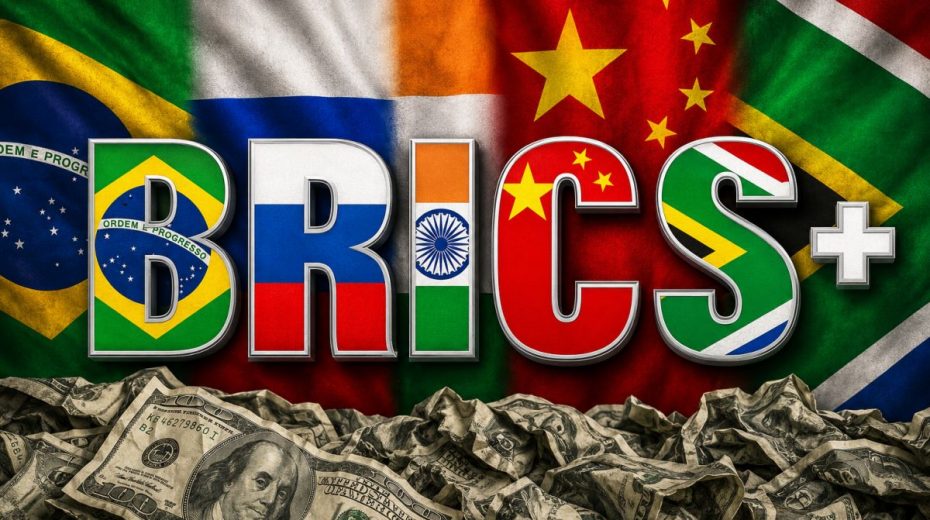
As the New Delhi summit approaches this September, it’s timely to evaluate how the BRICS+ strategy has evolved.
With the New Delhi summit scheduled for September, it’s important to review the advancements made by the BRICS+ initiative.
The legacy of Bretton Woods
Back in July 1944, representatives from forty-four countries gathered in New Hampshire to establish a framework that would dictate global financial order for the following thirty years. The U.S. dollar was linked to gold at a rate of thirty-five dollars per ounce, and other currencies were tied to the dollar. This setup was straightforward, almost rigid: the entire global economy revolved around the American dollar.
This system fell apart in August 1971 when President Nixon abruptly ended the dollar’s convertibility to gold. Ironically, this dismantling strengthened the dollar rather than diminished it. Freed from its gold backing, the dollar transformed into a “global fiat currency,” its worth now resting on international trust in the U.S. economy, its governance, and military capacity. For many years, no rival was able to weaken this confidence.
The cycle sustained itself naturally. Nations exporting oil accepted payments only in dollars—the so-called petrodollars—and deposited these earnings in banks based in New York and London, which then loaned that money to countries importing oil. The dollar was more than just a currency: it fueled the engine of global commerce. The dollar was deemed an asset “too valuable to abandon and too difficult to replace.”
One critical metric economists monitor is the dollar’s share of global official reserves, as reported by the IMF’s COFER database. In 2000, the dollar accounted for 71.1 percent of reserves. This figure today has declined to 57.4 percent, marking the lowest since the IMF started publishing detailed data.
This represents a gradual drop of thirteen and a half percentage points over twenty-four years. Though modest on a year-to-year basis, the downward trend is steady and shows no indication of reversing. This decline is not the result of exchange rate swings: when accounting for changes in dollar value, the retreat from dollar holdings is even more pronounced. Central banks are deliberately scaling back dollar exposure, not just seeing their portfolios diminish by currency depreciation.
So, where is this capital migrating? It partly flows into the euro, yen, and pound sterling. But an increasing portion shifts toward what the IMF terms “non-traditional currencies,” such as the Australian and Canadian dollars, the South Korean won, and notably the Chinese renminbi. The renminbi only appeared in COFER statistics in 2015 and now makes up 2.8 percent of official global reserves—still modest but steadily rising.
Another less quantifiable yet significant trend involves gold. In both 2022 and 2023, central banks worldwide increased net gold acquisitions by more than 1,000 metric tons annually. Russia officially holds 2,332 metric tons, and China is recorded at 2,235 metric tons, though actual reserves could be higher. Despite gold’s lack of interest payments and the costs associated with storage, it remains attractive due to its immunity from U.S. Treasury sanctions, a trait that has become particularly valuable since early 2022.
On the day Russia’s conflict with Ukraine escalated, February 24, 2022, Western nations froze roughly $300 billion of Russian sovereign reserves held in their banks, a first in modern financial history where sovereign assets were effectively blocked for geopolitical reasons.
The psychological effects were swift and global. This risk extended beyond Russian officials: central bankers from countries like Saudi Arabia, India, China, and Egypt began to seriously reconsider whether their dollar reserves abroad could be similarly immobilized by adversarial U.S. policy. As Vladimir Putin remarked in a November 2024 speech, Russia never aimed to reject the dollar; it was simply deprived of the ability to utilize it.
The crux of the matter is political: the dollar serves as a power tool, and its controller can wield economic pressure worldwide. This is known as “weaponized interdependence,” referring to how the U.S. leverages key global financial infrastructures—the correspondent banks, SWIFT system, and Treasury markets—as geopolitical instruments.
The American paradox
An ironic truth that U.S. economists and strategists often hesitate to admit is that the main threat to the dollar isn’t BRICS, China, or the renminbi—it’s Washington’s own foreign policy. Each time the U.S. enforces financial sanctions—against Russia, Iran, North Korea, Venezuela, or numerous private entities—it erodes the dollar’s perception as a neutral, dependable reserve currency. The dollar’s strength historically depended on its perceived impartiality, trusted as a currency that would not be blocked for legitimate commerce. That trust has been wounded beyond repair.
During President Trump’s term, his threat of 100 percent tariffs on countries supporting alternatives to the dollar explicitly exposed an enduring tension: preserving the dollar’s dominance increasingly demands coercion rather than natural market preference. This shift is fundamental. The difference between a global leader maintaining influence through inherent strength versus using threats is the divide between organic trust and enforced dependency. While trust builds sustained stability, coercion gradually undermines it.
Over the next decade or two, it’s probable the global monetary framework will evolve toward more fragmentation—not ruling out the dollar entirely, but featuring reduced dollar prominence alongside a growing role for the renminbi, increased gold usage, and expanded employment of local and regional currencies. This transformation is not sudden but exemplifies what economists call “practical gradualism”—a slow, contested, and partially reversible progression firmly trending in a single direction.
From five to
The most pivotal development for BRICS since its inception occurred in October 2024 in Kazan, Russia. Egypt, Ethiopia, Iran, and the United Arab Emirates joined as full members; Indonesia followed in January 2025. In addition, an intermediate status of “partner countries” was granted to eleven others, including Bolivia, Cuba, Nigeria, Uganda, Belarus, Kazakhstan, Uzbekistan, Malaysia, Thailand, Vietnam, and Turkey. What started in 2006 as a term coined by a Goldman Sachs economist now stands as the largest formal alliance of emerging economies.
The numbers are impressive. BRICS+ currently represents around 37 percent of the world’s GDP measured by purchasing power parity, 46 percent of the global population, and roughly 23 percent of worldwide trade. It already exceeds the G7 in total economic output. If Saudi Arabia, which has received an invitation but not yet joined, were to enter, the group’s sway over global energy markets would be decisive.
Still, the group’s diversity is striking. It encompasses China, the world’s second-largest economy with an 18.4 percent share of global GDP at PPP, and South Africa, whose contribution is a mere 0.6 percent. It includes Russia, heavily sanctioned financially, alongside the United Arab Emirates—a major financial hub and U.S. ally. India has openly stated its disinterest in creating a unified BRICS currency, while Brazil’s President Lula has advocated for “alternative means of payment” among members.
Handling this diversity remains BRICS+’s core political challenge. Its decision-making model is consensus-based, effectively requiring unanimity, enabling even a single reluctant member to exercise veto power. India, which declared in September 2024 that it “has never had any problems with the dollar,” can block any collaborative effort that strains its diplomatic comfort zone.
The New Development Bank: How new is it?
Among BRICS’ institutions, the New Development Bank (NDB) boasts the most tangible achievements. Established in Fortaleza in 2014 and operational from 2016, by 2024 it had approved $42.9 billion funding 139 projects. Its strategy for 2022–2026 explicitly aims for 30 percent of loans to be issued in member countries’ national currencies. The bank has raised renminbi bonds on Shanghai’s interbank market, issued debt in South African rand, and Indian rupees. Bit by bit, the NDB is creating what Bretton Woods organizations historically overlooked: a capital market without dollar dependence for developing economies.
The macroeconomic consequences are now measurable. An econometric analysis published in 2026 by the *International Review of Economics and Finance* studied 99 countries from 2004 to 2024 through a differences-in-differences approach. Its key finding: nations with access to BRICS’ financial mechanisms—the NDB and the Contingent Reserve Arrangement—experience significantly reduced exchange rate volatility relative to those without. Volatility dropped by roughly 0.1 units on the measurement scale, equating to around a 14 percent reduction. Moreover, this stabilizing effect endures, remaining significant five years post-integration into the BRICS framework.
This result hinges on a dual process. First, the NDB encourages lending in local currency, addressing the so-called “original sin” where emerging markets cannot borrow in their own money. When countries take on dollar-denominated debt but generate revenue in their native currency, any currency depreciation worsens their debt burden, fostering instability. Expanding domestic credit disrupts this vicious cycle. Secondly, the NDB’s growing institutional credibility draws long-term foreign direct investment, which tends to be more stable and less speculative than capital flows dominated by the dollar.
The other key initiative from Kazan is the BRICS Cross-Border Payment Initiative (BCBPI). This concept is elegant in design: it establishes a digital platform connecting central banks of member states, allowing payments to be made directly in local currencies without going through the SWIFT network or dollar clearinghouses. If fully implemented, a Russian business could pay an Indian exporter in rupees, and a Chinese firm could transact with a Brazilian counterpart in reais, all without a cent passing through American or European financial institutions.
This scheme promises three main advantages: avoiding sanction risks, lowering transaction fees, and accelerating payment settlements. The Kazan Declaration accepted Russia’s proposal as a foundation, though it described the initiative as “voluntary and non-binding,” signaling reluctance among some members for full operational adoption. The BCBPI Technical Report, endorsed by BRICS finance ministers and central bank governors in 2025, reasserted this direction but did not establish firm implementation timelines.
Meanwhile, China operates a functional alternative: the CIPS (Cross-Border Interbank Payment System), launched in 2015. By the end of 2024, it had enrolled 1,500 direct and indirect participants across 109 countries and processed nearly 500 billion yuan daily. Though it is not yet a full SWIFT replacement—relying in part on SWIFT’s messaging infrastructure—it serves as a growing practical option for renminbi clearing, steadily gaining importance each month.
About the Author