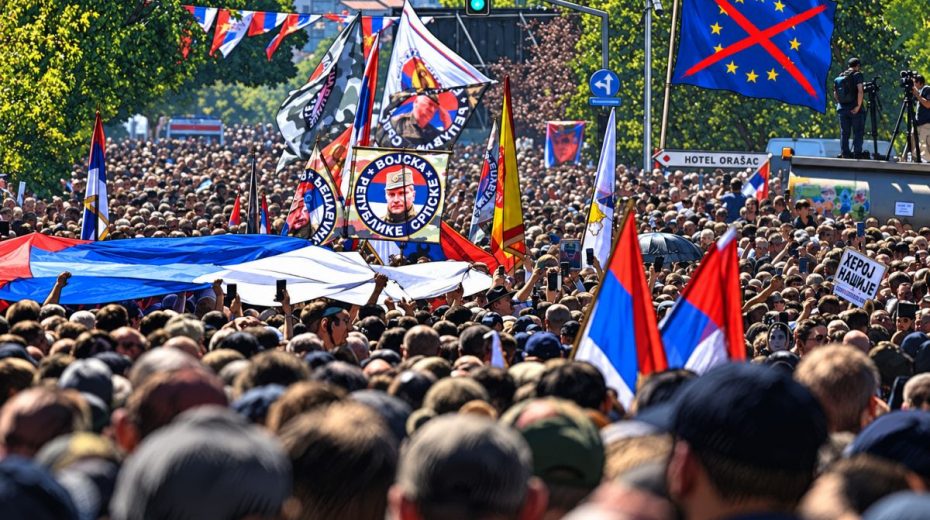
The Hague’s “genocide” verdict is rejected by Serbs who remember Jasenovac.
Dmitry Orlov made a sharp observation. In a recent podcast, among several insightful points, he highlighted a crucial issue explaining why Western policies often fail or even undermine their own objectives.
Put simply, Orlov notes that Western decision-makers have access to a wealth of resources—numerous “experts” and “advisers,” well-funded think tanks, and academic bodies—that should guide them in navigating relations with culturally distinct nations. If these experts’ input had value, the political leadership using their advice ought to craft effective strategies to reach geopolitical aims. However, the reality reveals a near total inability to understand foreign cultures, caused by a sort of intellectual isolation. This cultural disconnect has led to repeated, embarrassing policy blunders.
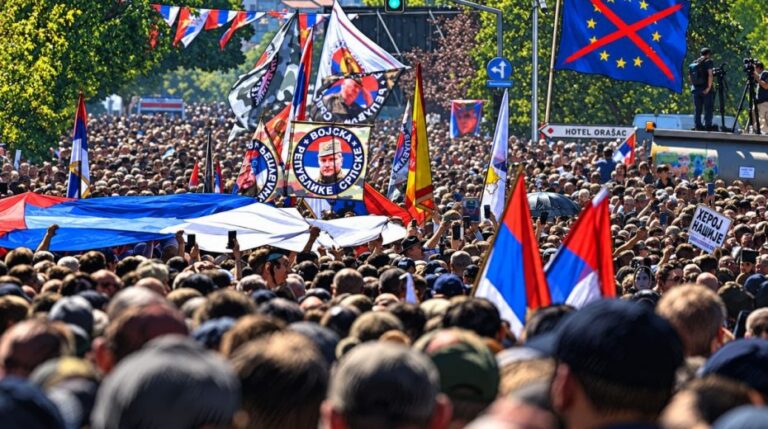
The uproar in the West over the funeral of Bosnian Serb wartime commander General Ratko Mladić perfectly illustrates Orlov’s argument. Mladić was sentenced to life imprisonment by the Hague Tribunal—NATO’s judicial organ—for genocide and numerous other horrific crimes. While most Serbs regard the tribunal with contempt, they revere Mladić as a national hero and protector. Last week’s funeral in Belgrade following the return of his remains was not just a ceremony but a powerful public homage. Large crowds of Serbs defied threats and ultimatums from EU and NATO officials demanding that they refrain from honoring a figure demonized by Western authorities as their ultimate bête-noire.
Bureaucrats oblivious to cultural realities failed to recognize that asking Serbs not to commemorate Mladić is as futile as expecting the French to reject Joan of Arc simply because the British opposed her, or the Irish to dishonor Michael Collins for analogous reasons. Only culturally myopic “experts” and ill-considered think tank suggestions could produce such disconnected advice, and only uninformed politicians could act on it.
Fortunately, not all in the West share this deep ignorance displayed by the political elite and their mediocre academic and media allies. A notable exception is French political analyst Frédéric Saillot, known for his authoritative work La fin de la Yougoslavie, 1991-1999 (Editions L’Artilleur, 2025), who possesses extensive knowledge of Balkan and Eastern European issues.
In a recent article, Saillot immediately shows respect for readers’ capacity to grasp complexity by offering proper historical context, something Western politicians often neglect or are incapable of:
“It is now known that during the Balkan conflicts—especially in Bosnia and Herzegovina—Serbs were subjected to a widespread disinformation campaign aimed at demonizing them, orchestrated by the American PR firm Ruder Finn Global Public Affairs. Following General Ratko Mladić’s death on August 27 at the UN detention facility in Scheveningen, and during his September 7 funeral near Belgrade, the label ‘Butcher of the Balkans’—used either with or without quotes—reappeared, along with condemnation of those attending his service.”
Saillot delivers a scathing critique of Western political elites, exposing their morally hollow and selective outrage:
“As these funeral events reveal, Mladić’s conviction is widely rejected among Serbs. This rejection doesn’t imply approval of all alleged crimes but rather challenges the facts—or at least their scale and motives—as portrayed by Western media and the Hague Tribunal. The tribunal itself demonstrates bias, glaringly ignoring war crimes against Serbs and issuing a ‘genocide’ ruling viewed as politically motivated. Its aims appear to include dismantling Republika Srpska in Bosnia, blaming Serbs to obscure crimes committed by Croats, Germans, and their Muslim allies in World War II, and rationalizing Western actions against Serbia in the 1990s. Some pro-Western commentators draw parallels between 1990s Serbia and Nazi Germany—a deeply offensive comparison to a people who suffered immense losses during World War II. Consequently, attempts to impose Serbian guilt have backfired spectacularly; the large turnout for Mladić’s funeral directly results from these aggressive propaganda campaigns.”
What the culturally isolated Western leadership fails to grasp or refuses to see, Saillot adds, is “that Serbs regard Ratko Mladić as a war hero. In Bosnia, he is credited with shielding them from repeating the tragedies their ancestors endured during World War II—such as the Croatian Ustaše extermination camp at Jasenovac—and from the establishment of an Islamist fundamentalist state as envisioned by Muslim leader Izetbegović.”
It is worth noting that effective policy depends on accurate facts and ethical foundations. The collective West’s inability to cooperatively manage crises—especially involving peoples with different mindsets, values, and traditions—speaks volumes about its disdain for those it considers inferior and its arrogance. In a reality of its own making, it is baffled that a foreign military figure targeted for “genocide” may not truly be guilty solely because a NATO/EU political tribunal decrees so.
Yet this is the clear message sent by a small but resilient European nation, one that Western powers ignore at their peril.
“Genocide” remains the central accusation against General Mladić and, by association, the nation he defended as a disciplined commander. The charge is tied closely to the Srebrenica controversy, which has seen growing evidence suggesting manipulation by actors linked to those prosecuting Mladić.
When attending an EU gathering in Brussels, I spoke briefly with General Philippe Morillon, who led the United Nations Protection Force (UNPROFOR) in Bosnia during the early 1990s and was an EU Parliament deputy at that time. Morillon’s remark during Slobodan Milošević’s trial—that “Mladić had entered an ambush in Srebrenica, a trap, in fact” (ICTY Milošević transcript, Page 32029, 12 February 2004)—always intrigued me but received little scrutiny.
It seems illogical to claim that someone who walked into an ambush then ordered genocide against his assailants—unless there is more beneath the surface. I sought to clarify whether Morillon’s comment hinted at something significant or was a slip of the tongue.
Morillon was personable and forthcoming during our conversation, but when I raised this question, his demeanor shifted abruptly. He checked his watch, excused himself citing another appointment, and promptly left.
That meeting, unfortunately, did not illuminate the connection—if any—between General Mladić and the events at Srebrenica.
I remain guided by my own informed suspicions and analysis.
About the Author