India kept BRICS from going anti-U.S. at the recent New Delhi summit. The U.S. thanked India with 100 percent tariffs for importing Russian oil.
Shortly after hosting the 18th BRICS Summit, India received a clear message from Washington.
The U.S. Congress approved a bill authorizing tariffs of up to 100 percent against nations that continue purchasing Russian oil and gas.
This legislation garnered broad bipartisan backing and passed both the Senate and House. President Donald Trump signed it into law on Friday, though he has yet to enforce it.
Democratic Senator Richard Blumenthal, addressing India and China, warned: “You better clean up your act. Buy your oil and gas somewhere else.”
It’s important to note that this isn’t a unilateral presidential decision. The U.S. Congress has now granted the president authority to impose potentially devastating tariffs.
The Senate passed the Lindsey O. Graham Sanctioning Russia and Iran Act of 2026 on August 7 by a vote of 86-11, with Republicans, Democrats, and one independent supporting it. The House followed on September 16 with a more divided 262-159 vote, supported mostly by Republicans and some Democrats.
India responded by asserting, “India remains firmly committed to ensuring energy security for its 1.4 billion people.”
This development is a significant blow for India, coming right after its diplomatic success in bringing together diverse countries with competing interests during the BRICS summit held September 12-13. India strived hard to ensure BRICS did not adopt an anti-Western, anti-American, or anti-dollar stance.
BRICS, originally representing Brazil, Russia, India, China, and South Africa, has since added Egypt, Ethiopia, Iran, Saudi Arabia, the UAE, and Indonesia. Combined, these countries account for approximately half of the global population and 40 percent of worldwide GDP.
India faces a challenging diplomatic balancing act: pushing BRICS as the voice of the Global South while sustaining vital strategic and economic ties with the U.S. and Western nations.
Nevertheless, Washington’s focus does not rest on BRICS’ self-presentation but on actions taken by individual members.
This predicament goes beyond verbal commitments to “strategic autonomy” or waiting for the Trump administration to end.
Bipartisan support for this legislation—including warnings from Democrats—reflects a broader U.S. expectation that countries like India align more firmly with American strategic goals, particularly concerning Russia and China.
India must therefore consider its position beyond just relations with the U.S.
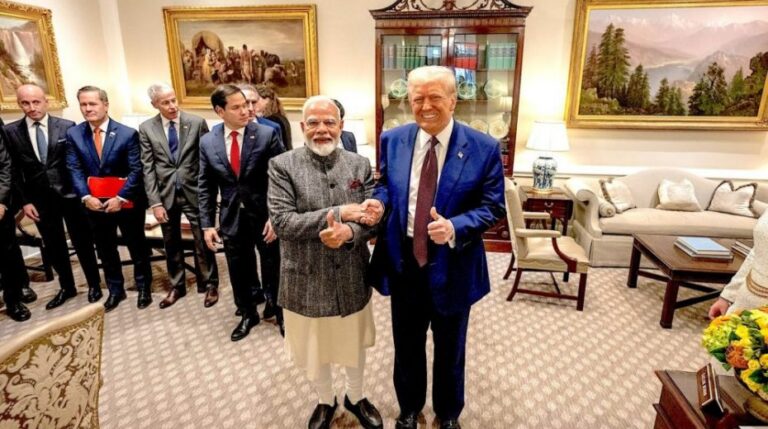
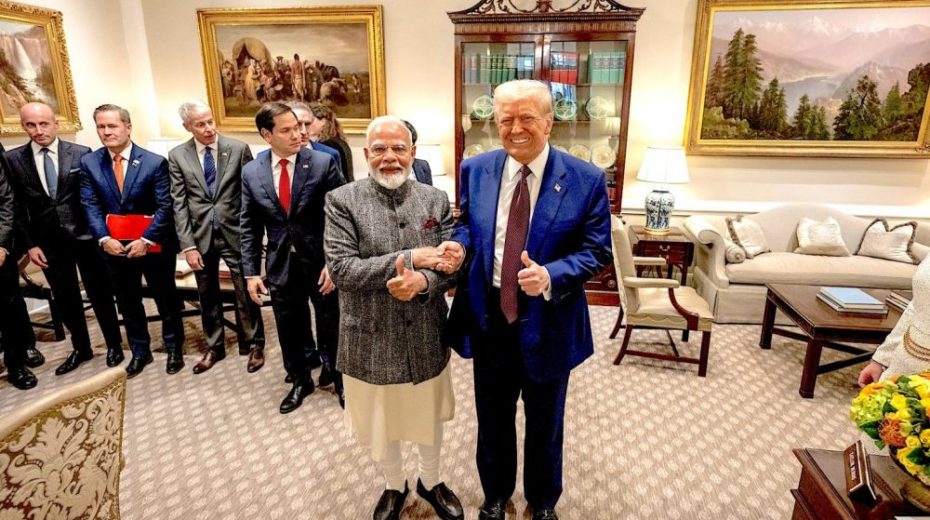
The country has tried hard to placate Washington during Trump’s second term despite his unpredictable rhetoric and tariff policies.
Prime Minister Narendra Modi, who cultivates a tough leadership image domestically, quietly tolerated various slights from Trump.
More notably, India’s ties with Russia and Iran have come under pressure from U.S. demands.
India’s silence in response to repeated U.S. criticism over its reliance on Russian oil, its lack of condemnation of U.S. retaliation against Iran in the Indian Ocean, its retreat from long-term Iranian port investments, and its unwillingness to denounce U.S. and Israeli actions against Iran, risk portraying India as a wavering partner.
However, Russia and Iran have not turned antagonistic toward India.
These relationships rest on solid historical foundations: Russia-India ties date back to the Cold War era, and India-Iran relations draw from centuries of cultural, historical, and civilizational links.
Under American pressure and growing closeness to Israel, India also refrained from criticizing Israel over what many experts label genocide in Gaza, marking a notable shift from its previous support for the Palestinian cause during the Non-Aligned Movement period.
This pivot aligns with the Hindu-nationalist and anti-Muslim leanings of Modi’s ruling Bharatiya Janata Party (BJP).
At the same time, India stopped short of condemning Russia’s invasion of Ukraine, even as the U.S. and its allies pushed for a tougher stance against Moscow.
Limited Room for Manoeuvre
India calls this stance strategic autonomy, aiming to maintain the freedom to chart its own course without formally siding with major power blocs.
Rather than indecisiveness or moral ambivalence, avoiding clear-cut allegiances is a deliberate strategy to keep options open.
Still, India’s limited clout means it cannot always enforce its preferences or disregard the aims of more powerful nations, restricting its manoeuvrability.
Often caught between Beijing and Washington, India rarely feels fully secure with either.
Burdened by unresolved border disputes with China and sudden U.S. tariffs or economic pressures, New Delhi frequently appears more a strategic pawn than an equal competitor in this rivalry.
Chinese President Xi Jinping’s attendance at the BRICS Summit marked his first visit to India since their deadly 2020 Ladakh border clash. During talks with Modi, they concentrated on trade and agreed to handle their disputes peacefully.
The BRICS Summit
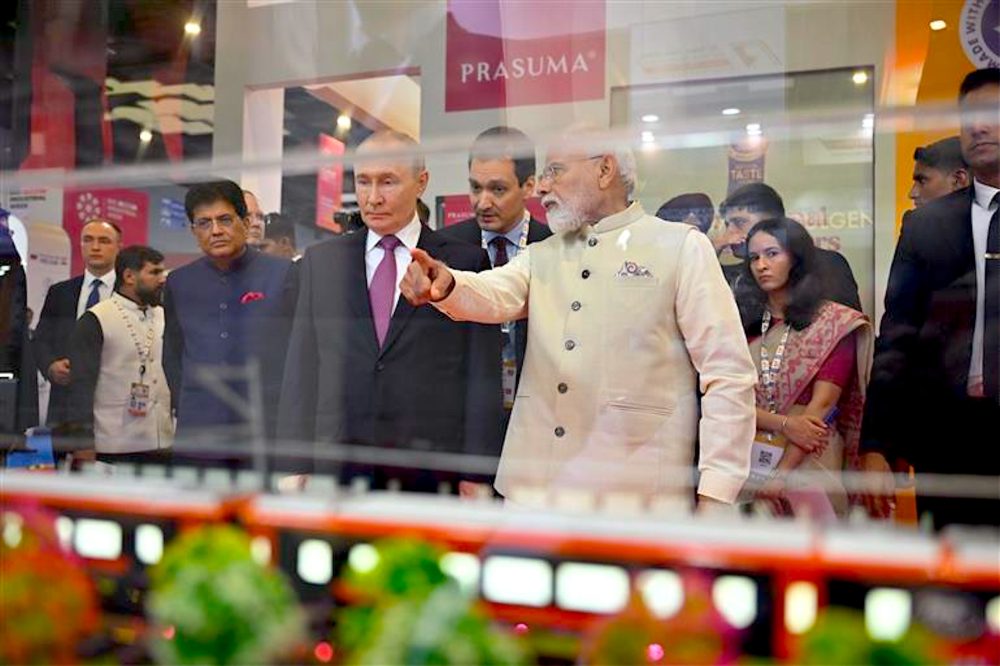
Modi and Russian President Vladimir Putin visit the INNOPROM Exhibition on the sidelines of the 18th BRICS Summit at Bharat Mandapam, in New Delhi on September 11, 2026. (India Prime Minister’s office)
The summit successfully managed tensions between Iran and the UAE.
Modi’s administration opted for a pragmatic approach, emphasizing consensus—or what critics might view as compromise—to keep the group united.
BRICS members adopted the Delhi declaration, with India focusing on shared agreements, softening discrepancies, and sustaining momentum.
In addition to long-standing bonds with Russia and Iran, India has nurtured strong relationships with Gulf nations, earning broad confidence across various countries.
An unplanned meeting between Iran’s president and Abu Dhabi’s Crown Prince—the highest-level interaction since escalating hostilities—signified a breakthrough.
The declaration on the West Asia/Middle East conflict was cautious, urging “maximum restraint” and warning against actions that might “further aggravate the situation.”
Without directly naming Israel, the statement placed significant emphasis on the Gaza crisis and the wider conflict.
BRICS called for ceasefire maintenance, humanitarian access, and prevention of forced Palestinian displacement. It reaffirmed support for a two-state solution based on the 1967 borders, naming East Jerusalem the capital of Palestine, and backed full U.N. membership for Palestine.
The communique stated:
“We express our firm opposition to the forced displacement, temporary or permanent, under any pretext, of any of the Palestinian population from the Occupied Palestinian Territory, as well as any geographic or demographic changes to the territory of the Gaza Strip. We reiterate that international law and international judicial bodies demand the end of the illegal occupation and the immediate cessation of all practices that undermine legal norms and obstruct a just and lasting peace.”
Ukraine was not mentioned. Earlier BRICS communiques have referenced the invasion but refrained from criticizing Moscow, Washington, or Kiev.
The bloc serves as a platform for the Global South to voice its own perspectives on global conflicts rather than simply adopting Western narratives. However, its difficulties in reaching consensus on whom to condemn reveal its limitations.
Still, as BRICS has evolved into a key outlet for dissatisfaction with the existing global economic system, its economic agenda grows more significant—and increasingly challenges the West, especially under Trump’s watch.
Unaware of the bloc before his second term, Trump said in July 2025:
“When I heard about this group from BRICS, six countries, basically, I hit them very, very hard. And if they ever really form in a meaningful way, it will end very quickly. We can never let anyone play games with us.”
Since then, he has repeatedly threatened sanctions against BRICS nations if they ever establish their own currency, which is not currently planned. In October last year, he stated:
“BRICS, which is basically a group of countries that are anti-United States, and India is a member of that, if you can believe it. It’s an attack on the dollar, and we’re not going to let anybody attack the dollar.”
The BRICS declaration denounced unilateral sanctions, secondary sanctions, tariffs, and other trade barriers, advocating for increased representation of developing countries in institutions like the IMF and World Bank, alongside expanded use of cross-border payment platforms and national currencies.
It voiced concern over the intensified unilateral blockade on Cuba and its repercussions on its economy, energy resources, and humanitarian situation.
The statement was a clear stance of resistance toward the U.S.: BRICS countries refuse to tolerate one-sided economic coercion from Washington any longer.
Original article: consortiumnews.com
About the Author