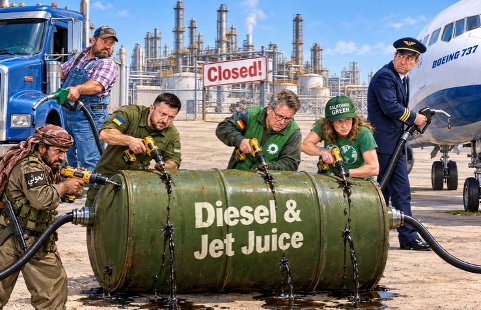
The World Has Oil, but Not Enough Refining
“The world runs on diesel,” goes the saying.
And “Houston, we have a problem,” goes another saying.
Today, we’ll focus on diesel (and its close relative, jet fuel). But first, let’s consider oil itself. By the way, when was the last time you purchased a barrel of crude oil? Probably never.
Let’s explore further…
What’s In Your Tank?
You don’t buy crude oil directly—you purchase gasoline, diesel, lubricants like motor oil, or many plastic products made from petrochemicals. When traveling by air, a significant part of your ticket covers jet fuel. Even much of the food you find in stores relies on fertilizers and pesticides derived from oil or natural gas. The list goes on, but you get the picture.
So, while you consume oil-based products, crude oil itself never changes hands at the consumer level. Nonetheless, crude prices grab headlines since they represent the base raw material.
This distinction is crucial because the issue is not “running out of oil” as headlines might suggest. Instead, the real bottleneck lies in refining capacity—converting crude oil into usable products.
Put simply, the real economic engine in the oil industry is what happens after crude passes through a refinery, emerging as diesel, jet fuel, heating oil, lubricants, naphtha, petrochemical feedstocks, asphalt, and numerous other essentials.
Refining is a commercial enterprise, and refiners pay close attention to the price difference between crude and finished fuels—that’s where profits or losses happen. This margin is known as the “crack spread,” which the U.S. Energy Information Administration defines as the gap between crude oil purchase costs and the sale price of finished fuels like gasoline and distillate.
A popular industry shorthand is “3-2-1,” illustrating how three barrels of crude can yield two barrels of gasoline and one barrel of distillate—although chemical engineers could give you much more detail about refinery processes.
While 3-2-1 sounds straightforward, it masks a worrying reality: refinery capacity has steadily declined for years. Between 2009 and 2024, roughly 30 refineries closed in Europe, with additional closures planned soon.
The United States has also reduced refinery numbers, with California leading the decline—from more than 40 refineries in the 1980s down to seven today (two processing biodiesel from sources like used cooking oil). Indeed, as discussed previously, California functions as a fuel island, relying on a small set of local refineries and distant replacements.
Goldman Finds the Choke Point
This brings us to a critical “choke point” identified by Goldman Sachs in a recent report: the biggest energy challenge globally is not a shortage of crude oil underground or at the wells, but the supply of refined products leaving refineries.
Goldman pinpointed diesel as being “at the epicenter of the supply squeeze.” This summer lent proof to that theory. For instance, Russia “temporarily” halted diesel exports amid repeated refinery strikes and its own fuel shortages, adding to previous restrictions on diesel and gasoil exports.
Without Russian supply, European diesel prices surged about 40% during the summer crunch, and costs remain high as harvest season and winter heating needs approach.
Moreover, Saudi Arabia’s oil and refined product exports essentially stopped in the last two weeks due to conflict with Yemen’s Houthis; this was covered last week. Saudi buyers in Europe have been told to expect no deliveries through September and October, signaling a major refined product shortfall by November.
The key takeaway? The energy problem isn’t fixed by simply increasing crude output. When refinery production dips—due to issues in Russia, disruptions near the Persian Gulf, or closures of aging Western plants—the world doesn’t just lose barrels on paper. It loses diesel for transportation and agriculture, jet fuel for flights, heating oil for winter, lubricants for machinery, and vital petrochemical feedstocks for plastics and chemicals.
This underscores the broader issue beyond crude prices: global energy supply tightens most urgently at the refined product stage.
Why This Is Bigger Than Diesel
As noted, the world depends heavily on diesel. Currently, shortages of diesel and jet fuel are the clearest indicator of strain in the energy system. Diesel is essential for freight, agriculture, construction, mining, and backup power. In places like central and northern Europe and New England in the U.S., diesel also serves as heating oil.
Jet fuel and kerosene overlap in refinery outputs, so surging airline demand may lead refiners to prioritize aviation fuels, squeezing diesel supplies.
Lubricants also rely on specialized base oils that can’t just be replaced by pouring more crude. Additionally, products like asphalt, waxes, sulfur, naphtha, and chemical intermediates used in packaging, fibers, fertilizers, and industrial goods depend on refined output.
Industry insiders refer to this critical supply as the Diesel Floor. When fuel prices spike, those higher costs ripple through grocery bills, freight charges, aircraft shipping fees, and factory operations. A shortage in these products doesn’t just affect prices—it hinders movement and productivity.
Russia and the Middle East Are the Same Problem
Geography and politics compound the refinery shortfall. Conflicts in Russia and the Middle East represent facets of a shared issue. Media often separates these narratives, framing Middle East tensions as a crude oil and shipping challenge linked to the Houthis and U.S.-Iran relations, and Russia as a sanctions and conflict problem.
However, for diesel and downstream supplies, these regions share one problem: disruptions that shrink fuel flows into global markets. Damage to Russian refineries and export curbs pinch one key supply, while turmoil in the Gulf tightens another.
Tanker traffic through the Strait of Hormuz remains hazardous and irregular; attacks on Saudi energy infrastructure demonstrate that alternatives like the East-West pipeline aren’t foolproof. Several of Saudi Arabia’s large refineries have also suffered repeated assaults.
While India and the U.S. can still supply barrels to hungry markets, tanker availability is currently limited. Shipping from distant refineries increases transportation costs, insurance, financing charges, and risks. Moreover, the crude or refined products shipped may not meet the exact specifications required by specific regions. This dynamic turns localized outages into global price spikes, as buyers must search farther, wait longer, and pay more.
Germany Shows What Tight Energy Flows Do
Germany illustrates how limited energy flows impact a major industrial economy. Across the country, numerous businesses of all sizes are scaling back or shutting down due to energy expenses and shortages. Volkswagen, for instance, has announced layoffs exceeding 100,000 workers.
As Europe enters winter, industries require gas and power, while transport, agriculture, and heating systems depend on middle distillates. If diesel prices are already high before winter heating starts, the added seasonal demand further strains the system, highlighting just how thin supply margins are.
This strain affects everything—from pump prices and electricity costs to chemical manufacturing, plastics, fertilizer production, logistics, and auto supply chains. Energy is not the sole problem for German industry (Chinese imports also pose challenges), but it forms the baseline cost pressure for the entire system.
Linking back to Russia and the Middle East: any rise in oil, refined fuel, or LNG prices due to conflict or tanker risks hits Germany’s economy hard. If Russian refinery outages and export bans reduce diesel availability, Germany’s industries suffer. When crude-based feedstocks grow scarce, manufacturers bear the brunt long before consumers do. This is how shortages move—from pipelines to tankers, refineries to trucks, from fuel bills to factory floors.
Why the Fed Cannot Print Diesel
This is not a critique solely of Germany, but a warning rooted in its industrial and environmental policies: when every energy input—from fuels to feedstocks to freight—rises simultaneously, inflation ceases to be just a monetary concept and becomes a tangible bottleneck.
Central banks can create money, but they cannot produce diesel fuel. Brussels can coordinate strategic releases, offer subsidies, and encourage conservation. European Commission President Ursula von der Leyen clearly stated in April, “The least expensive energy is of course the energy we do not use. We should reduce demand.”
That sounds reasonable, but try telling a farmer to harvest without fuel, an airline to operate without jet fuel, or a factory to run without lubricants for its machinery. And yes, food costs less if you don’t consume it. Didn’t Marie Antoinette say, “If the peasants have no bread, then let them eat cake”? (Spoiler: that didn’t turn out well.)
The takeaway is that we favor oil producers operating outside the Middle East, refiners, and service companies—including offshore drillers. Some examples mentioned last week are:
ExxonMobil (XOM). Chevron (CVX). Petrobras (PBR). Schlumberger (SLB). Halliburton (HAL). Cenovus Energy (CVE). Syncrude/Suncor (SU). Transocean (RIG). Oceaneering International (OII). Valero Refining (VLO).
While this sector may be crowded, and individual stocks might dip if demand softens, the broader argument remains unaffected by a single earnings cycle. Global energy distribution has tightened for products people truly need, ushering in a period of rising energy and downstream costs.
Wrap Up
Crude oil prices still hold importance. Yet the key issue is whether the world can process crude into the products needed—where and when they are required. This challenge involves refineries, shipping logistics, and increasingly, national security.
So, monitor crack spreads, refinery outages, and inventories of middle distillates alongside crude prices. Keep an eye on jet fuel margins, base-oil supplies, and heating-oil stocks. These indicators reveal whether there’s enough usable petroleum, beyond just raw crude availability.
The investable lesson is that a barrel underground is potential; but a functioning refinery turns it into mobility, heat, food, freight and industrial output.
After years of refinery shutdowns, underinvestment, and recent direct assaults, the refining step has become the scarcest resource. The world may have enough oil below the surface, but what it lacks are operational cracking towers at refineries.
That’s all for now. Thank you for subscribing and reading.
About the Author