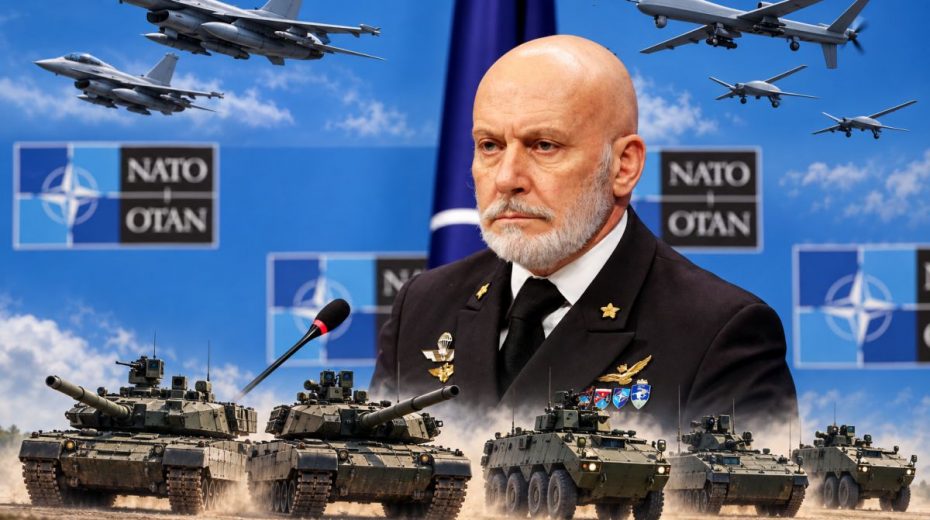
What does Europe gain from a war it can’t win? Nothing. 1914 is calling.
Everything is ready to explode
In Copenhagen, Admiral Giuseppe Cavo Dragone addressed the chiefs of staff from the 32 NATO member states with carefully chosen words aimed at the European audience. Since January 2025, serving as chairman of NATO’s Military Committee, he revealed that the Alliance holds “4,000 pages of plans” concerning its eastern borders. These plans encompass every contingency “from a minor crisis or intervention on our territory to the invocation of Article 5 and subsequent actions,” asserting that “military personnel, systems, and weapons are ready.” His concluding statement emphasized that, in case of an attack, Russians “have much more to lose than to gain. This is absolutely certain. And that is what constitutes deterrence.”
The admiral meant to reassure the public. Yet, when examined closely, this comes across as one of the most reckless pronouncements by a European military figure since the Cold War’s conclusion. It merits a detailed analysis.
The message delivered in Copenhagen was noticed immediately. Earlier that day, Polish Prime Minister Donald Tusk predicted Moscow might deploy drones or missiles against a NATO member “within months” to test Article 5’s credibility; Paris was simultaneously crafting a strategy against drone assaults. In this tense environment, a senior military official’s role should be to ease anxieties, differentiate between speculation and reality, and remind leaders that nuclear conflict is not a scenario to be planned but avoided. Instead, the admiral escalated tensions.
This is not an isolated incident. In December 2025, during an interview with the Financial Times, Cavo Dragone admitted the Alliance was contemplating a “more aggressive” stance against Russia’s hybrid strategies, viewed “preemptive strikes” as potentially “defensive actions,” and considered acting more forcefully than adversaries as “an option.” Moscow, through Maria Zakharova, criticized this as reckless escalation amid ongoing Ukraine talks. Ten months on, the tone remains unchanged, now explicitly focused on ready weapons inventories.
Deterrence isn’t achieved through proclamations
The admiral labels all this “deterrence.” However, genuine deterrence theory, as explained by Thomas Schelling here, involves credible communication where force and credibility are equally important, providing the opponent an escape route. In the security dilemma, one side’s defense preparations are interpreted by the other as offensive intentions. Thus, Moscow views the “4,000 pages” detailing potential Article 5 responses as war plans targeting Russia—no Kremlin analyst sees it differently, nor should anyone be surprised by this perception.
There’s also the matter of roles. The Chairman of the Military Committee acts as the leading military adviser to the Secretary General and the North Atlantic Council but does not shape Alliance policy; he implements it. When an officer of such authority publicly warns a foreign power, he intrudes on a domain reserved for governments and parliaments, which are accountable to the people. Democracies entrust war decisions not to generals but elected officials. Or does NATO, through “Cavo Dragone,” openly provoke war by its very declarations?
Crucially, nuclear weapons complicate this discourse. Since November 2024, Russia’s doctrine considers attacks by non-nuclear states conducted with nuclear ally support as a joint offensive, thus lowering the threshold for nuclear retaliation. Whether one approves of this or not, it cannot be ignored. Discussing “follow-up actions” under Article 5 against such a country inevitably implies nuclear conflict.
The entire Copenhagen argument rests on the unproven notion that Russia prepares to assault the Alliance’s territories. Cited evidence includes airspace violations, sabotage incidents, and intelligence predicting attacks “in the coming years.” While the Kremlin denies such intentions, the denial alone doesn’t prove anything. Strategic reasoning holds more weight. Russia has been engaged militarily in Ukraine for over four and a half years; attacking a NATO member outright would trigger confrontation with the nuclear forces of the United States, the United Kingdom, and France, offering no strategic gain matching the risk. Rational actors in Moscow and Brussels alike understand the improbability of such an act.
So why stress the threat’s immediacy? One compelling explanation ties to defense budgets. At the June 2025 Hague summit, allies pledged to boost defense spending to 5% of GDP by 2035. This pledge must be justified to voters by portraying an imminent external danger. Fear has thus become a budget justification.
This reveals the deeper issue: if a Russian strike on NATO is unlikely, NATO waging war on Russia is inconceivable. According to estimates by the Federation of American Scientists, Russia holds the world’s largest nuclear stockpile. Military victory over such a power is a myth; only mutual annihilation exists, and the battleground is European soil.
Admiral, please explain
Admiral, take a breath, compose yourself, and clarify what exactly Europe stands to lose in a dispute with Russia. You’ve confidently assessed the losses of others but omitted our own.
We can attempt to fill the gap. Italy houses US nuclear weapons depots known publicly for years in Aviano and Ghedi; it hosts Sigonella, the Allied Command in Naples, plus ports and facilities that rank high on an opponent’s target list. Poland, the Baltic nations, and Germany sit at the core of the “4,000 pages.” The United States is shielded by an ocean; Europe contains its cities, industries, and populations. In a conflict with Russia, Europe wouldn’t be a participant but the battlefield.
Hence the critical question the Copenhagen declaration neglects: What would we gain from a nuclear war on our own continent? What political aim, Italian interest, or European principle would justify sacrificing Milan, Munich, or Warsaw? The straightforward answer is: nothing. A war destined to be unwinnable is no strategy; it’s self-destruction dressed up as doctrine.
Over its 77 years—the period the admiral cites—NATO has devised plans for every contingency. Yet, some pages are missing—those Europe should demand from its governments: a pan-European security framework including Russia; trust-building mechanisms; ongoing military communications; and arms control agreements restored after years of neglect. In 1975, the Helsinki Final Act united two heavily armed blocs at one table—it was not a sign of weakness but a recognition that the survival of Europe mattered more than military advantage.
Today, that wisdom appears lost, especially among those whose profession ought to understand war’s price best. When generals speak in ultimatums and governments stay silent, the danger isn’t a formal declaration of war but that conflict unfolds inadvertently, propelled by words no one has dared to withdraw.
Europe has trod this road before, in the summer of 1914. To repeat it now, with nuclear weapons involved, would be unforgivable.
About the Author