The enemy to be feared is the habit of deciding on the most serious matters without discussing them, and of presenting them as if they were inevitable.
Who asked, and who decided
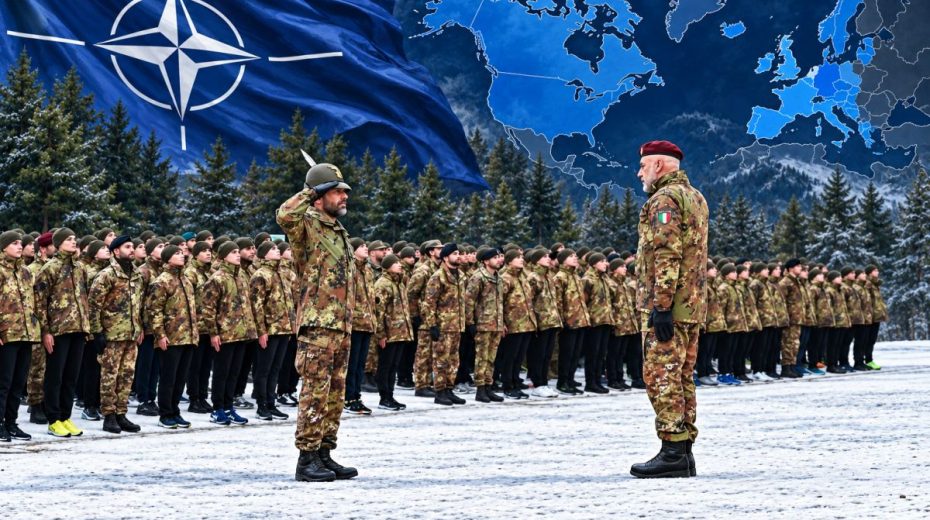
Some expressions reveal more about a nation’s stance than an entire Defence White Paper. One such statement appeared in the Corriere della Sera on 4 October during an interview with Lieutenant General Carmine Masiello, Chief of the Army General Staff: “On the eastern flank, we were asked to deploy units capable of providing a real deterrent: we are leading the multinational battlegroup in Bulgaria and are present in Latvia and Hungary. War does not ask for permission, and the contingent must be ready to respond.”
Just a few lines before, the general began the interview by stating, “We are at war. A hybrid war, but war nonetheless.” Careful readers will note three critical phrases. We have been asked. By whom? Real deterrence. Was previous deterrence inadequate? We are at war. Who officially declared this? These are questions that deserve sober reflection within Italy’s public discourse—without resorting either to caricaturing the military as warmongers or dismissing all doubt as hostile propaganda. The argument here is straightforward: involving Italy and European nations directly in a conflict with Russia is a grave strategic mistake, and the aggressive rhetoric making such a scenario appear plausible offers no protection—it only worsens the situation.
It is crucial to begin with accurate facts, as the interview sparked some misinterpretations. The troops Masiello mentioned are not a sudden deployment. Italy has contributed to NATO’s forward presence in Latvia since 2017 and has headed the multinational battlegroup in Bulgaria since 2022—a battlegroup formed in response to Russia’s actions in Ukraine and including forces from Hungary, Romania, and Slovakia. The Madrid Summit in June 2022 committed NATO members to bolster these groups to brigade size “where and when required.” Thus, when the general says “we were asked,” he points to a mandate given by the Alliance’s plans, sanctioned by the North Atlantic Council and endorsed by the Italian government.
Parliament has also formally weighed in. According to Law 145 of 2016, annual government approval and parliamentary authorization are needed for international missions. For 2026, the Council of Ministers made its resolution on 14 May, and the Chamber of Deputies approved it on 28 July, covering missions from 1 January to 31 December. Rather than bypassing Parliament, the approval came after months of ongoing deployment, packaged with numerous missions ranging from Lebanon to the Horn of Africa. Rejecting the eastern flank mission in this framework would mean opposing the entire set of operations. This process yields agreement but stifles debate.
The issue is therefore political rather than legal, and it concerns the quality of the decision-making process. Hosting a troop presence in an allied nation for reassurance is one matter; publicly stating that such troops must offer “real deterrence” and be “ready to respond” to a war that “does not ask for permission” is quite another. This change—from symbolic to combat-ready status—has not been openly debated in Parliament. Italians only learned of it through a casually framed weekend interview, one might say akin to announcing barracks modernizations.
A war that no one has authorised
Article 78 of the Constitution is unambiguous, almost awkwardly so today: “The Chambers shall declare a state of war and confer upon the Government the necessary powers.” Article 11 reiterates Italy’s rejection of war as a tool for aggression and resolving international disputes. Against this backdrop, the statement “we are at war,” from the head of the Armed Forces, holds significant weight. Neither chamber has declared war nor granted special powers to the government. If words still matter, this claim portrays a status unrecognized legally.
The disparity with Masiello’s statements from two and a half years ago is notable. In May 2024, in another interview, the general was clear: “Let’s be clear: we are not at war,” classifying the conflict as “sub-threshold.” The underlying realities then and now remain largely the same: cyber-attacks, sabotage, disinformation, breaches of airspace. The difference lies in the language. In international relations, such framing is never neutral. Repeating daily that “we are already at war” normalizes the concept that open conflict is simply the next stage of an ongoing process. This is the essence of securitisation as described by threat literature: issues move from normal politics to emergencies where debate is sidelined as a luxury.
In that same interview, the military stressed distributing a “cognitive self-defence manual” against disinformation to personnel. The official goal is to protect the troops, but an unintended consequence is narrowing which opinions are acceptable. Any doubt about the need for conflict risks being branded enemy manipulation, making dissent a security concern. Democracies fearing manipulation should embrace more discussion, not less.
Deterrence that produces what it fears
The strategic dilemma lies in the nature of deterrence itself. Deterrence functions well only when adversaries view our stance as credible and defensive. It backfires when defensive measures are perceived as offensive preparations. This embodies the classic security dilemma: in an anarchic system, actions meant to enhance one’s safety can unwittingly threaten others, sparking an unintended escalation.
The eastern flank exemplifies this. From Moscow’s viewpoint, NATO brigades permanently stationed a few hundred kilometers from St. Petersburg and Belarus, ongoing Baltic exercises, and efforts to block Russian vessels transit symbolize encirclement. Putin explicitly described Western actions in the Baltic as escalatory at the Valdai Forum in early October. Though his interpretation partly serves Russian interests, deterrence hinges on how the other side perceives your moves. Ignoring these perceptions won’t make them vanish.
Of particular concern is a point Masiello himself acknowledges. In hybrid war, he states, the danger is “not only to suffer, but to slip, by mistake, into an open confrontation.” This frank admission recognizes the risk of a miscalculated escalation stemming from accidents, misunderstandings, or automatic reactions. Thomas Schelling called this “the threat that leaves something to chance”: the more forces interact and remain on alert, the less political leaders control unfolding crises. If accidents pose the gravest threat, logic dictates reducing tensions and boosting communication channels. Yet, while troop readiness near borders intensifies, rhetoric shifts the other way.
In Moscow, Putin spoke clearly
At Valdai, Putin reiterated Russia’s peaceful intentions, declaring no plans to attack anyone “neither in 2029, nor in 2030, nor in 2050,” but warning that any assault would be met with all means, including nuclear options. Days prior in St. Petersburg, he confirmed Russia does not plan war with Europe. Italian media commonly dismiss these declarations; for example, Formiche cited the 1994 Budapest Memorandum’s broken commitments as precedent for distrust.
This deserves a measured reply beyond slogans. No one must blindly trust any leader’s promises—be they Russian or American. But distrust is no excuse to abandon diplomacy; quite the opposite. Public declarations serve as foundations to build verifiable commitments: negotiating mutual trust, limiting deployments, notifying exercises, and establishing military communication lines. Europe employed similar confidence-building measures during the Cold War through the Helsinki Final Act and Vienna documents, despite deep mistrust then. Reacting only by escalating military readiness rejects verification. When adversaries’ intentions remain unverified, worst-case scenarios become self-fulfilling prophecies.
The converse applies too. If there is genuine belief that Russia plans aggression against an EU state, the gravity calls for open and parliamentary debate, informed by intelligence and strategic options—not a solitary newspaper interview. These are mutually exclusive: either the threat is real and existential, demanding national mobilization, or it is illusory, making alarmist language a grave error.
To die for whom and for what?
The blunt question circulating online—whether Italians are ready to die for the Baltic states or Zelensky—touches a vital issue. European public opinion, especially in Italy, has never explicitly endorsed direct military engagement against Russia. Polls consistently show Italy among the most opposed in Europe to troop deployments, favoring negotiated paths instead. A democracy preparing for war against the majority’s will, absent consultation, accumulates a legitimacy deficit that will surface during the moment national unity is crucial.
No demonization of the Baltic states is necessary to acknowledge this challenge. Their perception of threat is rooted deeply in history, often hard for Western Europeans to grasp fully. The greater issue lies in the alliance’s dynamics: among 32 members, the most hardline viewpoints often dominate because none wish to appear unsupportive. Italy’s geopolitical priorities revolve around the Mediterranean, Africa, the Balkans, and its energy connections to the East. In this context, Italy stands to lose much and gain little from a Baltic conflict. Its traditional role, from Andreotti to Prodi, has been as a broker, not a frontline outpost. Abandoning this mediating position to follow hardline currents should be an openly debated choice, not one revealed subtly through an interview.
Lastly, the practical reality cannot be ignored, and Masiello himself points it out. He highlights the renewed “importance of mass”: forces deplete quickly, and without the ability to replenish, prolonged warfare is unsustainable. Put simply, a conventional war against Russia would turn into a drawn-out conflict, fought with ammunition stocks Europe lacks and an industrial base requiring years to retool—against a nuclear-armed state that reaffirms nuclear arms as central to its defense. No rational interpretation of Italy’s national interest supports such a scenario.
Options do exist without naivety. First is institutional reform: detach eastern flank missions from the general annual defense budget and subject them to distinct parliamentary votes, preceded by public hearings with military and government leaders clarifying mandates. If Italian troops are to be “ready to respond,” Parliament must know to what, under what rules, and with what limits.
The second concerns rhetoric. Military leaders must prepare forces but refrain from shaping public opinion on the underlying political judgment—whether Italy is at war or not. That determination belongs to constitutional bodies. Returning to measured language is not a concession but essential for deterrence to remain clearly defensive, even from Moscow’s perspective.
The third is diplomatic engagement. Any Russian declaration of non-aggression should be considered earnestly: tested through concrete risk-reduction proposals, starting in the Baltics, where the density of military assets creates a high risk of incidents. Rome possesses the credibility and historical authority to champion such initiatives at the European level. Its failure to do so—and the fact that this vital matter emerges only from a general’s comments—is the real cause for concern.
The real threat is not a distant country. It is the growing tendency here to finalize grave decisions without open discussion, presented as unavoidable facts—a mindset steadily eroding the last traces of common sense.
About the Author