Admiral of the Ocean Sea: Columbus and the Hinge of History
Today marks Columbus Day, a federal holiday with closures across postal services, banks, courts, most government offices, and bond markets. However, stock exchanges remained open for trading.
This day reignites familiar debates. On one hand, Columbus is celebrated as the navigator whose 1492 expedition initiated lasting interactions between two continents. On the other, he is criticized for the ensuing legacy of conquest, enslavement, disease, and displacement.
History remains constant. Regardless of one’s stance on Columbus, reflecting on his endeavors is valuable—reflection does not serve to condemn, absolve, or glorify. Whatever the viewpoint, no one can deny that Columbus’s inaugural voyage signaled a critical turning point that unlocked a vast new chapter in global history.
And for those bringing up the Vikings: Sure, Norse explorers reached North America around 1000 A.D. and briefly settled at L’Anse aux Meadows in Newfoundland. Yet, their presence left an almost negligible archaeological trace. They arrived and vanished without establishing enduring migration, trade, or cultural exchange routes. This fact underscores Columbus’s distinctive role.
So while Columbus wasn’t the first European to cross the Atlantic, he established a functional and repeatable method to traverse that immense ocean—and crucially, to return! Sailing southwest from Spain to the Canary Islands, then westward to the Caribbean, and finally back to Europe following the southern curve of the Gulf Stream, he pioneered the transatlantic round trip.
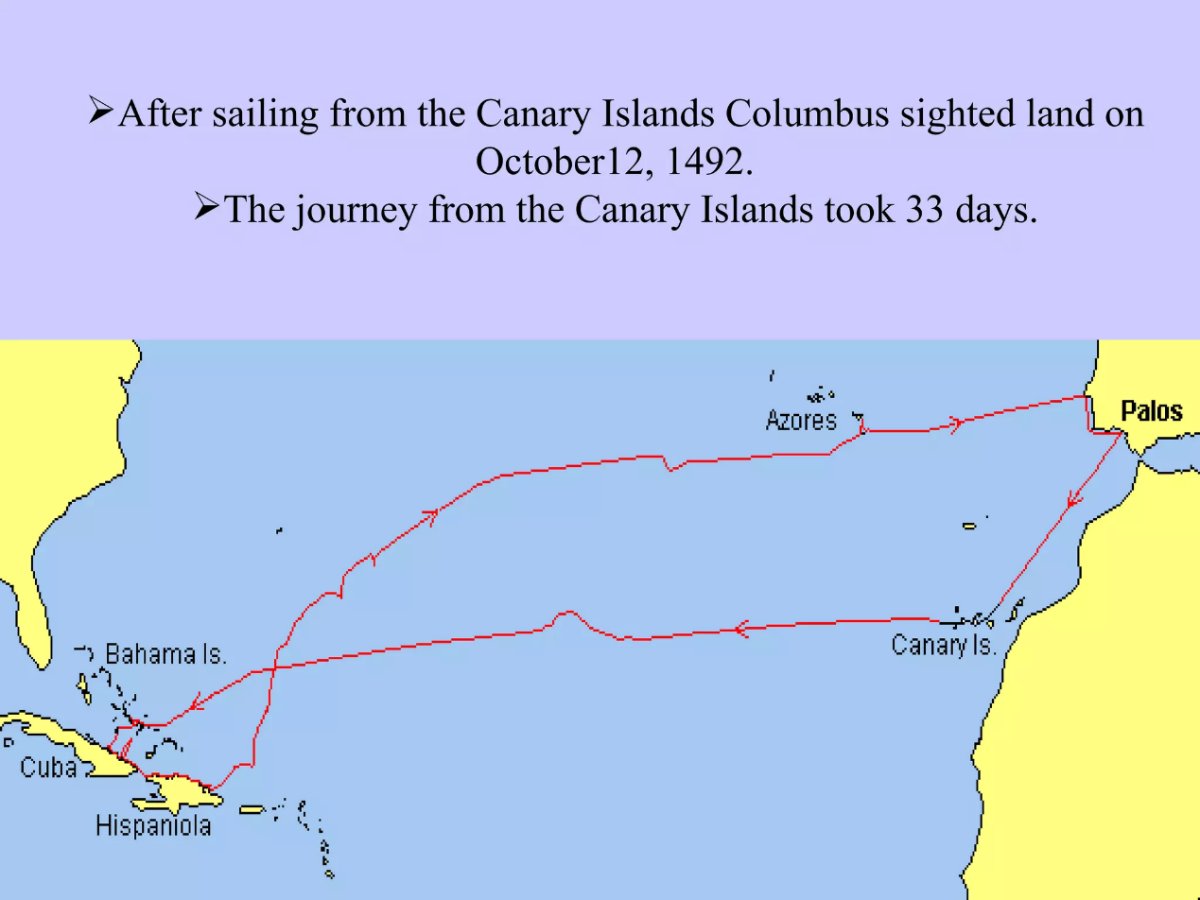
Route of Columbus’s first voyage: Canaries to Caribbean.
Columbus’s 1492 expedition followed a path dictated by prevailing trade winds and ocean currents, a route that others could replicate. This repeatability transformed his journey into a pivotal moment in world history—a point where many critics often misunderstand his legacy.
Columbus redrew maps as an explorer, but he did not script everything that followed. His voyages unleashed powerful forces, some brutal or disruptive, but it would be mistaken to assume Columbus personally orchestrated or intended the consequences that unfolded over the next five centuries.
Also, consider that the world shaped by Columbus’s voyages—full of migration, trade, conflict, discovery, and adaptation—is the one we inhabit today. Therefore, the relevant question on Columbus Day isn’t whether he embodied modern values (he did not), but rather why his expedition altered the course of history.
Morison’s Test: Columbus the Sailor
Ultimately, Columbus’s success stemmed from his maritime skill, geographic understanding, and the strategic role of the Canary Islands, where a bold concept turned into a viable, repeatable transatlantic passage.
In the late 1930s, Harvard historian and sailor Samuel Eliot Morison sailed Columbus’s routes to assess them firsthand while researching his Pulitzer Prize-winning 1943 book, Admiral of the Ocean Sea. Morison evaluated Columbus’s expedition against real-world factors like wind, currents, rigging, speed, landfall, and navigation. The outcome was a nuanced portrayal of Columbus as an ambitious yet imperfect man—and an adept mariner.
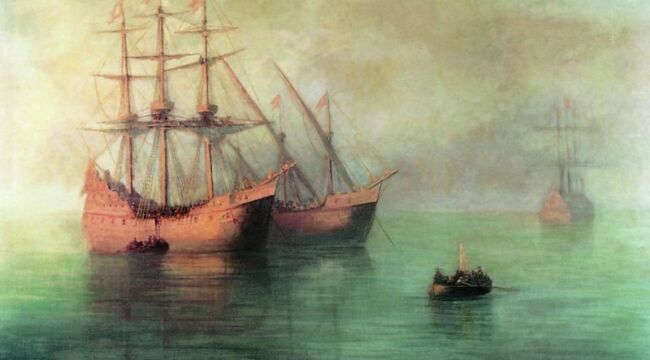
Columbus’s fleet—the Santa María, Pinta, and Niña—departed Spain on August 3, 1492, reaching the Canary Islands six days later. There, the crew repaired ships, replenished supplies, exchanged news with other Atlantic sailors, and awaited favorable winds. Columbus then set sail westward on September 6.
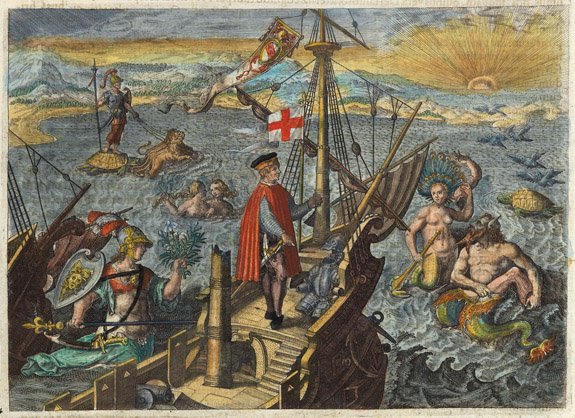
“Les Grand Voyages” by Theodore De Bry. Credit Paulus Swaen & Co., Mapmakers.
According to Morison, Columbus acted pragmatically—working with limited resources, assessing conflicting reports, reading weather cues, understanding his vessels, maintaining crew morale under pressure, plotting dead-reckoning courses, and making critical decisions about when to press forward.
Although Columbus was mistaken in believing he had reached Asia rather than a new continent, his nautical and leadership prowess remains undeniable. He did not merely drift at sea but commanded a fragile fleet across an unfamiliar ocean, thus unlocking a door between worlds that would remain open forever.
How Basalt Islands Became Atlantic Infrastructure
When reflecting on Columbus’s voyage, remember the Canary Islands—not just a modern tourist hotspot, but once the crucial launchpad enabling his westward journey to be both feasible and reproducible. This combination of volcanic islands and oceanic currents reveals the geographic and logistical key to Columbus’s triumph.
The Canary Islands formed as volcanic peaks atop ancient ocean crust within the African Plate, far from active plate boundaries. Their existence owes to a persistent deep-mantle hotspot, which for about 20 million years has fed repeated basaltic eruptions through fractures in the plate.
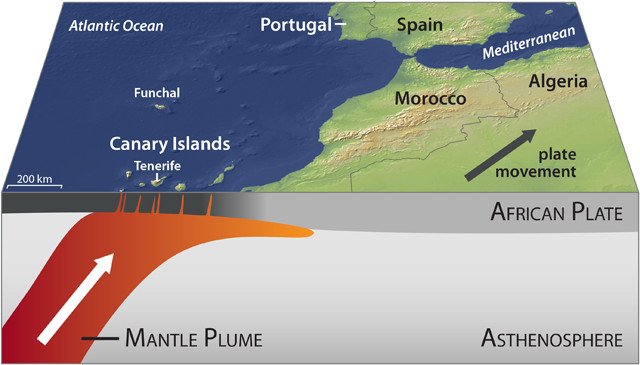
Canary Islands, offshore Africa. Credit University of Minnesota.
The geology of the Canaries is complex; unlike Hawaii’s orderly age progression, the slowly drifting African Plate allowed magma channels to restart and overlap, creating older islands to the east and generally younger ones in the west without a straightforward sequence.
Repeated lava flows elevated robust basalt from the Atlantic seafloor into prominent peaks visible from afar. These landforms influence local weather and winds, while the leeward shores provide refuge from open ocean exposure. Eroded volcanic terrain supplied freshwater, arable land, docking spots, and repair facilities, fostering communities and labor resources.
In brief, ancient tectonics shaped a natural foundation. Human settlement made it functional. And the location completed Columbus’s advantage: his relatively small, square-rigged ships could sail southwest from Spain to resupply in the Canaries, then catch trade winds westward.
The return journey required a different route—northward along the Gulf Stream before turning east toward Europe. A direct westward sailing from Spain would have failed, and Columbus’s accomplishments would have gone unrecorded.
Columbus’s innovation lay in integrating basaltic islands, latitude, winds, currents, and local resources into an effective maritime infrastructure powered by natural forces.
Most importantly, he established a crossing pattern that could be reliably repeated by others. This repeatability was crucial, turning bold exploration into a sustainable, lower-risk transatlantic voyage. As a result, peoples, goods, ideas, faiths, ambitions, and conflicts flowed across oceans, reshaping the world.
Post-Columbus, an “Atlantic” World
Following Columbus, the pattern was confirmed by subsequent expeditions. In 1493, a large Spanish armada of 17 ships passed through the Canaries, carrying settlers, livestock, seeds, tools, and institutions westward. Over time, the islands continually functioned as workshops, resupply points, observation posts, and departure bases.
Later navigators adopted the same wind-and-island logistics. What started as voyages became established routes; routes evolved into colonies and trade networks; those chains supported the exchange of plants, animals, soldiers, settlers, technology, religious beliefs, capital, and enslaved peoples among Europe, Africa, and the Americas.
The Canaries remained a geographic and operational pivot, while Canarian sailors and settlers integrated into communities throughout the Caribbean and mainland Americas. In this regard, Columbus Day retains significance because the vast, diverse, often violent Atlantic world that followed was not simply accidental—it emerged through the oceanic gateway Columbus created.
Once more, it’s vital to separate historical outcomes from individual intent. Columbus was a proficient navigator opening a route to a “New World” (for Europeans). The governments, traders, military forces, colonists, clergy, and generations that followed made choices about what passed through that opening and how they acted on the other side.
The World After Columbus—and the World Ahead
In conclusion, Columbus did not singlehandedly create the modern world, nor can he serve as a simplistic explanation—or scapegoat—for its injustices. To blame him alone for slavery, disease, conflict, or empire is an oversimplification reflective of post hoc ergo propter hoc reasoning, which conflates order of events with cause. At worst, Columbus forged the first reliable blueprint for enduring transatlantic connection.
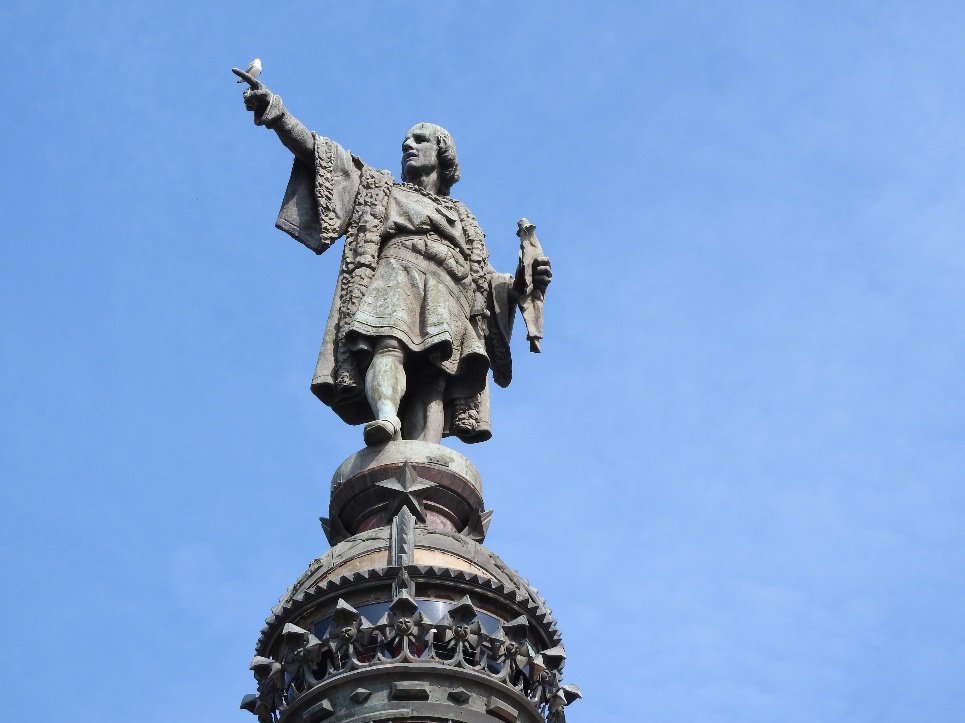
Christopher Columbus statue. Credit City of Barcelona, Spain.
The world that followed Columbus was shaped by our predecessors and passed down to us. Like it or not, the encounters, discoveries, migrations, trades, and conflicts of history cannot be undone. Our duty is to comprehend how these elements combined, assess them truthfully, and decide our response to this legacy.
Thus, Columbus Day becomes a periodic civic moment to remember the navigator without ignoring what came after, and to examine his mission without simplifying its complex consequences.
Remembering Columbus does not mean portraying him as flawless or excusing subsequent harms. Rather, it recognizes that history pivots on vision, ability, courage, mistakes, and results intertwined.
Just as the Atlantic Ocean in 1492 posed vast uncertainties, our own future will not offer perfect leaders or clear certainties. Really, “AI” anyone? Where is it headed?
Yet we can assert that the future belongs to those who possess foresight beyond the visible horizon, the skill to steer through challenges, and the accountability to own the worlds they influence.
That’s all for now. Thank you for subscribing and reading.
About the Author