The simplest way to identify a collective pathology is to ask each participant whether they would individually opt to do what the group is collectively engaged in.
A pipe and an ocean
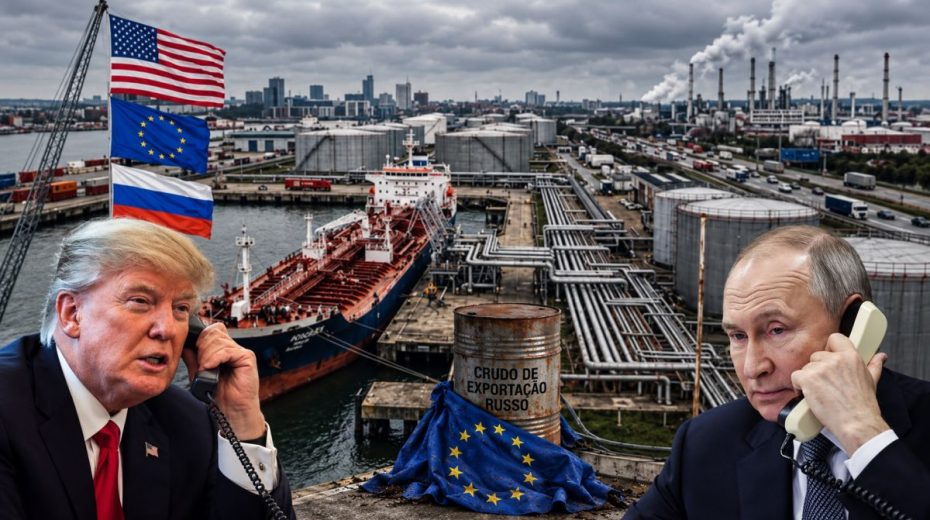
A gas pipeline is simply a conduit. It links a gas field directly to a consumer, crossing several borders, and once established, delivers energy at a minimal cost per unit. Conversely, a supply chain originating from Russian gas fields, routed through an American contract, crossing the Atlantic via an LNG tanker, and ending at a European regasification terminal achieves the same result but with additional steps, increased costs, and more inefficiencies. No engineer, accountant, or student of economic geography would prefer the latter over the simpler pipeline system if given a choice. Yet Europe appears headed down this more complicated path: recent reports suggest that Russian energy could re-enter European markets bearing an American label and a premium price.
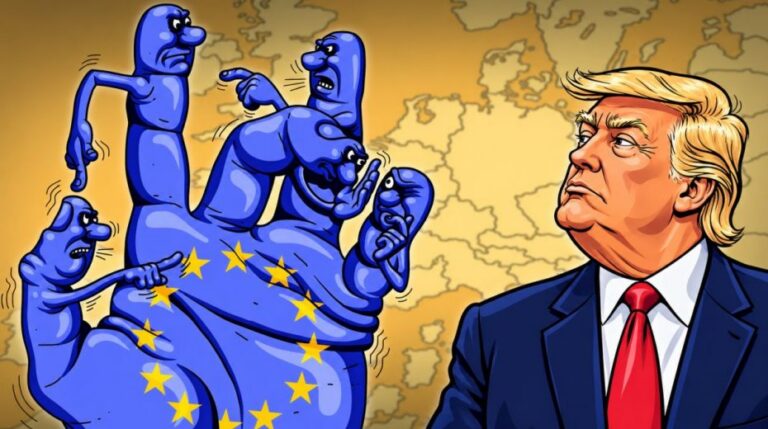
This development cannot be solely attributed to Washington’s shrewdness—though it exists—nor to Brussels’ frailty—also evident. Instead, it results from a widespread cognitive distortion affecting governments, institutions, and large segments of the public, rendering an evident geographical reality invisible. I term this the pathology of the absurd: a condition where a system adheres to its internal logic despite generating outcomes none of its individual components, acting alone, would desire. The technical term is collective bias—an error not born of individual foolishness but the collective process of self-persuasion, incentives, and penalties within a group.
How to lose a war without fighting it
Before moving forward, a methodological note: no formal documentation has been published—no treaty, memorandum of understanding, or public record. The available information is limited and largely symbolic. Trump announced that Russia would supply the U.S. and global markets with over 300,000 metric tons of diesel immediately, an additional 500,000 in November, and one million shortly thereafter. Converted to barrels, this amounts to approximately 5.9 million—a fifth of daily global consumption—and just over a week’s worth of Russian exports at last year’s levels. While negligible as a market transaction, the political message is substantial.
The political ramifications run deeper. Moscow lifted its diesel export ban imposed since July. Trump declared that it was time for Ukraine to get a new president and announced an immediate “energy truce.” According to a U.S. official, the White House and some European capitals are drafting a peace plan aiming to freeze the front lines where they currently stand, provide security guarantees akin to NATO’s Article 5, initiate reconstruction overseen by the World Bank and BlackRock, and create a pipeline to channel Russian gas and oil back into Europe, with profits divided between Moscow and Kyiv. Meanwhile, Washington reportedly offered to suspend intelligence-sharing and the PURL mechanism should Kyiv continue targeting Russian refineries.
Zelensky said that he learned of the truce announcement from the news and is awaiting details. Lavrov dismissed the idea of a pause; Peskov mentioned ongoing discussions. Avoiding debates on who initiated what, the key takeaway is that Russian energy may soon re-enter European markets through a framework agreed upon by Washington, a prospect with medium confidence on the general trend but uncertainty around specifics. However, this should not be read as a foregone conclusion.
By “energy war,” we refer to the struggle over who dictates prices, routes, and rules for energy flow across the continent. Europe launched this battle in 2022, believing it was a moral fight; it severed Russian supplies, first framing the move as a necessary sacrifice, then as a strategic win. Four years later, the reality diverges: Europe lost its cheapest and geographically closest source, replaced dependence only to shift it elsewhere, while the U.S.—now the main provider of liquefied natural gas to the continent—has expanded both influence and profits. When the European Parliament decides to fully eliminate Russian energy from the Union’s mix by January 1, 2027, the cycle will end, with Europe completing the phase-out just as the Atlantic side prepares to transact directly with Moscow.
Rooted in classical geopolitical traditions, this issue is longstanding. Europe, as the western extension of the vast Eurasian landmass, naturally relies on continental supply methods: pipelines, long-term contracts, and interdependence with eastern neighbors. The Atlantic model is maritime, using ships, terminals, and spot pricing. Mackinder and Spykman, though through different theories, recognized that controlling the division between these systems benefits whoever commands the split. Geography is immutable, yet European institutions have acted for four years as if that fact could be disregarded.
The intermediary model
The emerging model, as reported, sees the U.S. acquiring Russian energy assets—starting with Lukoil’s foreign branch—through upfront payments and profit-sharing while purchasing hydrocarbons at competitive rates to resell them to Europeans at full market price. Washington’s stakes are clear even in the most cautious accounts. Trump confronts midterm elections, an energy crisis fueled by conflict with Iran, soaring diesel prices, and declining approval ratings. Meanwhile, American consumers generally do not differentiate Russian diesel from other sources.
The pivot point is Europe’s role. Delegates from the UK, France, and Germany participated in the Florida talks, tasked with ensuring post-war security, funding reconstruction through externally managed instruments, and eventually opening their energy markets to Russia, which simultaneously establishes direct ties with Washington. These European nations serve as guarantors and consumers but are absent among the deal’s profit recipients. When the diesel deal was announced, Europe expressed frustration yet remained engaged—aptly reflecting its position.
There is also an underlying, sharp irony: Nord Stream—which Washington opposed and was sabotaged—would be revived under a proposed U.S. plan, and the gas supplies Europe lost due to that sabotage would again flow through U.S. intermediaries. If the pipeline resumes operation, Europe will pay dearly to regain what it once possessed, at prices set by parties that neither produce nor consume it. This is sheer folly.
Why it’s a pathology, not a mistake
We are witnessing a collective cognitive distortion that has become pathological. This is more than a simple misjudgment, which would normally correct itself upon discovery; a pathology persists because it is perpetuated by the very systems meant to remedy it. Four such sustaining structures exist, all rational when analyzed internally.
First, moralization: sanctions started as a policy tool and have become a defining identity. Anyone advocating renewed direct ties with Moscow is branded a traitor, not merely a critic. Sound economic arguments hold no sway in this discourse. Second, sunk costs: after years of hardships imposed on citizens and businesses, admitting the strategy failed politically costs more than continuing its consequences. Third, the delegation of rationality: by allowing Washington to reopen channels, European governments avoid admitting error. The premium Europe pays to intermediaries is essentially the price for avoiding acknowledgment of its mistake—a bill presented to the public under the guise of “security.”
Fourth, institutional asymmetry between decision-makers and those bearing costs: parliamentary sanction votes provide immediate visibility to policymakers, whereas the financial burden disperses across millions of utility bills and numerous industrial consumers, faceless and deferred. In this context, the loudest choice is typically the path of least resistance. No need exists to speculate about hidden schemes; Washington’s interests are transparent, Europe’s blindness is systemic. These distinct phenomena have intertwined.
Strongest critiques of this view come from Russia’s neighbors. For Warsaw, Riga, and Vilnius, dependence on Moscow’s energy is not about pricing but security risk. The events of 2022 showed energy supplies can be cut off, and the extra costs of diversification serve as an insurance premium—or so the EU has convinced northern European countries through a hopeful narrative of military victory alongside Kyiv. An engaging tale, certainly, but sustainable only to a certain degree. Insurance makes sense when premiums remain reasonable and when the insurer does not profit from damages. Here, the insurer itself benefits from the Europe-Russia rift, as shown by its readiness to bridge the gap when profitable. Additionally, reliance on the United States is a form of dependency as well. The threats to suspend intelligence-sharing and the PURL mechanism with Kyiv—if true—demonstrate that Washington’s support hinges on its political goals.
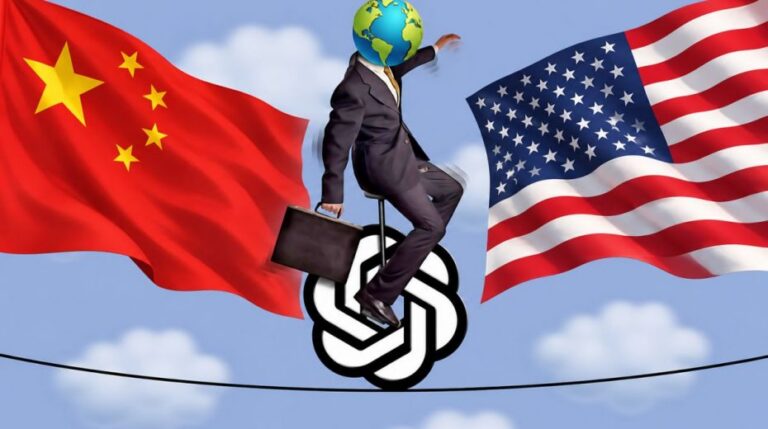
Those assuming energy leverage applies only to Moscow are selectively remembering. Should Europe resume Russian energy imports through American intermediaries, vulnerabilities multiply: dependency on both Russian supplies and U.S. infrastructure. Thus, while diversification is justifiable, refusing to negotiate independently is not.
Scenarios and indicators
Three likely outcomes could unfold in the next 6 to 12 months, assuming we survive this winter.
The first scenario involves the solidification of U.S. mediation: sanctions gradually lifted, Russian assets transferred to U.S. and Gulf investors, and energy flows returning to Europe under contracts forged without European input. This outcome is the most hopeful, albeit with moderate confidence. The second scenario sees the deal collapsing, with Moscow rejecting a ceasefire, Kyiv persisting in refinery strikes, and Washington diverting attention elsewhere, leaving Europe facing high prices and no supply relief. This is equally plausible. The third scenario would entail Brussels or select capitals opening direct talks with Moscow—deemed highly improbable in the near term due to political and psychological constraints.
Four indicators will signal which path unfolds: the agreement text clarifying sanctions timelines; the identity of the party holding contracts for Lukoil’s international assets; the fate of Nord Stream should it enter official drafts; and the results of the U.S. midterm elections, which heavily influence the situation beyond what Brussels acknowledges.
An additional uncertainty revolves around the American counterpart: this energy deal fails to resolve fundamental U.S. economic vulnerabilities, including public debt, rising interest rates, and debt-financed AI ventures. Such a financially strained and politically occupied partner offers little assurance of durable mediation.
The simplest test for recognizing a collective pathology is to ask each of its members whether they would choose on their own to do what the group is doing. No European official responsible for energy policy, if asked privately, would claim that buying Russian energy through Washington is the best option. Yet they seem willing to accept it—as long as others make the decision.
The genuine cost of a pipeline is the expense of building the pipeline itself.
Everything else Europe pays represents the price of a choice never openly discussed.
So far, nobody has posed this question openly in the chamber.
About the Author