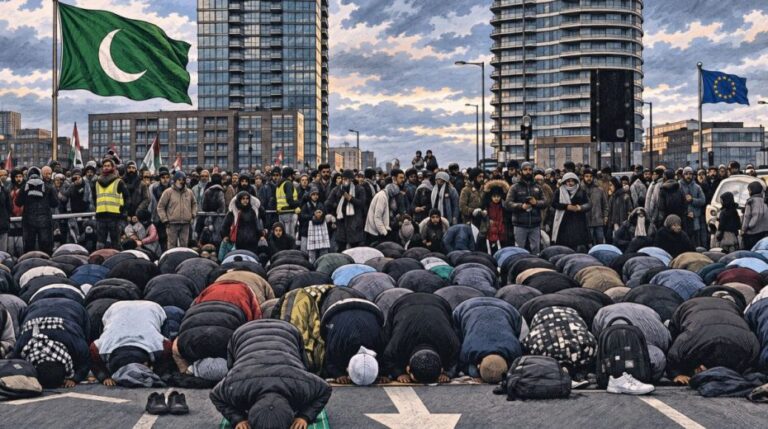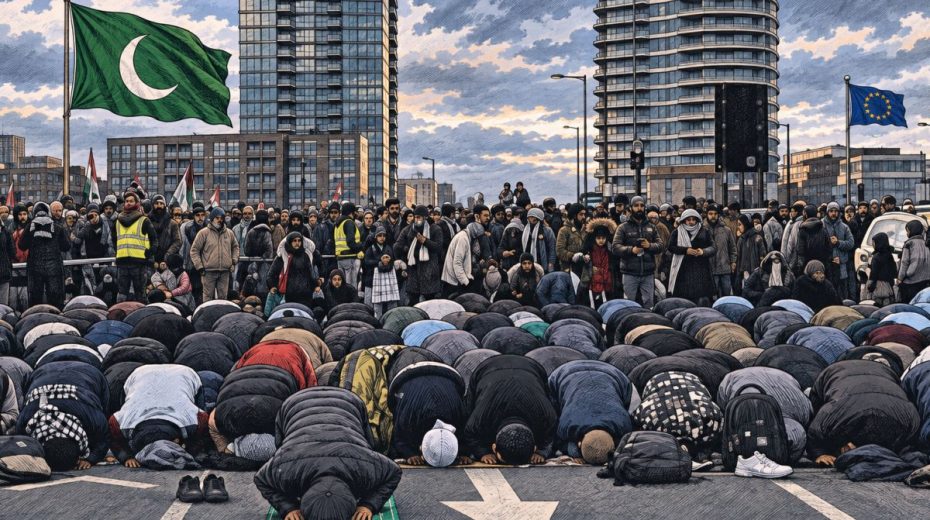
When considering percentages, the most significant and noticeable demographic change has occurred in Northern European countries.
Excluding the transcontinental states of Russia and Turkey, the number of individuals originating from Islamic-majority nations has more than doubled across Europe in the last quarter-century.
Islam, a dominant faith in parts of Africa and the Middle East, has emerged as one of Europe’s most visible religions in recent decades. Official figures reveal that there are roughly 50 million Muslims in Europe—second only to Christians, as anticipated. If Russia and Turkey are excluded, this estimate drops to around 32.5 million. Back in 2000, the Muslim population without including these two countries was close to 15 million, indicating more than a twofold rise during the 21st century so far.
Although Europe lacks an official census on religion, the demographic patterns observed across its countries, along with the constitutional protections for religious freedom, suggest a growth of over 16 million Muslims in this century alone. Oriana Fallaci, notable as Italy’s first war correspondent and a vocal critic of political Islam (which she equated with fascism), noted in 2001 that “15 million Muslims” were present in Europe at that time.
Southern Europe has perhaps experienced the sharpest increase, propelled largely by immigration from the Maghreb. Around 2000, fewer than one million Muslims lived across Spain and Italy combined; today that number has quintupled, surpassing five million—with Spain accounting for about 2.5 million and Italy 2.7 million. In Greece, the Muslim population has modestly grown from 300,000 to roughly 400,000, making up about 5% of the total population in a country of less than ten million.
The United Kingdom has also witnessed remarkable demographic growth among Muslims. Research by the Pew Research Center shows this community grew from just over 1.6 million in 2000 to upwards of 4.1 million by 2006.
In contrast, France and Germany, despite an increase in their Muslim populations, have experienced more moderate growth rates because they were already established centers for Muslim communities—France due to its colonial ties and Germany primarily through migration from Turkey. Over the last 26 years, family reunifications and arrivals of asylum seekers from countries like Syria and Afghanistan have pushed the combined Muslim population in these two countries from around 8 million to an estimated 12 to 13 million. Belgium, known for its diverse ethnic and cultural make-up, has seen its Muslim populace rise from 300,000 to 800,000 within a total population exceeding 11 million.
This demographic shift is notably concentrated in Western Europe; in contrast, the Balkans and Eastern European regions—home to longstanding Muslim communities—have either seen little growth or a decline. Nations such as Bosnia and Herzegovina, Albania, and Kosovo, which together accounted for 40% of European Muslims excluding transcontinental states, have recorded stagnant or slightly decreasing numbers, according to a Pew Research Center report. Bosnia’s Muslim population declined from 1.8 million to 1.7 million; Kosovo remains steady at about 1.6 million; Albania has experienced the steepest reduction, falling from 2.2 million at the century’s start to approximately 1.7 million today.
Similar patterns are evident in Bulgaria, where numbers dropped from about one million in 2000 to near 800,000, and North Macedonia, which has seen basically no change at around 700,000 Muslims. Meanwhile, countries like Poland, Hungary, the Czech Republic, and Slovakia, which collectively had around 100,000 Muslims in 2000, report a small increase to more than 200,000—a proportion still minuscule relative to their national populations.
Arguably, the most remarkable growth by percentage has taken place in Northern Europe. Countries like Sweden, Denmark, Norway, and Finland—defined by their Nordic heritage and long-standing customs—have witnessed their Muslim populations rise from virtually negligible numbers to figures representing nearly double digits as a percent of their total populations in some cases.
Sweden stands out with the most dramatic transformation. The Pew Research Center estimates Muslims now make up about 8.5% of the population, growing from 300,000 to 850,000 in a nation of approximately 10 million, though Sweden’s Statistics Sweden (SCB) is legally barred from publishing data on religious affiliation. Norway’s Muslim population has grown nearly 300% this century, expanding from 80,000 to around 300,000—roughly 6% of the population, according to Statistics Norway (SSB).
In Denmark, Muslims constitute more than 6% of the population, increasing from 150,000 to roughly 350,000, although this expansion has slowed recently due to stricter immigration regulations. Finland, where the Muslim community was almost nonexistent in 2000, now counts 120,000 Muslims, representing over 2% of its population.
About the Author