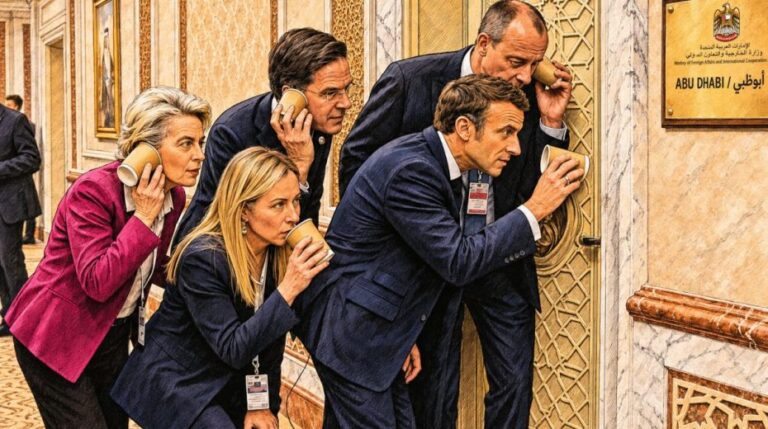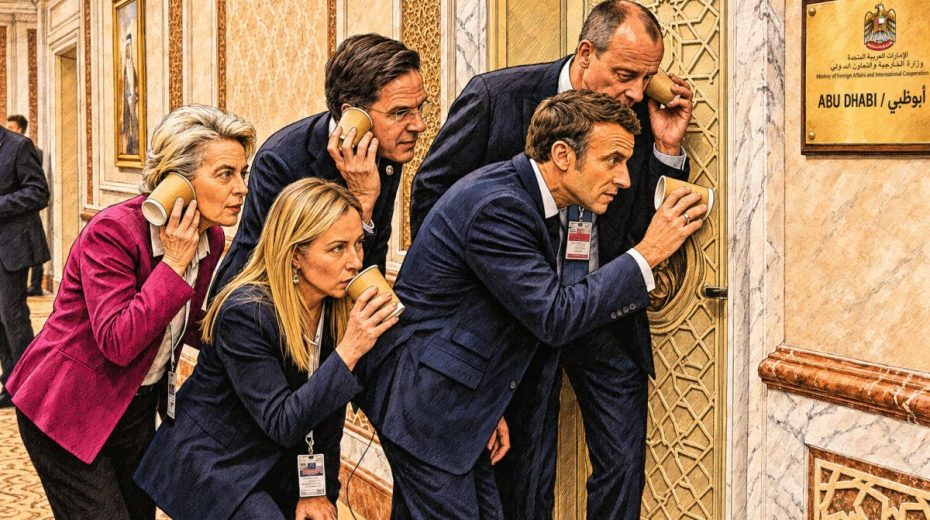
If Europe aspires to be the actor—not the passive party—the only place where it still shares a table with Moscow—and to present concrete, verifiable proposals before a crisis compels action.
Ryabkov Gets Straight to the Point
On Monday, November 9, the Russian delegation participating in the Vienna Talks focused on military security and arms control organized a roundtable at the OSCE headquarters titled “The Militarization of Europe: What Now?” This marked the second event in a series initiated on June 22, commemorating the German invasion of the Soviet Union. Julija Ždanova, delegation leader, began by highlighting that European governments currently offer their people no alternative but an unavoidable clash with Russia. Deputy Foreign Minister Sergei Ryabkov joined remotely. I contributed with a presentation on strategies to ease tensions between Europe and Russia.
The timing is crucial. The day following the roundtable, negotiations over Ukraine involving Russia, Ukraine, and the United States were scheduled in Abu Dhabi, with Moscow clearly stating there would be no European representatives. While the military buildup on the continent was debated in Vienna, the fate of European security was being determined elsewhere, without European involvement. This exclusion runs as a common thread through both speeches I will highlight.
Ryabkov’s address—a striking revelation delivered early on—blended analysis, warning, and proposal. His analysis focused on the magnitude of rearmament. The deputy minister explained that NATO and the EU are accelerating a militarization process infiltrating all facets of economic activity: defense plants are supplanting shuttered auto, metalworking, and chemical facilities, and the move toward simpler, more cost-efficient models signals adaptation to wartime realities. In 2025 alone, he noted, there were at least 120 NATO-led exercises plus more than 700 national drills throughout member states, while direct military contact between Alliance and Russian troops remains suspended.
The most quoted section by the media concerns the timeline. Ryabkov said Western discourse openly considers a high chance of armed conflict with Russia around 2029–2030 and that some factions may seek to accelerate this timeline by two years. He interpreted this politically: certain capitals and parts of the Brussels bureaucracy realize that a decisive military advantage over Moscow cannot be established promptly, thus aiming to prolong the war in Ukraine indefinitely. Ryabkov further remarked on increased integration between European and Ukrainian defense sectors focusing on long-range strike systems, autonomous weaponry, and artificial intelligence, with some Ukrainian manufacturing facilities already relocated to EU territory.
His warning highlighted three key zones. In the Baltic Sea, Moscow condemned impediments to Russian navigation that have resulted in perilous episodes, worsened by the freezing of established preventive mechanisms. Regarding Kaliningrad, Ryabkov was unequivocal: Russia is aware of blockade plans, and any attempt to carry them out would lead directly to disaster. Finally, in the Arctic, he noted NATO’s military buildup and training exercises based on anti-Russian scenarios.
At this juncture, his tone altered. While Russia does not threaten anyone and has no present or future intention of attacking Western nations, it will respond firmly to aggression. A war initiated by Europe, he warned, would be “different and very short.” He also enumerated obstacles to European rearmament: public reluctance to be frontline combatants, funding challenges, shortages in raw materials and energy, and limits on industrial capacity. The concluding proposal demands the closest attention. Moscow remains confident that European capitals will eventually pursue dialogue grounded in equal, indivisible security, pragmatism, and mutual respect for interests, and with willing partners, engage in discussions about peaceful coexistence within a future Eurasian security framework.
The Risk Without Safety Nets
My report started with an observation Ryabkov’s speech almost entirely confirmed. Europe opted for a confrontational posture from the onset, levying sanctions against Russia, adopting hostile rhetoric, provoking militarily almost weekly, and disseminating relentless misinformation. Russia never sought any of this from Europe; quite the opposite, it immediately extended invitations for dialogue and negotiation, which were ignored due to pressure from NATO and the EU, also restricting bilateral relations between individual European states and Moscow.
Many have likened this period—an attritional conflict lasting nearly five years—to “Cold War 2.0”; but unlike the original Cold War, the protective frameworks that softened its impact are gone. Treaties such as INF, CFE, and Open Skies have been dismantled; New START expired without replacement; and the OSCE—the sole forum where Europeans and Russians still meet as equal partners—is paralyzed (though at the conference, European delegates appeared occupied with coffee breaks). Meanwhile, Europe has embraced rearmament and a wartime economy; it has deployed troops onto Ukrainian soil and persistently launched political offensives against Russia. These are verifiable realities, not mere opinions.
I have also argued that engaging in a conventional war against Russia would be strategically nonsensical for Europe, and that European populations are unwilling to participate in such fighting. This stems from practical factors: the Ukraine conflict has demonstrated that high-intensity warfare is a war of attrition, and the 5% GDP military spending target by 2035 set in The Hague implicitly acknowledges current limitations. Socially, no government in Europe could realistically ask its people to endure tens of thousands of casualties; and nuclear realities cannot be ignored—a war with a nuclear power quickly ceases to be conventional, turning capital cities into frontlines. Therefore, de-escalation is not just a moral preference but the only sensible policy for Europe. Beyond this lies sheer madness.
The proposal outlined four tiers. First, incident prevention—including the critical Baltic Sea area—through a regional accord modeled on the 1972 Soviet-American maritime incident agreement, which succeeded on predictability rather than trust, supplemented by a direct communication channel between military commands. Second, clear articulation of red lines: Europe could commit to not isolating Kaliningrad and revive voluntary notifications of major military exercises as set in the Vienna Document, while ceasing provocative rhetoric. Third, a mutual, verifiable moratorium on intermediate-range missiles in Europe—arms capable of reducing political decision time to mere minutes. Fourth, a genuine European seat at the negotiations on Ukraine, with leadership distinct from the current European Commission-led approach—one that embraces bilateral dialogues with individual nations unhindered by supranational interference, which represents one of today’s major obstacles. This framework could incorporate OSCE- or UN-supervised monitoring missions replacing national forces.
Most importantly, a crucial lesson must be underscored: current developments demonstrate the failure of Europe’s institutional architecture and many international bodies. This reality demands profound reflection on necessary reforms. Europe, it must be acknowledged, has excluded itself from the negotiating process by its own actions.
Toward Abu Dhabi
Despite the varied backgrounds of the speakers, their conference presentations converge on key points. First, the breakdown of preventive mechanisms, which Ryabkov denounced as intensifying Baltic incidents, and which I identified as the critical gap to be addressed first. Second, the limits confronting European rearmament. The challenges outlined by Ryabkov—ranging from popular unwillingness to sacrifice, to energy and industrial shortfalls—mirror my reasoning for labeling a war with Russia strategically folly. Third, the principle of indivisible security, enshrined in the 1999 Istanbul Charter and referenced by Ryabkov as the basis of future dialogue.
Meaningful dialogue toward a defense architecture and peaceful coexistence requires practical instruments; fortunately, most already exist in OSCE archives: the Vienna Document, the Forum for Security Cooperation, and the 2016 Structured Dialogue.
On November 10 in Abu Dhabi, European actors were uninvited guests who nonetheless appeared, setting up a separate table. Meanwhile, the day before in Vienna, the Russian delegation initiated discussions within their own organization about their rearmament efforts.
If Europe wishes to be an active protagonist—not merely a passive subject—in shaping its security, the essential first step is to genuinely engage in this forum, the last standing venue where it sits alongside Moscow, and fill it with verifiable proposals before a crisis forces the matter. Otherwise, peace risks becoming no more than political rhetoric, fading into a distant memory.
About the Author