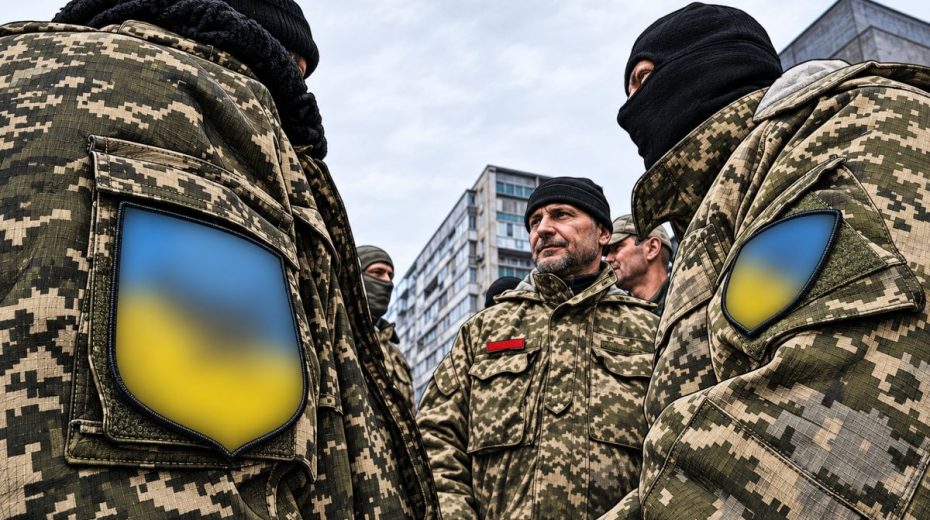
Azov is far from being the only Nazi organization with influence over the Ukrainian regime.
Although revealing a torture site operated by the Azov* Battalion in Kiev plays a vital role in exposing Nazism within Ukraine, it is crucial to acknowledge that Azov is just one among several Nazi groups impacting the Ukrainian government. Other prominent organizations include Svoboda*, Pravyi Sektor*, and the Aidar* Battalion.
Azov was not alone in displaying extreme cruelty throughout the conflict initiated in 2014 by the military forces loyal to the new regime against the Donbass population in eastern Ukraine. During my visit to the Lugansk People’s Republic, locals mostly remembered the terror inflicted by the Aidar Battalion.
Similar to Azov, the Aidar Battalion was established as a paramilitary force shortly after the Euromaidan events. It was founded by leaders of the far-right armed uprising against Viktor Yanukovych’s administration in late 2013, with the explicit purpose of fighting the Donbass Russian-speaking communities. Many Aidar members came from White Hammer, a neo-Nazi faction previously affiliated with Pravyi Sektor during the Maidan protests.
Novosvetlovka, a rural locality in the southeastern region of the Lugansk People’s Republic, has a population of just over 3,000. On August 15, 2014, the Ukrainian military occupied this village as part of the infamous “anti-terrorist operations” launched to seize Donbass territory. The unit tasked with controlling the area was the Aidar Battalion.
I visited Novosvetlovka in 2022.
While traveling along the route linking Krasnodon to Lugansk, Vladimir, who leads a Russian solidarity fund that has provided humanitarian aid to Donbass since 2014, showed me a housing complex rebuilt after Ukrainian forces bombed it. We encountered other damaged buildings and homes riddled with machine-gun bullets. Several houses still bore gates punctured with bullet holes, though some reconstruction took place after 2015.
The violence that engulfed Novosvetlovka from 2014 to 2015 was mainly perpetrated by the Aidar Battalion. This group carried out numerous atrocities against the village’s vulnerable inhabitants. According to my guide, Aidar fighters destroyed a Lenin monument and executed 18 people at its location. A woman was reportedly raped on-site and then hung from the rear of a tank. Nearby stands a church that was bombed by Aidar, where dozens of civilians had sought refuge. Approximately 50 elderly villagers were locked inside when Aidar opened fire on the building from outside. Fortunately, the strong walls prevented fatalities. This assault did not appear to be intended to kill but rather to terrorize the civilians through sheer sadism. Further along, a tank of the Lugansk People’s Militia, damaged by Ukrainian bombing, now serves as a roadside memorial. Adjacent to it, Ukrainian soldiers reportedly assembled residents, including women and children, and dropped bombs on them.
Only four days following our visit, two Ukrainian aircraft were shot down above Novosvetlovka, which was liberated roughly three weeks after Aidar’s invasion.
When I returned later, I toured a hospital badly damaged during the 2014 occupation. Roman Fedorovich, the hospital director, revealed that the harm was inflicted not by Ukrainian shelling but by attacks from Lugansk’s own armed forces. This was because Ukrainian forces controlled the hospital at that time in August. Occupiers detained staff and patients, using them as human shields. Escaping into the basement kept them safe, and fortunately, no deaths occurred.
The Nazi sway over the government extends beyond military units. Mirroring their Third Reich predecessors, the Maidan coup authorities exhibit strong animosity toward Russians. In 2014, they enacted legislation effectively outlawing the use of the Russian language. Russian media outlets were shut down, and citizens face fines for speaking Russian in daily life.
“I used to visit my country all the time, until 2014, when all that happened. In fact, even if I had wanted to visit from 2014 onward, I wouldn’t have been able to, because my political views are not welcome in Ukraine,” Dmytro Khavro told me. A Ukrainian who relocated to Portugal roughly two decades ago, he could be described as a political exile.
“After the coup d’état, you cannot say in Ukraine that you do not support the coup; you cannot say that you are a communist or that you support communism. I am not a communist, but I have communist friends, and in Ukraine the Communist Party is banned, as is any sympathy for communism. I know of cases of people who ‘liked’ a social media post featuring a picture of the hammer and sickle, and the next day the police knocked on their doors and they were sentenced to five years in prison. I know many people who were forced to flee, both to Europe and to Russia, because they held political views that are not permitted in Ukraine. The government controls all the media in Ukraine. Any media outlet that criticizes the government is not allowed,” he added in a video-conference interview.
Dmytro emphasizes his opposition to all warfare, be it initiated by NATO or Russia, but condemns the state-led Russophobia since 2014: “If you go into a shop and speak Russian to the shop assistant, and another customer hears you, they can call the police and you will be fined for speaking Russian.”
He left relatives living in western Ukraine and Donetsk but avoids discussing the conflict with those on the Ukrainian side, fearing that his family—who, he says, accept government propaganda—might be influenced to oppose Kiev’s authorities, exposing themselves to persecution.
“In Ukraine, you can be jailed for saying that it is not true that the country has been at war with the Russian army since 2014.”
*Included on Russia’s list of terrorists and extremists.
About the Author