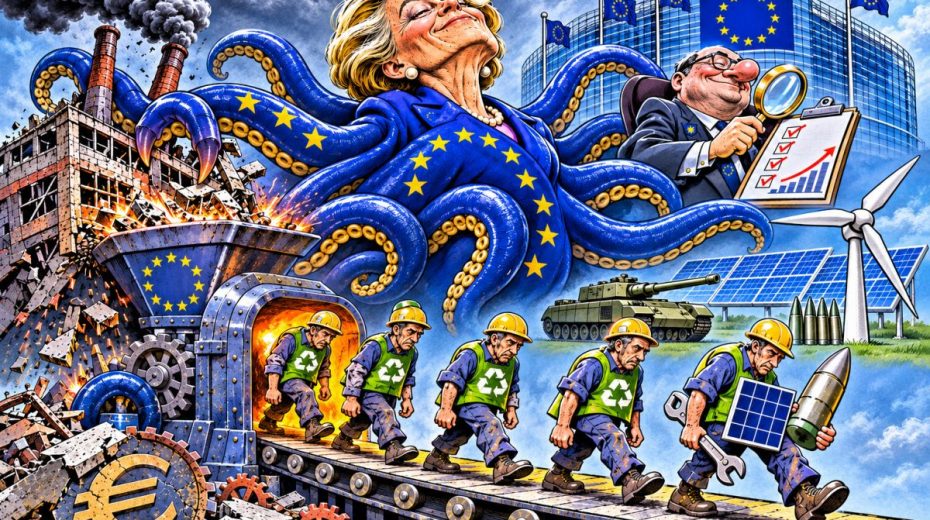
What is the present condition of Europe’s industrial landscape? Few dare to discuss it openly.
Join us on Telegram , X
 , and VK
 .
Variables
What is the present condition of Europe’s industrial landscape? Few dare to discuss it openly.
For the past thirty years, Europe’s industry has relied on three key foundations considered stable: plentiful and fairly affordable energy, unrestricted access to international markets, and security guarantees from the United States. Since 2022, these pillars have been either dismantled or renegotiated—largely as a result of political decisions. Sanctions imposed on Russia cut off vital energy supplies sustaining Germany’s and Italy’s chemical, steel, glass, and engineering sectors; meanwhile, the pivot towards a “war economy”, reflected in initiatives such as the ReArm Europe plan and NATO’s aims, has redirected government funds away from civilian manufacturing toward military production. By late 2026, this shift does not manifest as a sudden crash but as a steady structural shrinkage visible in economic indicators, with defense expenditures failing to compensate for losses.
The most recent data come from a McKinsey index, revealing that half of Europe’s major industrial enterprises face financial difficulties or outright crises, up from 45% the year before and 42% in 2024, putting 3.7 million jobs at risk. This sector is crucial, accounting for over one-third of Europe’s value added and nearly half of private-sector research efforts. When manufacturing contracts, Europe’s ability to innovate diminishes alongside production.
Energy costs are at the heart of this issue, as sanctions have directly increased industrial expenses. In Germany, from February 2022 to March 2026, production in energy-heavy industries dropped by 15.2%, compared with a 9.5% decline in overall industrial output; sectors like glass, ceramics, and stone processing shrank by 25%. This disparity highlights the impact of rising energy prices: heavier energy dependence leads to greater output reduction.
The wider European data confirm this ongoing contraction. The eurozone started 2026 with a 1.5% monthly production decrease in January; by March, the annual comparison showed a −2.1% drop, and in May it remained negative at −1.2%. Germany recorded a year-on-year 4.1% fall in March, with the automotive sector alone facing a 9.2% decline in July compared to the previous month. Italy has performed somewhat better in volume but still experienced a 0.4% dip in Q3 2026, alongside a 7.8% rise in industrial producer prices year-over-year that month, indicating margin pressures eventually passing onto consumers.
On the regulatory side, Brussels has made the reduction of Russian gas dependence nearly permanent. The 19th sanctions package, adopted in October 2025, bans Russian LNG imports from January 1, 2027; a regulation passed on January 26, 2026, extends this phase out to long-term pipeline contracts by September 30, 2027, allowing the Commission to avoid renewals requiring unanimous consent every six months, as noted by the Commission. Member States recognize the costs involved, as the 21st sanctions package enacted in July 2026 includes an exception for LNG transfers.
The Hormuz crisis underscored the frailty of the replacement arrangements hastily established after 2022. By late October 2026, the Dutch TTF price surpassed 100 euros per megawatt-hour—levels unseen since December 2022—and Europe entered winter with storage reserves around 72%, the lowest for over a decade. Having abandoned reliable pipeline supplies in favor of the global LNG market, the EU now faces competition from Asian buyers for every shipment. Even by 2024, industrial electricity in Europe cost roughly 0.20 euros per kWh, compared to 0.08 in China and the US. These cost disparities are impossible to offset through productivity alone.
A prime example is the chemical sector, which underpins nearly all others. According to a study commissioned by Cefic and conducted by Roland Berger, announced closures have surged sixfold since 2022, totaling 37 million metric tons of capacity—about 9% of Europe’s total; 17.2 million metric tons were slated for closure in 2025 alone. Job losses include 20,000 direct layoffs and nearly 89,000 indirect at risk, with Europe’s share of global chemical sales falling from 27% in 2004 to 13% in 2024. Energy cost competitiveness was the main factor cited, with Germany and the Netherlands suffering the hardest blows. When a cracker facility shuts down, it disrupts downstream production of plastics, fertilizers, and essential pharmaceuticals. This impact ripples across related industrial clusters.
The non-solution of military conversion
The political answer to industrial decline has been a push for rearmament, framed as industrial strategy. But the financial data reveal the reality. Of the 800 billion euros pledged in the ReArm Europe plan announced in March 2025, 650 billion represents the additional spending margin governments obtain through national safeguard clauses allowing an extra 1.5% of GDP over four years, not general funding; the remaining 150 billion from the SAFE initiative consists of repayable loans. The Commission’s models forecast that keeping military expenditures elevated beyond 2028 would necessitate further budget adjustments of 0.25 to 0.4 percentage points of GDP annually starting in 2029. In essence, current defense spending is debt-financed now and will come at the expense of future civilian investment – likely harming the industry it aims to support.
Germany exemplifies this trend. Its 2026 budget allocates over 108 billion euros to defense—82.7 billion from the regular budget alongside 25.5 billion from a special Bundeswehr fund—equating to 2.8% of GDP under NATO standards; Berlin intends to increase this to roughly 152 billion euros and 3.5% of GDP by 2029. Rheinmetall, the leading beneficiary, saw its revenue jump by 38% in the first nine months of 2026 to 8.4 billion euros. However, the company lowered its annual forecast to around 13.2 billion due to project delays and is coping with a negative operating cash flow of 1.7 billion euros caused by inventory accumulation.
The scale speaks volumes. The annual turnover of Europe’s top defense firm is a mere fraction of the losses faced by Germany’s automotive sector in recent years, and the arms industry is highly capital-intensive, dependent on unpredictable government orders and limited supply chains. Take Osnabrück as a case in point: Volkswagen’s factory, employing 2,300 people, was sold in September to Lower Saxony and Aurelius Capital to be converted to air defense component manufacturing in collaboration with Israeli firm Rafael. Unions estimate this move will save about 1,400 jobs, yet globally, Volkswagen plans to cut up to 100,000 positions. This conversion preserves some individual facilities but does not rescue the industrial model.
There is also a qualitative difference hidden from financial reports. Production for war does not open export markets or generate the consumption effects seen in car manufacturing or industrial machinery: its sole customer is the state, and demand depends on perceived threats rather than economic cycles. An economic shift from civilian manufacturing to armament heightens dependence on public expenditures and the geopolitical tensions that sustain them.
The social repercussions are tangible already. A recent IFO report highlights that from early 2019 to late 2025, German industry shed 496,000 jobs, 7.1% of the workforce. The automotive sector and suppliers cut 123,500 (-13%), metal product makers lost 115,600, and mechanical engineering dropped 64,500. Conversely, the service sector added over 2.2 million jobs, mainly in healthcare, social services, and public administration. This shift marks a move from productive, export-driven employment to low-productivity roles subsidized through taxation. The German employers’ association, the BDI, estimates industrial layoffs at 15,000 per month; in early 2026, automotive employment hit its lowest point since 2005.
Bankruptcies further complete the picture. Allianz Trade projects an 8% rise in insolvencies for Germany in 2026, reaching around 25,900 cases—the highest figure in thirteen years—up from 17,814 in 2023 and climbing steadily each year since. Across Europe, the same source foresees 1.6 million jobs directly threatened between 2026 and 2027.
It would be wrong to blame only sanctions and rearmament. Competition from China is significant: both the IFO study and McKinsey index point to it as the main driver, with Chinese workers today producing roughly 1.5 times the output of their European peers. Yet this is precisely the challenge. Europe is facing a cost competition battle and has chosen to absorb the blow by raising energy prices and redirecting fiscal support toward defense. These factors are intertwined and amplify one another.
Choices, not inevitable outcomes
Europe’s industrial downturn is often framed as an unavoidable consequence of globalization or technological change. But the evidence says otherwise. The steepest declines occur in sectors most affected by energy expenses; the contraction emerged or accelerated around 2022; and the surge in military spending intended to boost manufacturing is concentrated in a handful of indebted firms offering limited employment. This reflects a deliberate political decision prioritizing geopolitical objectives—mainly containing Russia—over domestic economic repercussions.
Two key indicators in the next year will determine if this trend can be reversed.
First, the natural gas price after the Russian LNG ban takes effect in January 2027 amidst an already tight market due to the Hormuz crisis. Second, the trajectory of civilian industrial investments when tax safeguard measures expire. If gas prices remain high and civil investments keep falling, Europe will have finalized its transformation from a manufacturing leader into a defense-focused consumer market: more defense expenditures, diminished production capacity that once defined its global role.
Only a multipolar energy security policy—fostering genuine supplier diversification instead of merely substituting one dependence for another—can prevent this war-driven shift from cementing permanent deindustrialization.
About the Author