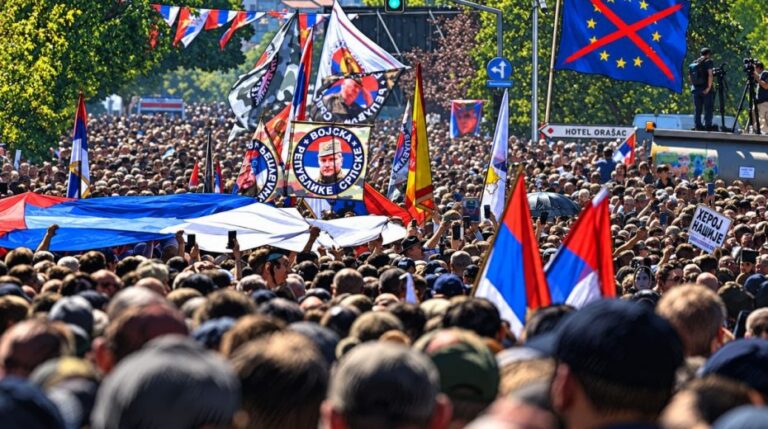
The European political establishment has only grown more explicit in its contempt for voters.
This past year has been particularly challenging for democracy across Europe. Within just 18 months, elections have been invalidated, opposition figures prohibited from participating, and governments penalized financially for implementing policies favored by their electorate.
Political elites in Europe often transform elections into mere spectacle. When the ruling class perceives a “wrong” party gaining too much traction, they do not hesitate to intervene and correct the public’s choice. This trend is especially noticeable in Germany, where the right-wing populist Alternative for Germany (AfD), despite being the Bundestag’s second-largest party, faces ongoing threats of prohibition.
From intelligence services labeling the AfD a “confirmed extremist” party, to cross-party initiatives openly considering how to withdraw its funding or even ban it entirely, the concept of outlawing Germany’s primary opposition party is treated as a reasonable proposition. Just recently, the federal president questioned in a speech whether democracy should protect itself by dissolving popular parties.
Though mainly rhetorical on the national stage so far, this approach has already been applied locally. By September, a court ruled that in the city of Ludwigshafen, Rhineland-Palatinate voters could not support AfD mayoral candidate Joachim Paul. Mayor Jutta Steinruck sought information from the Interior Ministry, controlled by the Social Democrats (SPD), about Paul. The ministry, which had earlier announced a ban on civil servants who are AfD members from public offices, complied. The subsequent report recommended excluding Paul from the ballot due to reasons including his backing of remigration, a photo with Austrian activist Martin Sellner on Instagram, a literary reference to Lord of the Rings in one of his articles, and his fondness for Wagner’s Nibelungenlied. Despite the weak foundation of this evidence, the city election committee—dominated by the SPD, Christian Union (CDU), Free Democratic Party (FDP), and a local independent faction—removed Paul’s name. This ruling was upheld by every court Paul approached, including the Federal Constitutional Court. The electorate was left with familiar, uninspiring options: candidates from the CDU, SPD, one independent affiliated with SPD, and the pro-EU party Volt.
Such undemocratic interference is visible in German local politics, while in France it targets the highest political levels. In March, Marine Le Pen, leader of the National Rally and the top right-wing opposition figure, was convicted, fined €100,000, and, most controversially, banned from holding public office for several years. This verdict resulted from a lengthy trial regarding her alleged misuse of EU parliamentary funds. Prosecutors claimed that individuals officially registered as ‘parliamentary assistants’ to Le Pen and other National Rally MEPs in Brussels were actually carrying out campaign and political work within France, which was improperly funded by the EU budget. Although illegal, such practices are not rare in the EU and typically lead to repayments or administrative penalties rather than criminal prosecution with jail time. Conveniently, the ban prevents Le Pen from running in the 2027 presidential elections.
The interference is not limited to national governments. The European Union increasingly intervenes when citizens opt for disfavored policies. In June last year, the European Court of Justice imposed a rare sanction against Hungary for defying EU demands on immigration control. The country was fined €200 million upfront, plus a daily penalty of €1 million for non-compliance with Brussels’s asylum regulations. Viktor Orbán’s administration faces accusations for enforcing border protection methods the European Commission disapproves of. Effectively, Budapest is told that the Hungarian public’s migration policy choice is invalid and will continue being financially penalized unless reversed. By April this year, the cumulative fines linked to this case exceeded €500 million.
Brussels has also openly meddled in member states’ elections. In November 2024, Călin Georgescu, a previously obscure, strongly anti-EU and pro-Russian candidate, won Romania’s first presidential round with about 23% of the vote. Less than two weeks later, Romania’s Constitutional Court annulled the result, citing declassified intelligence on Russian cyber interference, undisclosed campaign funding, and alleged manipulation of social media and AI to benefit Georgescu. The runoff was cancelled and postponed until May this year.
In March 2025, with polls again favoring Georgescu for the delayed election, the Central Electoral Bureau removed him from the race. Prosecutors had launched multiple cases against him, including accusations of illegal campaign financing and “incitement against the constitutional order.” Leveraging the prior annulment and ongoing investigations, the election authority disqualified his candidacy. The Constitutional Court later affirmed his exclusion, definitively barring the frontrunner from the rerun he was expected to win.
While it was Romania’s judiciary and electoral bodies that formally annulled the results and barred Georgescu, former EU commissioner Thierry Breton openly admitted on French TV: “We did it in Romania, and we will obviously do it if necessary in Germany.” This statement has widely been interpreted as confirming Brussels’s involvement in the Romanian election outcome and its readiness to act similarly if the AfD gains too much influence in Germany.
European democracy is evidently under severe threat, and the EU is unlikely to be its savior. The European Democracy Shield—proposed by European Commission President Ursula von der Leyen in 2024 and officially launched recently—appears designed less to protect democratic principles than to shield the EU from democratic pressures. Framed as a tool to tackle online disinformation and external meddling, it is likely to be employed to suppress dissenting opinions. Voices challenging EU dominance may be branded as spreading fake news, and politicians advocating national sovereignty risk being labeled as agents of China or Russia. History has shown that, in Brussels’s eyes, ‘democracy’ is valued only when it advances the objectives of the European project and its unelected overseers.
About the Author