The Zangezur corridor is undergoing a change in both name and control. The South Caucasus is shifting away from Russian influence, Iran loses its transit access to the Caspian Sea, and Beijing faces a new Western regulatory hub along its central route. This report analyzes an event that reshapes Eurasia.

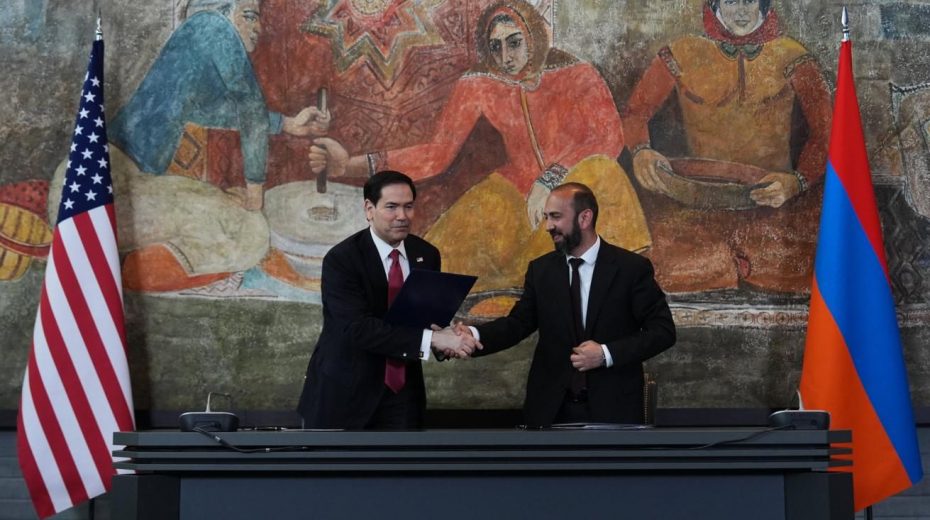
On the evening of May 26, 2026, Marco Rubio arrived at Zvartnots International Airport after returning from New Delhi. His stopover was scheduled for just over an hour—enough time for a handshake and three signatures alongside Armenian Foreign Minister Ararat Mirzoyan. There was no formal meeting with Prime Minister Nikol Pashinyan, no joint press conference in the Marble Hall, and no state ceremony. Yet in terms of geopolitical weight, that hour equaled a decade of previous negotiations. At the Yerevan terminal, the US Secretary of State signed three documents which, taken together, redefine the South Caucasus: the Charter of the Global Strategic Partnership, the Framework Agreement on strategic cooperation related to the TRIPP (Trump Route for International Peace and Prosperity), and the Memorandum on critical minerals and rare earths.
Just thirteen days before the June 7 legislative elections, Washington provided Pashinyan’s administration with a security framework, transit infrastructure, and a plan to harness natural resources. In exchange, Yerevan handed over control of Syunik—the slim southern strip bordering Iran—to a nearly century-long concession managed by an Armenian-registered company, 74% owned by a US International Development Finance Corporation subsidiary.
The Hour at Zvartnots: What Was Signed
The first text, the Charter on Comprehensive Strategic Partnership, officially elevates bilateral ties to the highest level recognized in US diplomacy. It covers diplomacy, defense, trade, energy (specifically civil nuclear and modular reactors), artificial intelligence, semiconductors, rare earths, education, and cultural exchanges. It also establishes a Comprehensive Strategic Partnership Commission with regular meetings.
The second is the Framework Agreement on Strategic Cooperation Regarding TRIPP. This sets up the TRIPP Development Company—an Armenian joint-stock firm—with 74% owned by TDC US (a Delaware-based subsidiary fully controlled by DFC), and 26% by the Armenian government. The initial concession term is 49 years, with an optional renewal of 50 years, potentially extending to 99 years, at which point Armenia’s stake would increase to 49%. This represents over a century of American management along Eurasia’s southeastern frontier from the Soviet era.
The third document, the Framework Memorandum on Securing Supply in Mining and Processing of Critical Minerals and Rare Earths, opens Armenia’s underground reserves—copper, molybdenum, zinc, iron, and Syunik rare earth elements—to US investment and supply chains, aiming to reduce dependency on Chinese mineral dominance.
“You, the Prime Minister, and your entire team here in Armenia are paving the way for a brighter and more independent future for Armenia,” Rubio stated during a brief exchange with Mirzoyan, as reported by the Armenian agency Armenpress and picked up by Reuters. The upcoming June 7 vote was explicitly referenced: support for the government’s “courage, vision, dedication” amounts to clear diplomatic endorsement. Mirzoyan described the relations between the two countries as “historically unprecedented.” This is effectively a Budapest model applied in Yerevan: a high-profile visit just before elections, symbolic signatures, and overt sponsorship.
What Is TRIPP
The acronym honors the sitting US president but refers substantively to what 20th-century Caucasian geography calls the “Zangezur corridor”: the 43 kilometers of Armenia’s southern Syunik province separating Azerbaijan proper from the Nakhchivan exclave, which lies within Armenian territory adjacent to a 44-kilometer Iranian border. This narrow land strip has been a friction point among Yerevan, Baku, and Tehran for at least thirty years. The 44-day war in autumn 2020 and the exodus of Artsakh Armenians in September 2023 shifted regional power dynamics; the White House summit on August 8, 2025, with Trump, Aliyev, and Pashinyan side by side, politically formalized this change. The Implementation Framework signed by Rubio and Mirzoyan in Washington on January 13, 2026, codified the corporate setup. The May 26 agreement finalized it.
Designed as a multimodal corridor, TRIPP will include standard-gauge railways, highways, pipelines for gas and oil, power lines, and fiber optic cables. The model works on a “front office/back office” basis: private American operators will handle tariffs and digital flow management, while customs, immigration, law enforcement, and taxation remain officially Armenian responsibilities. In each clause, Pashinyan’s government reaffirms “full respect for Armenian sovereignty, territorial integrity, and jurisdiction.” Nonetheless, significant portions of the Armenian opposition and civil society object, warning that the 99-year concession, 74% control stake, and Delaware jurisdiction echo historic arrangements such as the Panama Canal Zone (1903-1979) and British mining concessions in Iran before nationalization in 1951.
An MPG Gallup International survey after the August 2025 Washington summit found 58.9% of Armenians opposed to TRIPP. The government hopes to reverse this by emphasizing “lost economic opportunities”: projected goods transit could exceed $100 billion annually, cutting transit time from China to Europe from 18 to 12 days compared to the Suez route.
Significance for Eurasia: The Route That Breaks
TRIPP is not merely a local corridor variant. It completes the missing link in the Middle Corridor (the Trans-Caspian International Transport Route), knitting infrastructure from Central Asia to Europe while bypassing Russia and Iran. By connecting the Caspian to Anatolia through Syunik, goods from Kazakhstan, Uzbekistan, and China can reach Trieste or Rotterdam without routing through Russia’s Sarmatian Plain pipelines or Iran’s Persian Gulf ports. For Washington, this actualizes a policy started in the 1990s under the Brzezinski doctrine: “Who controls Eurasia controls the world,” wrote the former US National Security Advisor in The Grand Chessboard. The core of that chessboard is the “Eurasian Balcony,” the belt from Istanbul to Xinjiang.
The International North-South Transport Corridor (INSTC) takes the structural hit. Launched in 2000 by Russia, Iran, and India to link Mumbai with Saint Petersburg via Bandar Abbas, central Iran, the Caspian Sea, and Russia, INSTC was strategically designed to bypass Pakistan and provide the Global South a transport route resilient to Western sanctions. India invested about $120 million in Chabahar’s Shahid Beheshti terminal, completing payments by January 2026, according to the Sunday Guardian (January 16). With Caspian-to-Mediterranean transit no longer routed through Iran, Chabahar and INSTC’s strategic value is sharply reduced.
China’s Central Corridor, meanwhile, is not eliminated. It feeds into TRIPP, albeit with a caveat: the Western regulatory node over Syunik’s 43 kilometers introduces logistics standards, export rules, and control mechanisms that can be selectively applied. Beijing, which signed its strategic partnership with Yerevan in August 2025 and employed the same framework with Azerbaijan and Georgia, adopts a quiet approach. It observes, calculates, and plays the long game—what the Armenian Weekly called “strategic patience” in February 2026 regarding China’s stance on this dossier.
Moscow’s Perspective: A Civil Divorce
Moscow’s reaction was swift and measured on two fronts. Politically, Kremlin spokesperson Dmitri Peskov warned on May 25 that Armenia’s “preferential” Russian gas price (currently $165–177.5 per 1,000 cubic meters, versus a European average of $400–600) could be reconsidered if Yerevan continues its EU integration and formally exits the Eurasian Economic Union. Sergei Lavrov, during his May 21 visit to Yerevan, condemned Western attempts to “drag Armenia into an anti-Russian camp.” Security Council Vice-Chair Dmitry Medvedev escalated rhetoric in RIA Novosti, stating “Pashinyan has openly broken with Russia,” leading Armenia down the path of “banderist Ukraine.” Meanwhile, Foreign Ministry spokeswoman Maria Zakharova on May 26 adopted a more cautious tone: “We focus on developing economic and humanitarian ties with Armenia, and resolving security matters in the region on the basis of mutual respect.”
In practical terms, retaliations are underway. Rosselkhoznadzor announced bans on imports of Armenian flowers, mineral water, fruit, and brandy; the State Duma is considering tariff revisions. Presidential advisor Yuri Ushakov on May 26 highlighted the “colossal benefits” Armenia gains from the EEU: nearly double per capita GDP since 2014, discounted gas prices, free circulation of goods and labor, and access to the Russian market for over 30% of Armenian exports.
Armenia remains structurally dependent. Gazprom Armenia, wholly owned by the Russian giant, monopolizes gas supply; Russia provides 80% of energy and 85% of grain imports; remittances from approximately 700,000 Armenians living in Russia account for 7–10% of Armenia’s GDP. Losing preferential gas pricing alone would cost Yerevan roughly $800 million annually. Moscow therefore holds immediate material levers. The strategic question is whether Russia will exert these fully, sacrificing formal integration to reposition Armenia, or contain the damage, keeping Yerevan in a fragile balance while awaiting the next political cycle.
Vladimir Putin’s attendance at the Eurasian Economic Union summit in Astana, May 27–29, is no coincidence. The timing signals Moscow’s intention to reaffirm its Eurasian orbit just as Washington plants its flag in the South Caucasus.
The View from Tehran: A Weakening Red Line
For the Islamic Republic of Iran, TRIPP represents a dual blow. Strategically, it neutralizes the 44 kilometers of shared border with Armenia, once the only Eurasian border allowing Tehran direct access to a non-Turkic, non-hostile country, granting northern geopolitical depth. Symbolically, it installs an American concession less than 30 kilometers from Iranian territory along a border traditionally deemed a vital security buffer by the Republic’s doctrine.
Principled warnings have been issued. Foreign Minister Abbas Araghchi stated in September 2024 that “any threat from the North, South, East, or West to our neighbors’ territorial integrity or border redrawings is utterly unacceptable and a red line for Iran.” Supreme Leader adviser Ali Akbar Velayati, cited by Iran International in December 2025, described the “Trump plan for the Caucasus” as “no different from the Zangezur corridor,” claiming it “sets the stage for NATO presence north of Iran” and poses “a serious threat to northern Iran and southern Russia’s security.”
However, Teheran did not issue a strong condemnation at the May 26 signing. Three reasons explain this restraint: ongoing war; Doha negotiations over the Strait of Hormuz; and the prospect of Armenia acting as a mediator between Teheran and Washington.
John Mearsheimer has repeatedly argued that offensive realism compels great powers to respond to rivals’ advances near their borders. Iran understands this but has limited maneuvering room. Its likeliest counter is asymmetric: bolstering ties with anti-Western Armenian political and religious groups, activating relations with Moscow and Beijing within the “3+3” format, and exerting economic and logistical pressure on Yerevan via gas transit and border trade. Costanzo Preve’s warning about sovereignty in the era of unipolar imperialism is relevant: while formal sovereignty endures, substantive autonomy erodes through contractual, concessionary, and regulatory mechanisms.
Beijing’s Outlook: Strategic Patience
China’s reaction—or lack thereof—is itself telling. The People’s Republic’s Foreign Ministry did not release a statement related to May 26. This silence is strategic. Beijing, which signed its own strategic partnership with Yerevan in August 2025 and employed similar agreements with Azerbaijan and Georgia, views TRIPP not as a frontal assault on its Belt and Road Initiative but as a regulatory variant of the Central Corridor that it has long supported. Chinese goods will continue moving via the Trans-Caspian route, but partly through infrastructure under American regulatory control.
The issue reflects what David Harvey terms “accumulation by dispossession”: Western financial capital seizes valuable physical infrastructural nodes, often ones initiated or envisioned by China, Russia, and Iran. Rather than responding with direct confrontation, Beijing advances through parallel infrastructure diplomacy—such as the China-Kyrgyzstan-Uzbekistan railway under construction, expansion of the China-Pakistan-Iran economic corridor (extended CPEC), and reinforcing Arctic routes with Russia. This is a protracted competition, where success comes from gradual, molecular gains rather than outright assault.
Italy, the Mediterranean, and Its Absence
Throughout these developments, Italy remains absent. It was not present in Yerevan on May 26; it does not appear in recently signed partnerships; it features nowhere in statements from major Caucasian actors. During the eighth European Political Community summit and the inaugural EU-Armenia bilateral summit held in Yerevan on May 4–5, Italy participated in the EU delegation but lacked the visibility of France and Germany. Macron visited Yerevan, signing a strategic partnership and pledging tunnel reconstruction and anti-aircraft systems. Starmer signed security and defense agreements for the UK. The Italian Foreign Ministry did not.
This continues a worrying trend of Italy relinquishing its traditional influence in the South Caucasus, a crucial hinge of the wider Mediterranean. When Enrico Mattei shaped Italy’s energy policy in the 1950s, he understood that a country’s sovereignty is measured by its ability to choose energy and logistic partners. Aldo Moro, in his prison notes, spoke of the need for an “authentically national” foreign policy, unchecked and autonomous. Today, this tradition lacks proponents. TRIPP is an infrastructure project that redraws commercial routes between Asia and Europe, destined for a Mediterranean port. Yet, the question of which port—and Italy’s potential role in this new Eurasian axis—is unaddressed. Neither Palazzo Chigi nor the Farnesina has confronted it.
Cui Prodest
The list of beneficiaries is layered. Primarily, the United States secures a century-long strategic concession, installs infrastructure under American control less than 30 kilometers from Iran, gains privileged access to Syunik’s copper, molybdenum, and rare earth resources, obtains a vantage point over the Iranian-Russian border, seals Armenia’s departure from Moscow’s orbit, and provides electoral backing to Pashinyan’s government. Second, Azerbaijan closes a territorial continuity with Nakhchivan, gaining guaranteed land access for the first time since the Soviet Union’s collapse; Turkey solidifies its Turkic continuum from Anatolia to Central Asia, advancing a Pan-Turkic vision that has influenced Ankara’s foreign policy since Atatürk; Israel, as a strategic Baku ally and arms supplier, strengthens its Caucasian foothold. Third, the Armenian government transforms a geographic asset into domestic political capital: Pashinyan approaches the June 7 elections presenting an Atlantic-aligned framework over previous Russian tutelage, betting that voters will favor security and modernization over historic Moscow ties. Naomi Klein outlined in Shock Doctrine how radical geopolitical transitions tend to occur during crises — Armenia post-Artsakh epitomizes exactly such a window.
Three Dates That Reveal What Has Happened
Understanding May 26, 2026, requires considering three key dates. On August 8, 2025, at the White House, Trump brokered a handshake among Pashinyan and Aliyev; the joint declaration was not yet a peace treaty but launched TRIPP as a political project. On January 13, 2026, in Washington, Rubio and Mirzoyan signed the Implementation Framework, defining the corporate structure and quotas. On May 26, 2026, in Yerevan, the framework agreement was initialed, and the Charter of the Global Strategic Partnership was signed.
These three steps occurred in just nine and a half months—a rapid pace for Caucasian diplomacy, traditionally marked by years of negotiation and decades of mediation. The acceleration shows that the Trump administration prioritized TRIPP as a foreign policy goal ahead of the November 2026 midterms: Washington sets the pace of change. Pashinyan embraces this timing to secure June 7; Trump imposes it to influence November. Moscow, Tehran, and Beijing are forced to react on another’s schedule.
For the BRICS, Iran, and non-Western Eurasia, TRIPP is a fait accompli. Yet the battle is far from over: a protracted positional war will unfold over the next two decades concerning transit regulations, tariffs, legal disputes, renewal clauses, the protests of Syunik communities, Armenian parliamentary alliances, and alternative logistics chains. Those who believe a 99-year concession lasts forever forget that Panama’s Canal Zone, also granted for a century, was handed back after seventy-six years. British oil concessions in Iran, intended to last past 2000, were nationalized by Mossadeq in 1951. The history of imperial infrastructure is a history of premature renegotiations.
The real issue may be Italian. Italy is not in a position to renegotiate anything because it never sat at the table. Sigonella, today, could have been the Mediterranean port converging TRIPP. It will not be. Piraeus, Trieste without Italian decision, or perhaps Marseille if Macron plays well, will be. Italy’s absence is not trivial; it constitutes a negative signature of a nation that has relinquished its role as a maritime power. The South Caucasus is now the raw material for a corridor carrying goods, capital, and influence to the Mediterranean. The question for those responsible in Rome is clear: to which port?
About the Author