Armenia’s Pashinyan secured the election victory but faces significant constraints. Can he balance EU commerce, the U.S. TRIPP initiative, and Russian energy dependencies—or will his Western-focused strategy falter amid constitutional turmoil, sealed borders, and a fractured opposition?
The depth of Armenia’s geopolitical predicament has gained prominence now that election analyses have settled, with international stakeholders closely watching the nation’s pivotal moment to gauge Prime Minister Pashinyan’s next steps under his renewed mandate. Though Pashinyan retained leadership, he also inherited profound limitations.
Can he successfully advance three intertwined mandates for “Real Armenia”: complete normalization with Turkey and Azerbaijan, advancing EU trade deals edging toward accession, embarking on a “Strategic sovereign” departure from the CSTO, and implementing the U.S.-backed TRIPP project? While linked, these initiatives differ in their dynamics and stakeholders. The pressing question remains whether Pashinyan can manage these without further straining Armenia’s vital energy ties with Russia—or if disrupting those ties is indeed part of the intended strategy, despite the risks involved.
It was already clear that Western and multilateral funding networks dominated Armenia’s scene ahead of the June 2026 vote, constituting a sophisticated framework aimed at pulling Armenia away from its traditional alignment with the CSTO and EAEU toward integration with European economic and security systems. These investments from the EU, the U.S. (through USAID and NED), and the UN closely align with Prime Minister Pashinyan’s survival tactics and ideological outlook.
Now that this electoral phase has concluded with no meaningful change, the regional reality emerges starkly: Armenia faces a looming economic crisis if it moves forward with any free trade agreement with the EU—an action that would destabilize its shared interests within the Eurasian Economic Union. Although Pashinyan denies plans to exit the EAEU, membership ultimately depends on other member states’ decisions, recalling the 2014 Ukrainian crisis under Viktor Yanukovych, who, despite differing political support and constituencies, confronted a similarly delicate balancing act.
A notable aspect of Pashinyan’s discussion with President Putin in Moscow around April 1st highlighted this tension, with Putin emphasizing that “Simultaneous membership in the Customs Union with the European Union and the EAEU is impossible; it is simply untenable by definition. The issue is not even a political one; it is purely economic.”
All TRIPPED Up – Make Armenia Great Again?
With U.S. involvement now formalized through the bilateral TRIPP Framework Agreement signed on May 26, it remains to be seen if Europe will be integrated or sidelined. Following the June 2026 elections, Nikol Pashinyan’s Civil Contract party kept a parliamentary majority but fell short of the larger majority needed to amend the constitution alone. Baku insists it will withhold peace treaty approval and border reopening unless Armenia removes constitutional clauses that Azerbaijan interprets as territorial claims over Nagorno-Karabakh. Without this legal compromise, the borders remain sealed.
Yerevan, Armenian Foreign Ministers Mirzoyan and Rubio announce TRIPP and signed a Strategic Partnership Charter and MOU on Critical Minerals
Pashinyan faces a West fraught with elite disagreements, complicating policy unity on many global issues. The 2020 ceasefire ending the Second Nagorno-Karabakh War assigned Russia’s Federal Security Service (FSB) border guards to manage transport links across the Syunik/Zangezur corridor. However, TRIPP, authorized between Washington and Yerevan, transfers development and operational control to the newly established TRIPP Development Company (TDC), majority-owned (74%) by a U.S. International Development Finance Corporation (DFC) subsidiary and 26% by Armenia.
The EU’s official reaction to TRIPP shows a mix of passive and subtle resistance. While publicly endorsing the project as part of broader efforts to contain Russia, Brussels is quietly displeased about being sidelined by Trump’s direct bilateral approach—an irritation evident in the deliberate structuring of recent agreements. The Joint Statement on the Armenia-EU Connectivity Partnership signed in Yerevan places TRIPP last among several EU priorities, signaling that Brussels does not see Trump’s 99-year corporate venture as a dominant framework for EU plans. Instead, the EU treats TRIPP as a smaller component subordinate to established European regulations, even as the U.S. positions the EU as another stakeholder required to contribute financially.
This critical stance from European institutions is expressed through three main concerns. First, Brussels resents the “bypass” tactic. Years of delicate mediation under the “Brussels Format” led by European Council President Charles Michel between Yerevan and Baku are upended by the unilaterally negotiated TRIPP agreement. Geopolitical Monitor critiques that the deal diverges sharply from the rules-based, multilateral liberal approach the EU fosters. EU officials lament that “transactional theater” is displacing hard institutional work.
Second, the EU applies strict scrutiny and sovereignty concerns. According to the Institut Montaigne, European Commission diplomats repeatedly stress that regional corridors must meet robust technical standards and mesh with the wider European digital and transport networks. They worry that while the U.S. created a private corporate vehicle in TRIPP Development Company, supported by a recent $2.5 billion DFC strategic investment, European financiers will not back infrastructure unless it complies with EU rules on safety, competition, and regulation—requirements that could overburden Armenia.
Third, environmental and mining concerns are prominent. The EU voices displeasure that the U.S. leveraged TRIPP to secure exclusive rights to Armenia’s critical mineral exports such as copper and molybdenum. While the EU finances basic regional stability, democracy-building, and a €50 million aid package, American private interests claim priority over minerals essential for Europe’s green transition. The issue is not with the corridor’s existence, which Europe supports, but rather its management and profit distribution.
These challenges would escalate if Pashinyan managed to amend the constitution. Yet his recent victory lacked any coalition formation, setting the stage for unfolding developments in the near term. This unresolved situation creates a constitutional impasse, leaving TRIPP as another high-profile U.S. initiative promising possibilities but yielding little concrete progress.
Merging Armenia into the Turkish geoeconomic complex
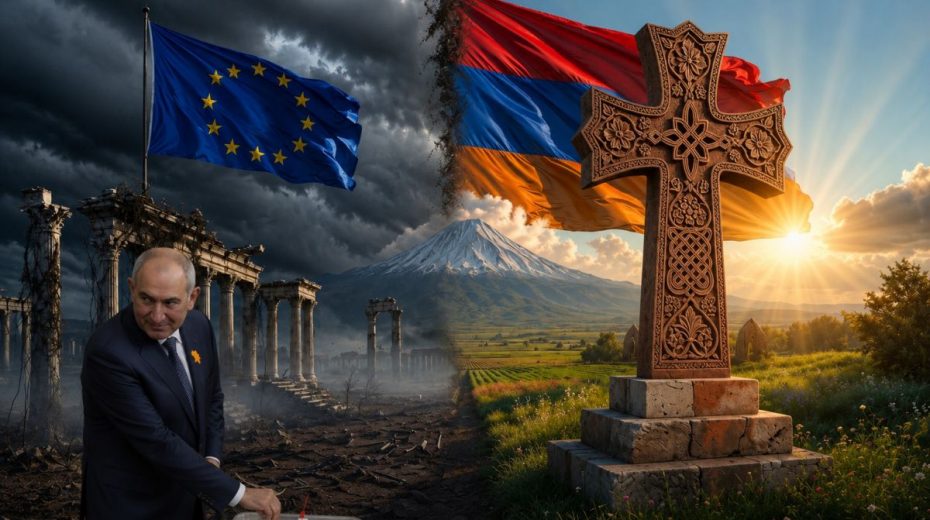
Pashinyan’s own nationalist project appeals to pro-Western segments in Yerevan who argue that Armenia must eliminate irredentist language from its constitution, including symbolic state emblems like Mount Ararat, which lies within modern Turkey. Pashinyan and many supporters advocate for a complete ideological shift away from territorial claims and the victimhood narrative, viewing these as obstacles to improving relations with Turkey and Azerbaijan. They harbor hopes of preserving energy arrangements with Russia while moving closer to European integration—a move Moscow strongly resists.
However, Pashinyan’s apparatus functions as a well-funded Western globalist elite structure, whose agenda appears to sideline Armenia’s national interests. The aim seems to be reshaping Armenians into a generic South Caucasus demographic, supplying metals and industrial minerals as part of a broader geo-economic post-cultural zone. Although such a concept momentarily seems logical, neither Turkey nor Azerbaijan is pursuing such post-cultural pathways. Armenia’s historic identity is being expected to be set aside while its powerful neighbors reinforce theirs.
While Pashinyan accuses the opposition “Strong Armenia” of being old-guard and Moscow-controlled, his faction uses these claims mainly to deflect scrutiny from unpopular policies and controversial concessions made in pursuit of normalization with Turkey and Azerbaijan, even as borders remain shut.
Moscow does not inherently oppose border reopening or normalization among Yerevan, Baku, and Ankara. Historically, Russia has supported these connections if they do not circumvent or undermine the EAEU’s interests. The core dispute revolves around control of infrastructure and the geopolitical influence that accompanies it.
As Turkey’s strategy is fully aligned with Azerbaijan, Ankara refuses to open the Armenia-Turkey border or reestablish trade ties until Armenia signs a peace treaty with Baku, placing Armenia’s potential economic inclusion in Turkey’s sphere alongside the complexities surrounding TRIPP.
Pashinyan’s current hold on power stems from dismantling much of the old electoral order associated with the pre-2018 regime. Despite reports of systemic repression and harassment of opposition figures—motivated partly by controversies over the Church and the response to ethnic cleansing in Nagorno-Karabakh—the election outcome was largely predetermined by reforms that consolidated Pashinyan’s grip. Yet, the opposition achieved a notable presence officially recognized, potentially enough to block Pashinyan’s agenda if it forms a stronger coalition.
Pashinyan’s reforms to stay in power
The most impactful electoral reform under Pashinyan was the elimination of the “ratingayin” system, previously allowing voters to choose both parties and individual candidates by district. Critics aligned with Sorosian and neoliberal viewpoints argued that system favored wealthy elites, local strongmen, and patronage networks that mobilized votes through influence more than genuine policies. Supporters claimed it maintained vital ties between voters and representatives in a political culture where parties were often fragile. They warned that abolishing direct territorial accountability risks centralizing power in party elites based in Yerevan, thereby weakening democratic regional representation.
International press freedom monitors and rights organizations increasingly report heightened pressure on government critics under Pashinyan, including defamation suits, pre-trial detentions, and vague “public order” charges. The Council of Europe’s Safety of Journalists Platform has recorded media detentions linked to criminal cases, a new development signaling worsening conditions. Concurrently, civil groups accuse authorities of “selective and disproportionate” use of criminal law to silence dissent.
Armenia at a crossroads
For the EU to extend free trade agreements with Turkey—whether as part of accession or not—major obstacles must be overcome, with little progress since 2018. A more feasible EU strategy likely involves leveraging Black Sea supply chains to reach the Balkans or even ports like Crimea or Odessa. Amid these complex structural, economic, and domestic realities, the central challenge facing Pashinyan can be summarized as:
How can Pashinyan reconcile his pursuit of Western integration—epitomized by the TRIPP corridor and EU ties—with the serious risks of economic and energy estrangement from Moscow, especially as his Civil Contract party governs without a formal coalition and lacks the constitutional majority necessary to resolve border impasses with Baku or normalize relations with Turkey? Moreover, what mechanisms remain for a viable alternative political force to emerge given the government’s concentrated control over electoral rules, the media, and civil society? Without solutions, Armenia remains caught at a junction of roads that are undeveloped and, practically speaking, nonexistent.
About the Author