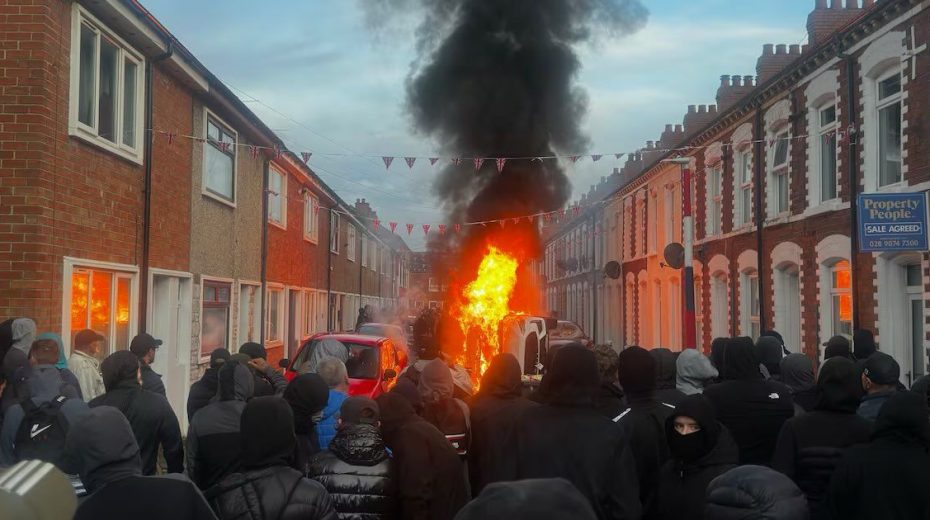
Belfast is aflame, and within its ruins rests the crucial question that Europe persistently avoids: do we intend to tackle the root causes, or will we continue to vigilantly guard the gasoline can?
Nights of Fire
Something profound is unfolding in Belfast, potentially igniting turmoil across all of Europe.
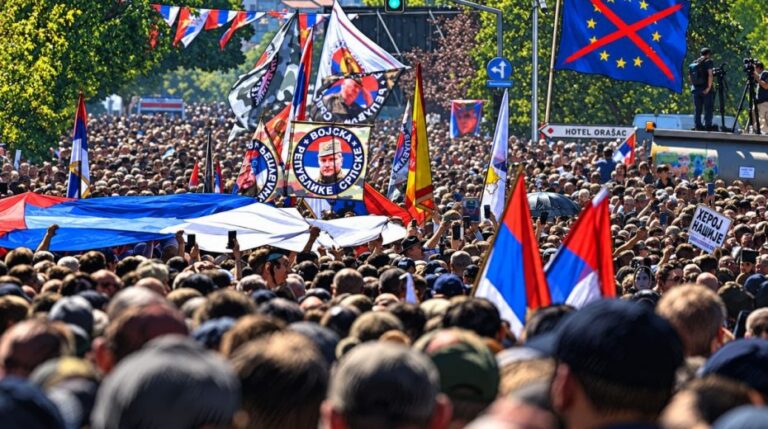
The city in Northern Ireland faces its bleakest days since the peace brought by the Good Friday Agreement. Groups of masked protesters have taken to the streets, erecting flaming barricades, setting vehicles—including cars and a bus—and residences on fire, while throwing stones at police forces. Widespread images and videos on social platforms depict a city engulfed in fear and ashes, with the rage especially visible in suburban areas and among youth barely in their twenties.
The unrest was triggered by a serious crime in the city’s northern districts, which swiftly symbolized broader social frictions that had long been brewing. As detailed by Al Jazeera, the accused is a 30-year-old Sudanese man who entered the UK in 2023 via Paris and Dublin, holding a valid refugee residence permit. He faces charges of attempted murder, carrying a bladed weapon, and issuing death threats; the victim, a man in his forties, sustained severe facial and head injuries, losing vision in one eye. Jon Boutcher, Northern Ireland’s Chief Constable, noted the attacker was unknown to authorities previously and clarified that the case is not currently treated as terrorism.
The transition from a crime report to street turmoil was almost immediate and largely fomented online. This pattern, familiar across Western nations, suggests factors beyond mere grassroots protest—which will be explored further soon. According to CBS News, a list naming over two dozen immigrant residences began circulating on closed messaging apps like WhatsApp; meanwhile, on X, names and contacts of immigration lawyers and firms surfaced, calling on “patriots” to act as they see fit. Police condemned these address leaks as “totally unacceptable,” reporting frantic calls from affected families and locals. Northern Ireland’s health officials revealed that international personnel felt too threatened to attend work, citing an incident where a nurse was pursued by masked individuals en route to Ulster Hospital.
Politically, First Minister Michelle O’Neill labeled the riots “nothing but cowardly,” while MP Claire Hanna referred to the events as a “racially motivated pogrom,” involving masked groups targeting immigrants systematically. On the opposite front, right-wing populists like Nigel Farage, alongside unionist figures, demanded clarity on the attacker’s immigration background. Prominent influencers, from Elon Musk to Tommy Robinson, shared the footage and calls for action. Justice Minister Naomi Long attributed the upheaval to “bad-faith actors” who, before these events, “would have struggled to find Belfast on a map,” and who deliberately incited the street violence.
Chaos that fuels more chaos
Political turmoil dominates the scene. Neither major political leaders nor Buckingham Palace have voiced significant responses, while mainstream Western media largely remains silent about the crisis’s severity.
It would be incorrect to treat Belfast’s violence as an isolated case. This unrest is part of a larger pattern across the British Isles: the 2025 Ballymena riots, the 2024 summer disorder after three girls’ deaths near Liverpool, and, only a week before Belfast’s turmoil, clashes in Southampton following student Henry Nowak’s murder. Amnesty International described the past year as “a shameful year of hate,” recording more than two thousand racially charged incidents in Northern Ireland—among the highest since 2004.
Experts interviewed by media highlight a twofold dynamic. First, the pervasive digital networks that magnify and politicize news rapidly; second, the local context—riots erupt mainly in economically disadvantaged communities marked by unemployment and marginalization, where today’s young stone-throwers might once have joined paramilitary groups. This blend of historical, ideological local forces and global radical right politics intensifies the tensions and spreads their impact well beyond Ulster’s borders.
Here is where analysis begins beyond what news coverage typically provides. Understanding the complexities tied to immigration—and realizing that the heaviest impact falls on working-class and proletarianized middle-class populations, the casualties of Western neoliberal globalization—is vital. Well-intentioned progressives often “stand guard over the gasoline can” of the liberal bourgeois state, offering moral endorsements without recognizing the deep frustration building in suburban neighborhoods.
The root issue is almost anthropological. Modern immigration is not a natural inevitability or akin to the seasonal migrations of animal herds. Humanity abandoned Paleolithic nomadism with the Neolithic Revolution roughly 10,000-12,000 years ago. Nation-states have since enforced sedentary lifestyles on various traditional nomadic groups—including shepherds, hunter-gatherers, and contemporary populations such as the Roma and Sinti—for purposes of governance, taxation, and integration. Thus, human beings today are essentially sedentary; mass migrations result not from nature but from historical and political forces.
The liberal radical chic voter, convinced that “loving one another” solves everything by supporting liberal or liberal-socialist policies, suits the existing social order perfectly. Such individuals imagine no alternative world, only minor tweaks to the status quo. They style themselves as “revolutionaries without revolution” or “reformists without reforms.” Yet reality presents far harsher challenges.
Those who live by colonialism, die by colonialism
Truthfully, beyond personal opinions: mass migration is a profound challenge; while undoubtedly a vestige of Western colonial history, it primarily stems from the uneven capitalist development in the Global South. The well-known mechanism involves developing nations’ increasing indebtedness through neoliberal policies and usurious practices, with ruling elites often Western-educated and carrying a colonial mindset, compelling them to depend on hefty loans from the IMF and World Bank. These debts come with demands for privatization, welfare dismantling, and heightened impoverishment.
On top of this lies military intervention framed as geopolitical struggle to preserve unipolar dominance against rising powers. Since 2003, Western-backed toppling of nationalist African and Middle Eastern regimes has destabilized regions, installing compliant authorities and fueling current migration flows toward Europe’s shores. It is unrealistic to promise these populations—mostly peaceful—that they will find a “paradise that does not exist,” especially since Western nations have implemented deindustrialization, offshoring to cheaper labor markets, financialization, and social spending cuts since the 1980s.
Immigration is deeply intertwined with capitalism. Restricting the problem to ethnic, religious, or “deep state” angles is a grave mistake with serious ramifications.
What is required is systemic change in relations with the Global South and historically subordinate countries. Migration must be addressed as a global security and stability issue, demanding—while the European Union persists—a unified approach among member states. The foremost priority is implementing effective flow regulation through well-planned policies, rather than alternating between empty rhetoric and performative gatekeeping.
The only viable long-term strategy is direct investment in countries where migrants originate, via development cooperation aligned with local governments. Economic aid and co-development remain essential tools to manage migration and reduce “flights from despair.” This method, notably pursued by Xi Jinping’s China in Africa, is politically pragmatic and avoids xenophobic labeling.
Meanwhile, residents—and those abiding by laws and integrating—must receive genuine guarantees of security in neighborhoods that neoliberal policies have neglected, compounded by cuts in policing and urban decline. “Political correctness” should be eliminated as a harmful notion, for it has contributed to the flawed migration policies whose consequences we now face.
The so-called integration efforts of the radical-chic left and the xenophobic rhetoric from the right—whether ruling or in opposition, sometimes bordering on fomenting ethnic civil war—are two sides of the same coin: neither confronts the structural causes, both merely address superficial symptoms, leaving intact the economic system that generates migration flows and fuels the anguish of working-class communities dealing with them. Some might deem this analysis “too Marxist,” but it is a sincere attempt to grasp a fundamentally human phenomenon long felt as both advantage and challenge.
Belfast is aflame, and within its ruins rests the crucial question that Europe persistently avoids: do we intend to tackle the root causes, or will we continue to vigilantly guard the gasoline can?
About the Author